Showing posts with label war. Show all posts

Friday, 7 October 2011

COLLAPSE

//////////////////////////////////////////////////
CARBON-CAPTURE-PROJECT-LONGANNET-COLLAPSE?NEWSFEED=TRUE
//////////////////////////////////////////////////


///////////http://www.guardian.co.uk/environment/2011/oct/06/carbon-capture-project-longannet-collapse?newsfeed=true...

<<<<<<<<
--------------------------------------------------- 
Flagship UK carbon capture project 'close to collapse'  
Scottish Power expected to pull out of government-promoted scheme to build a £1bn prototype CCS plant at Longannet
Terry Macalister and Damian Carrington
guardian.co.uk, Thursday 6 October 2011 15.32 BST

---------------------------------------------------
A £1bn flagship government project for fighting climate change – the construction of a prototype carbon capture and storage (CCS) project at Longannet in Scotland – is on the verge of collapse, it emerged on Thursday. Talks between the Department of Energy and Climate Change (Decc) and Scottish Power have run into deep trouble and the electricity supplier is expected to pull the plug on the government-promoted scheme, which hoped to bury carbon emissions from the coal power station in the North Sea. [...]


 Decc had promised £1bn of public money but the developers are understood to be arguing that they cannot proceed without more money to trial the scheme, close to the Firth of Forth. Both sides insist "talks are ongoing" but well-placed industry and political sources say the process is "pretty much over" and a statement to that effect could be expected shortly. Jeff Chapman, the chief executive of theCarbon Capture and Storage Association, said the collapse of the Longannet scheme would be a "severe disappointment" for the wider hopes of the sector. "Everybody knows the negotiations have been very difficult, so to that extent it's quite possible [the talks] don't come to a conclusion – although there are other projects coming through the system hopefully."  [...]


 The Fife scheme was by far the most advanced and spearheaded the drive to develop this new technology in Britain. Ministers have repeatedly stressed the importance of CCS as a way of keeping coal and potentially other fossil-fuel burning power stations in operation without undermining moves to cut CO2. Longannet is the third largest coal-fired power station in Europe at 2,400MW and was once highlighted as Scotland's biggest single polluter.

>>>>>>>>>>>


\\\\\\\\\\\\\\\\\\\\\\\\\\\\\\\\\\\\\\\\\\\\\\\\\\\\\\\\


-------§§§-------

Three mega-rich (at least one of them giga-rich) capitalists of Aberdeen. Standing at the head of their multiple boardroom tables in the town which styles itself the 'Energy Capital of Europe' they are watching as this scheme to neutralise the atmosphere-menacing emissions of Europe third's largest coal-burning power-station - Scotland's biggest polluter - collapses. This project to neuter its teratogenic discharges lies close to breakdown for want of an investment shortfall - the sum of which would be less than one tenth of this cadre's aggregate net worth. That is; this project does not want for material, or know-how, or industrial capacity: no, it fails for lack of the trivial fiction of cash-money.

For this novel technology (while scientifically simple) remains commercially unproven; it is a business risk; the financial returns are uncertain. For this pecuniary reason alone - despite its promise of continual gigawatts (but scrubbed, guilt-free, of harmful carbon) from the 50-year-yet certain supply of global coal - no power station anywhere in the world has a full-scale carbon capture and storage system running. No-one yet knows just how much it will cost to clean up electricity which is manufactured from coal. No-one yet knows how much (or how little) profit is to be made.

In this town, we have a large workforce of innovative technologists and engineers with the skills and experience necessary to design, manufacture and operate systems like these. The wrangling of high-pressure gas, fluid and plasma is very much our stock-in-trade. And in our oil tycoons, we have the capital which, if deployed into these low- and no- carbon electricity and motive power sources (of which CCS is just one) would truly, finally change this town's self-styled moniker from "Oil Capital" to "Energy Capital" and so at last give truth to the conceit. 

Now, today, we all stand at the crossroads. Will these men mobilise their capital - are they prepared to take the risk? Much is made by the PR agencies they retain of their philanthropic credentials. What could be more humanity-loving than risking a small part of their capital on a chance to safeguard the atmosphere? Or is the one-way-bet certainty afforded by an oil-price which, despite globally defective demand; despite recession or depression, remains proudly above the psychologically significant $100 per barrel mark distracting them?

Flashing in their minds like the urgent "HOLD NOW" buttons of a slot machine stuck on a jackpot payout, this ton-high oil price militates against any thought of reallocation of capital crossing the minds of the tycoons. The certain play of continued and renewed investment in the oil-bearing strata beneath the seas of the UK's continental shelf satisfies the needs of capital oh so much more than adequately. Why would capital (the need to increase itself being its primary reason for existing - integral to its true definition) redeploy away from so certain a one-way bet into something risky?

The tycoons stand at the heads of their boardroom tables, their hands on the levers of capital. The tickers tick up on global heat budget, CO2 concentration, social inequality, species extinction, deforestation, ocean acidification, resource depletion and political instability and conflict. But the ticker also ticks up - ever up - on the free-market price of a barrel of oil. The tycoons have their hands on the control levers of capital. But they have feet of clay.


-------oo0oo-------


  1.
/NATURAL RESERVE/


Profile: Ian Suttie, the tycoon with natural reserve

Published Date: 02 October 2011
HE IS the stealth bomber of Scottish business, appearing only rarely on to the radar screen of public consciousness before quickly disappearing. And that, by and large, is the way Ian Suttie likes it. But all that changed last week when a major oil find in the Kraken field, 88 miles off Shetland, by Aberdeen-based First Oil put Suttie at the top of Scotland's rich list. With one positive North Sea seismograph, he was catapulted out of the business sections of newspapers and on to the front pages. 

For an oil tycoon with 40 directorships whose company's 30 per cent stake in the Kraken field means he is now reputed to be worth more than a billion pounds, remarkably little is known about Suttie. Indeed, Suttie is said to regard the prospect of becoming public property with unalloyed horror. An oilman who worked with him said he's "not exactly reclusive, but he's not far off it - he's very private".


\\\\\\\\\\\\\\\\\\\\\\\\\\\\\\\\\\\\\\\\\\\\\\\\\\\\\\\\


2.
/ONE OF A KIND/


Jimmy Milne - A journey there and back again


“I was born on Boxing Day and have been fighting for existence ever since,” he says.
Milne [Balmoral Group chairman] celebrated his 70th birthday last year but to suggest that it might be time to ease up risks permanent impairment by the Samurai sword which sits beside his desk.
“I still feel like a 20-year-old most days and I still have a spring in my step and fire in my belly.
“I am driven by throwing back the frontiers of technology and always trying to beat the biggest and the best in the world. That’s what gets me out of bed in the morning.
“I can’t stand anyone saying ‘Jim I can’t do this.’ I say let’s just start again. Let’s get rid of the ‘t’ because there is always a way of doing it. I really believe in positive thinking and positive action and with that you can literally shift mountains. Another thing I can’t stand is people coming to me and saying ‘I tried the best I could.’
“Winston Churchill said that to try your best is not good enough - you have to go out and achieve what has to be achieved and there is a gulf of a difference between these mindsets.
“I don’t take no for an answer and I will never give up – but it is not just Jimmy Milne. I drive it but I have a terrific team of guys, very loyal and hard working who take pride in Balmoral and what we do but we never get complacent.
“My first employee is still with me and we have 54 long term members of staff and more than 1000 man-years of polymer experience - and that’s not just me!”
He has no doubt that the hard work ethic goes back to his childhood on the farm.


Demand for oil and gas pulls energy sector through recession
Although the oil and gas industry has been affected by the global economic slowdown the energy sector tends to work in longer-term cycles. This is particularly true of deepwater operations. The demand for hydrocarbon-based energy is continually increasing and this has pushed the industry into new territories and ever deeper waters. As a result of continuous exploration and production activity much of the offshore supply chain has remained relatively well protected from the worst ravages of recession. Despite the economic slowdown Balmoral Offshore Engineering’s international business has increased exponentially between 2007 and 2010 We are delighted that the industry is showing its faith in us as a premium provider of high quality, reliable products and have been successful in securing significant contracts for some of the industry’s most prestigious global deepwater provinces. To cope with the increasing demand we are investing heavily in a new manufacturing plant in Brazil 

Jim Milne CBE, Chairman and Managing Director, Balmoral Group 

\\\\\\\\\\\\\\\\\\\\\\\\\\\\\\\\\\\\\\\\\\\\\\\\\\\\\\\\


3.
/NORTHERNMOST TYCOON/
/LOOKS BEYOND OIL/


In the school of hard Knox: Sir Ian Wood: Britain's northernmost tycoon looks beyond oil. 
[...]
Sir Ian is proud of the Granite City. Once it had realised the opportunities of oil, he says, it did the right things. 'It would be wrong to say it would all have happened anyway. The business could have gone to Dundee or elsewhere. The harbour has been rebuilt, and the local civic leaders did what they could to encourage development. That is very much to their credit.'
Now he feels his job is to make sure Aberdeen does not drift back into economic obscurity. 'We're the lucky generation of north-east Scotland,' he says. 'I'd hate the next generation to look back and say,
 "Well, what did you leave us?" '

\\\\\\\\\\\\\\\\\\\\\\\\\\\\\\\\\\\\\\\\\\\\\\\\\\\\\\\\


Tuesday, 7 June 2011

Ploughshares

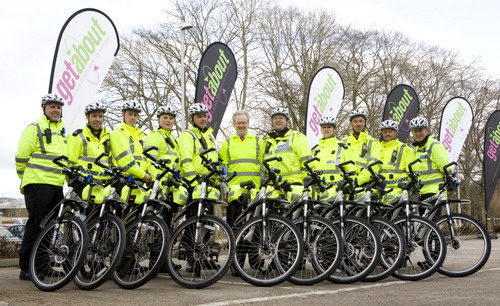
As cycling advocates, we're always pleased to hear of any increase in cycling activity. We recently heard of an increase in the number of Grampian Police officers on bicycle patrol - splendid! Here they are along with former Transport and Climate Change minister 'Fatty' Stewart Stevenson:


Chief Superintendent Mark McLaren said:
"Being visible and accessible within our communities is important to us.
"We know that people like to see us out and about on pedal cycles as it creates opportunities for better engagement which is not always possible when officers are travelling in vehicles.
"The big advantage here of course is that our staff like to use the bikes too, so this is a bit of a win/win situation.
"This is a great opportunity for us as not only do the bikes offer health and environmental benefits, they also have the added advantage of being able to quickly get into areas that aren't always immediately accessible by cars."
In a related development, we recently noticed bicycle paramedics on speculative patrol in central London:


All good stuff. But what particularly caught our interest was the name of the supplier of these public service urban mountain-bikes. Monopolytastic Killingry-mongers Smith and Wesson! Here are the most common specifications of their police bikes:

The 'Smith and Wesson Tactical':
Developed with the experiance and input from officers, the 'Tactical' model delivers the performance and reliability necessary for any department.
The 'Smith and Wesson Perimiter':
An excellent entry level bike offering the same high frame build standard as the higher specification bikes. Ideally suited for patrolling or community policing.
Both specifications include "silent hubs" (for "stealth" cycling) and are available for "civilians" to purchase.

At first we revelled in the thought that this arms-manufacturing company was now engaged in making bikes. We delightedly thought it was an example of swords being beaten into ploughshares. But then we shook off our idealistic naivity and realised that it was, perhaps, an example of the exact opposite of that.

With the exercise of a little healthy perspicacity we learn that the bikes are, in fact, generic bikes of the sort which you'll have seen bike shops marketing under their own names. They are outsource-manufactured in a who-knows-where factory through an agency agreement controlled by the box-shifting US-based bike mass-marketer Cycle Force Group, with the Smith and Wesson brand being licensed for marketing purposes only.
Neither Smith & Wesson nor Cycle Force Group risk any of their real capital in this enterprise. It seems that, perhaps, police forces respond positively to the core-brand-values embodied in the Smith and Wesson trademark. We have also learned that Smith and Wesson have similarly entered into a licensing agreement with North Carolina based Wellco Enterprises for the design and distribution of a full line of 'tactical law enforcement' footwear.
From the jungles of Vietnam to the mountains of Afghanistan we have supplied our best and bravest with the innovations needed to prevail in the world's toughest conditions. Today this mission continues as we outfit those currently fighting overseas as well as those returning home to face new challenges. It's this commitment that spawned our credo: There and Back. No matter where the battle lines are drawn.
We can, perhaps, learn a little of the mindset of these bicycle and boot marketers via their use of such language. And we can also learn a little of the mindset of institutional procurement officers when we realise that the Smith & Wesson brand is the critical marketing lever which pulls the trigger of their buying decision.


Friday, 15 April 2011

Men of Violence. Enough!

To our shame, we hadn't noticed until the week before last that Aberdeen is to gain yet another statue commemorating men of violence. This new statue, to sit in the  Castlegate at the heart of the historic town, commemorates and lionises the Gordon Highlanders regiment; to remember them "with pride and gratitude".

At the outset, let us acknowledge the regrettable fact that war and war memorials are part of the weave of the fabric from which our society and civilisation is tailored. We have many war memorials, including the most impressive, beautiful and apt statuary and colonnade, reliefs and inscriptions at Cowdray Hall on Schoolhill.

Splendid, sober, restrained, appropriate.
Unfortunately, and contrasting with the sober memorial at Schoolhill, the new Gordons statue will join with and augment the effect of all the other pompous martial statuary which venerates people of violence and slaughter and which peppers our town centre like the cluster munitions which today exemplify the state-of-the-art in these people's stock-in-trade.

Now, let's be clear, some of these individuals made important contributions to our town, to our country, indeed (arguably) to the wider sweep of western civilisation - but the one thing which links them, the crimson thread which runs them all through, is violent slaughter.
What a big sword!
To this list will be added the new Gordons commemorative statue. We must ask: What message about our town does this transmit? Is this a message of open welcome, or is it rather one of vainglorious militaristic bellicosity and triumphalism? Will venerating violence in this way add to our prestige? Or will it just make us look like chauvinistic jingoistic swaggering braggart ruffians with an effusively mawkish streak? Moreover, what is the message which this sends to coming generations of Aberdonians? Dulce et Decorum Est Pro Municipiuum Mori?

We would submit that the Gordons are already quite well-served by memorials (some of which highlight adventures in the mechanised mass-slaughter of 'natives' which today might be regarded as something to refer to The Hague) and a historic regiment could hope for no better commemoration than their splendid and award-winning museum at Rubislaw.

Meanwhile, national bard Robbie Burns stands alone above doomed Union Terrace Gardens and, farther up the Denburn, Lord Byron stands in the grounds of the Grammar School. Our two statuary acknowledgements and commemorations of creative (rather than destructive) genius. Men of peace and justice. Men who literally lauded love and practiced what they preached. Though Burns wasn't from anywhere round here, the sentiments he expressed and the creative genius by which he transmitted his philosophy stands embodied in this statue. Burns clutches not the swords of Wallace or George; not the guns of the Gordons - rather, Burns delicately holds a single mountain daisy in his hand. Byron clutches a book and and a pen.

Mary Garden's little plaque in a verge
off Cragie Loanings.
It's not enough.
We suggest that, rather than have new statuary commemorating men of violence, we would do far better to add to and augment the Burns and Byron statues with statues of men and women of peace, creative genius and scientific and social progress. There are many candidates of international standing, and some of them are even from Aberdeen.


Some of these people are commemorated in little plaques around town. This list isn't exhaustive - we're sure there are many more equally worthy of immortalisation in stone or bronze in the heart of our town. Of these, our personal favourite is James Clerk Maxwell. Without Maxwell's work on electromagnetic theory you wouldn't be reading these words or, indeed living anything like the life you live today. Maxwell truly is a "without whom", critical path, nexus figure. His work at Aberdeen University on the true nature of light, electricity and magnetism, and his special genius in noting that these three manifestations are but three aspects of the one phenomenon, is one of the greatest ever advances in physics. His work is comparable in importance to that of Einstein or Newton. We're not kidding and we don't say this lightly.

We suggest that our town would be much better served by erecting a statue to this colossus of modern science, using as he did his genius to enlighten the world and help generate the future which we live in today. A new statue of a man who can wield his intellect to improve the world would be a much more fitting addition to our town than a new statue of men waving guns and/or swords about.

The plaque on Union Street is the size of a sheet of letter paper.


Thursday, 14 April 2011

Thin Places Delineated at the Broad and Gallows Hills

A couple of months ago, we were on Aberdeen's Broad Hill to visit the innovative and subversive art installation: "By Order of Me".

Some of the artworks invite the viewer to consider the psychogeographical aspects of our situation ("You make the world the world"), as well as the psycho-historical aspects of the location ("Just think - there used to be bears here"). Go along with an open mind and time on your hands, observe the signs and you'll see what we mean. The installation is to remain in place until the end of the year.

It was a most raw February day when we were there, with a high tide battering hard against the esplanade which forms the sea-wall protecting the links from the North Sea. We walked under the esplanade and between the beach and the Broad Hill, then traversed the Trinity Cemetery up to the summit of Gallows Hill. Our interpretation of and interaction with the landscape inspired by the artifacts and the topography of the area.

Under the esplanade
Esplanade surveillance cluster.
For your safety and comfort.
From the top of Broad Hill, we see some remarkable views over the town lying to the west and, it being a prominent landmark, we're not surprised to find both an OS Trig Point pillar and a granite boundary stone at the hill's summit.


South face "R"
Both photos are of the same stone, we think it marks the boundary of fishing rights, the incised groove runs west to east pointing seaward. The inscribed letters will be the initials of the proprietors of the fishing rights. We're not certain of this, so if you know better, let us know...

North face "ND"
Traces of the foundations of recent structures can be seen in the low-lying flat links land - now a cricket pitch - beneath the hill. The area was heavily militarised during the Second World War, reflecting one of its historic uses as a convenient open and flat place to hold wappenshaws - "weapon-showings" - mustering of men under arms to satisfy clan or feudal lords that a suitably large, fit, well-equipped and bellicose corps of men could be gathered to execute their war-like bidding. We can't say whether the marks we see are the outlines of military camp structures and emplacements, or whether they are to do with the more conducive sporting and leisure uses of this land, which have included horse-racing, livestock shows, football, golf, galas and markets.

Impressions of previous land-use.
The shifting patterns of land use in this marginal zone between the town and the sea reflect the dynamic nature of this littoral zone itself. It is said that from time to time in pre-history the mouth of the River Don would become silted up and its waters would flow southwards, innundating the area now occupied by a links golf course and exiting to the North Sea somewhere around the latitude of the Broad Hill. Recent geographers doubt this assertion, the impervious clay bed of the links being at too high a level to allow the river to flow all the way south to the Broad Hill before finding an outlet or re-breaching its established one. However, the past undoubtedly saw the area characterised by a dynamic and shifting landscape with boggy quicksands, tidal lagoons, freshwater and brackish lochs (the Canny Sweet Pots - a bastardisation of Gaelic roughly translating as "the head of the settlement by the deep pools of water) fed by the Powis Burn and Banstickle Burns, which now run in underground culverts beneath the links. At their confluence, those burns became known as the Tile Burn which had a tidal flow allowing sea-going vessels to navigate some half-a-mile inland to the 18th century tile and brick works which gave the burn its name.

On the day when we visited, when a very high tide and a storm blowing in from the sea caused the waves to bluster and batter against the sea wall with more violence than we'd ever seen before, it was very easy to imagine a similar day in a time before modern sea defenses, the water inundating the land and reconfiguring the shifting sands, lagoons and watercourses.


This feeling of impermanence; of the diaphanous edge between something and nothing - the delicate balance between certainty and inconstancy which we felt and experienced as we stood braced against the onshore gale surveying the foreshore - put us in mind of the concept of the "Thin Place" in Celtic spirituality and the early Christian church. I've heard there's a Celtic saying that heaven and earth are only three feet apart, and that in the "thin places" that distance is even smaller. The early Christian church in Ireland, in Wales and in Scotland sought out these "thin places" for pilgrimage and in some cases to co-opt the sites and plant their missions on the foundations of pre-existing spirituality.

We feel that others have felt the same about this site throughout the history of our town and perhaps before. On the western slope of the Broad Hill, descending into a hollow and then ascending up to Gallows Hill is the Trinity Cemetery, which hosts a unique monument to people who've willed their remains to medical science for research.
The increase of knowledge and the advance of medicine
An ancient scabby dog-shit strewn right-of-way leads up the side of the graveyard to the summit Gallows Hill. As if to emphasise the theme of changeability and inconstancy, as we mounted the summit, the weather changed dramatically, the skies cleared and the sun shone strong and low in the late winter sky.

A young couple on the summit of Gallows Hill

Looking back down the right-of-way from Gallows Hill
 to Broad Hill in the backgound, North Sea beyond.
Some old maps show a powder magazine sited on Gallows Hill, and a rifle range extending down the right-of-way between Broad Hill and Gallows Hill, chiming with some of the martial aspects of this part of Aberdeen. An ancient site of execution, where the gibbet remained in place until at least 1776, the choice of this site for the storage of volatile military materiel was apt. No doubt folk would avoid the area if they could, because of its associations with crime and punishment, death and bodily corruption. The Victorian Trinity Cemetery tempers the negative psychogeographical aspects of Gallows Hill somewhat with the usual mawkish Victorian aspirations towards spiritual redemption and resurrection in an idealised afterlive of child-cherubs and young-women-as-angels. These Victorian signs and symbols strike a saccharine note with us in the 21st century, and so merely add a further freight of peculiar queerness to the undeniably singular atmosphere which is embodied in the topography, artifacts and history of this area, despite it being very close to the town centre today.

Clinging to the old rugged cross
Gravediggers baronial-gothic cottage
The hill is marked with a couple of 19th century (probably) boundary stones and a much older stone, marked with a cross. The retired grave-digger (no, really) who lives in the splendid Gothic-Victorian pavilion guarding the gates of the graveyard told us that this was a "Doupin Stone" like the one out west at Wynford, but we can't corroborate that. Aberdeen City Council's archaeology pages don't appear to have a record for it and the RCAHMS record it as a boundary stone.

Groove-incised boundary stone.

Boundary stone inscribed "TH"

Cross-marked stone
The hill overlooks Aberdeen Football Club's stadium at Pittodrie. We understand that the hill was at one time known as the Miser's Hilly, because hard-up or parsimonious football fans could watch the match free from the prominence. We suggest you read Alex Mitchell's pieces on the Ancient Burgh's of Aberdeen in the Aberdeen Voice for more background.


Remains of a bonfire on the summit
There used to be a manure works nearby to the north at Linksfield, involved in the production of fertiliser and chemicals for the leather tanning industry and bleachings. The feedstock for for the works was provided by a police stables, it's dung-heap occupying the site of the present-day football stadium, the name of which - Pittodrie - is from the Gaelic "pitt" - place of and "todhair" - manure; bleaching


The Manichean paradox embodied in the fact that the filth of manure is transmuted into an agent of purity: the bleach for the tanneries and bleachings, similarly chimes with the transformative and dynamically charged psychogeography inherent in the shifting topography of the area and how that in turn has affected our use of it. A place of comings and goings; of shifting surfaces; of things which are not as they seem; of deaths, planned and natural; of aggression and recreation; and of crime and redemption all in a "thin place", a place on the edge between the land and the sea, the edgelands between here and there; the border between the past and the future. The difference between something and nothing.


Tuesday, 15 February 2011

HMS Diamond's Affiliation

A wander down the docks yesterday morning to have a look at Aberdeen's newest 'affiliated' warship: HMS Diamond. We've written about Aberdeen's previous affiliation to the frigate HMS Scylla before but Diamond is altogether different, being a Type 45 'Daring' class air-defence destroyer this ship is said to be the world's most advanced [sic!] warship (at the time of writing). It's a big boat.

Little did we know that we were going to be sort-of too late, and Diamond was actually 'at sea'. But hold on, there it is, tied up at Telford Dock.


A word with the Harbourmaster security guard at the dock gate let us know that the warship had been scheduled to sail at 9.00 am, but - lacking the sheer grunting thrust of the type of anchor-handlers more normally seen using Aberdeen Harbour -  wouldn't have been able to make it over the sand and gravel bar which retards Aberdeen Harbour's entrance given the swell that was running at the time (that's what they say, isn't it?). And so Diamond had remained tied up. Tugs were awaited. How embarassing - it's just as well we weren't under air attack today. At least it didn't get stuck on a sandbar like that submarine last year.

Because of Diamond's 'at sea' condition, we weren't allowed any closer than the gate of the dock - but got these shots of the sci-fi forms of this terrifying weapon of war. We don't really like weaponry. 'Killingry', as our hero R. Buckminster Fuller would have had it - we prefer 'livingry', naturally enough, at Other Aberdeen - but we must admit to a grudging admiration for the alienating cold stark beauty of these forms.


Edit 15 Feb:

Anonymous sources tell us that, it being "Aberdeen's Warship", the Captain of Diamond and his senior bridge staff were invited to worship at St Nicholas Kirk on Sunday. Quite amazingly, they actually showed up late and missed the service, having got 'lost' in the Fittie/foreshore area.

So, firstly a snub to the godbotherers at the Mither Kirk and then stuck in port unable to surmount our well-known sandbar. Not a particularly auspicious start to our mutual affiliation.

The Royal Navy's Type 45 Destroyer webpage was offline at the time of writing.

Edit. Weds 16th Feb.

Other Aberdeen Scooped the Sun!

http://www.thesun.co.uk/scotsol/homepage/news/3414303/1bn-ship-stranded.html

And the P&J

http://www.pressandjournal.co.uk/Article.aspx/2137334?UserKey=


The warship wasn't the only interesting thing to see down the harbour that morning before elevenses.


Nae drunk much.

Friday, 11 February 2011

Private Enterprise Petit-Police at Union Square - UPDATE

Back in December, we posted about a bad experience at the hands of security staff at Aberdeen's controversial Union Square shopping centre. The post went viral, and to this day still generates a very high level of hits for this blog.


Yesterday, we received a comment on the original thread, which we thought warranted a blog-post all to itself, so here it is:
Interesting encounter this afternoon.
Had been for a meal in Yo Sushi with my sister and her two daughters (aged about six and seven I think). Afterwards one of them wanted to go on that trampoline / bungee rope thing in the main court. The child was happily springing up and down when one of the security guards approached us, pointed at a Japanese tourist taking photos, and asked if he was with us. 
We had never seen him before, so said no - at which they went over to him and demanded that he stopped taking photographs and leave.
My sister wasn't pleased with this and told the security guard that she was perfectly happy for him to take photographs if her children were fully closed and going about their normal activities, and felt the fact there was a problem with this was indicative of a sickness in society where everybody is under constant suspicion of being a paedophile.
Next up, the other Union Square person in charge of the trampolines got launched into a rather heated and patronizing flow - saying 'yes, they're fully clothed ... but what if he uses Photoshop to take your child's face and superimpose it onto a naked child's body" then he finished with "do you know how computers work?" - this was funny considering my sister did a post grad in computer programming and was a vice president at Deutsche Bank, working with computer security.
The first security guard went on to ask how she'd feel if she switched on her computer and was confronted by such a photograph - to which she replied that she wouldn't be seeing that on her computer because she wouldn't be looking for that sort of thing, and had filters to block it anyway. He then went on to say they had the same dangers when it came to people photographing the Union Square security cameras ... the photographer could be planning to blow up Union Square - or be a suicide bomber. My sister asked if they thought the tourist taking photos of her daughter was a suicide bomber? They said that you could never tell, he was ex-military, and these people are experts at covering their identity and could be wearing suits or anything.
By this point my sister was fairly openly laughing at them, and the security guards were pretty much shouting at her, while her daughter bounced away on her £5 trampoline session. At the end she just told them their policies were sick, and said that they had better be wary of her daughter when she put her mask and cloak back on (she was dressed as Batman) in case she was a plotting to blow up Union Square herself.
I didn't get involved in this argument myself, but must say it was quite amazing that my sister had to endure being shouted at and patronized by two knuckleheads while paying for her daughter to have five minutes of trampoline fun.
If anybody bothered reading this far, do you think the security guards were in the right?


Heh.

Thanks to this anonymous commenter for posting the story.

Clearly, these ex-military security guards believe themselves to be in the right. Union Square is their domain, and they protect those who come there.

Even a small risk is still a risk, so it's better safe than sorry. Everyone knows that them sick pediatricians always go about their sick perversion in public, and always prey on children who're accompanied by family members. Similarly everyone knows that those suicide bombers are somehow associated with Japan, where the cult of the kamakazi was invented after all - coincidence? I don't think so!

Anyhow, these pedos and suicide bombers aren't a match for the guys on our side, thank god! Those who wish to harm us in Union Square are so stupid they always telegraph their intentions by ostentatiously making obsessively extensive and slightly arty photographic surveys of their targets. The fools - they keep giving the game away! No wonder none of them have yet succeeded in their aim of bringing down the West by destroying Union Square! For, make no mistake, that is what they intend - nothing short of the destruction of our civilisation by striking at Aberdeen's newest generic shopping centre, which is the lynchpin of all Western commercial activity.

But with this incident we see the rise of a new and highly insidious threat to our comfortable western consumerist way of life - yes, the paedophile suicide bomber! The filthy b@stards!

It all adds up -
children + Japanese people + camera...
= Pedo suicide bomber
DEFCON 1. !!!

So we should congratulate these security operatives on their absolutism; stamping down on any aberrant behaviour keeps us all safe from these murderous suicidal foreign perverts. And it's better safe than sorry! We should be heartened that our operatives (our boys!) have a military background; perhaps they were posted to conflict hot-spots where Taliban and Al Qaeda IED's sharpened their hair-trigger reflexes.

It can't have been easy for these heroes, but we're benefitting from their sacrifice as we go about our innocent lives of consequence-free consumption. Is not consumer choice in free markets the one true freedom? Isn't that what we're still fighting for in Afganistan? Isn't that what we've achived in Iraq? Now, with the return of these heroes to their native soil, the front line has come home with them as they take up these jobs in our shopping centres which are the 'bastions' of our civilisation.

Some might say that these heros could use a course of counseling to re-integrate them into normal civilian life where threats to life and limb do not lurk around every corner. Some might say that the brutalisation these heroes have suffered ill serves them for public-facing jobs. Some might say that some of these guys are haunted by demons, that the things they have seen and the thoughts which they cannot dispel predispose them to paranoia and overreaction.

But we say: No! Bleeding-heart liberal politically-correct hand-wringingly cringeworthy attempts at 'understanding' these proud veterans only belittles them; emasculates them. These guys are men's men. They don't need namby-pambying mollycoddling. They can handle themselves just fine. The proof of this is that no paedo suicide pervert has yet succeeded in destroying Union Square.

It. Makes. Us. Proud.

Monday, 19 July 2010

Regeneration, restoration, redevelopment.

Elsewhere, and in real life, we have had discussions regarding the relative merits of redevelopment or regeneration, as opposed to restoration of 'historic' areas within a city.

Often, when we speak to older relatives or friends, who have a deeper well of memories, it is tempting to indulge in a sort of "oooh it's not like the old days" nostalgia. A case in point is the recent comprehensive redevelopment of the major part of the south of Justice Mill Lane. Let's have a little think about the context in this 'historic' area.

A large office complex flanked by a premium hotel on one side and a budget hotel on the other now occupies a site which has, for the last 30 years been more-or-less derlict, home to itinerant small businesses, ad-hoc car-parks, vacancy and neglect.

The area, without doubt, is 'historic' - being associated with a particularly regrettable episode during the Wars of the Three Kingdoms; but the built environment in the area has, throughout our lives, been host to a different source of regret - that of blight. (Yeah, alright, nobody dies of blight, but bear with us...)

Now as the new-build complex approaches completion, we are aware of increasingly strident voices denouncing the development. This surprises us.

Did those who denounce the new development prefer the derelict motor trade premises and brick & concrete former furniture factory which most recently occupied this site on Justice Mill Lane? Or do they want to turn the clock back further still?

The car sales/service/filling station place (Town & County Motors) did some nasty now-you-see-it now-you-don't misdirection in order to achieve the demolition of Strawberry Bank in 1967, but that was before our time, so we cannot honestly lament it. We're certainly not going to call for its restoration. Of all things we might dislike in the built environment, we detest hollow pastiche the most.

Where would it stop, with that sort of "keep everything as it is/was" philosophy? We note that during this particular area's industrial and residential heyday in the 1860's, the recently grassed area with the shallow steps close to the former (wrong) site of Hardgate Well was occupied by a public house. The Hardgate Well itself was on private ground, with no public access, and a little down the hill a large tannery operated. Would the voices of reaction wish to restore all that? Would they restore the agricultural implement factory (which was on the site where the Travelodge is about to open) even though it would have no hope of finding staff to work in it or a market for its products?

When in time do they believe that the 'perfect Aberdeen' existed? We have no wish to live in someone else's idea of an 'ideal' utopian or arcadian past, for we know that no such thing ever existed. By contrast, we have every intention of living in the future - a future in which we will be full participants - making it as great a place to live as possible.

Or is it that those voices raised against redevelopment simply do not like the physical appearance of the new buildings? Here at Other Aberdeen, we do not have any particular favourite architectural styles; beauty, or otherwise is in the eye of the beholder. Fashions come and go. You've got to give architecture time. Tastes change.

What we do appreciate is quality, authenticity, and integrity. We believe that these aspects cannot be judged instantly when a new building is unveiled - so we're reserving comment on the architectural merit of this complex for the moment. Did similar controversies rage when the redundant Upper Justice Mill was demolished by Scott Sutherland to make way for his Regal Cinema (latterly Odeon, most recently some sort of gym)? Did the folk of Rosemount object to the building of the Shell HQ on the site of Altens farm?

This position is subtle; for instance, there has been much comprehensive redevelopment in Aberdeen which was regrettable. St Nicholas Street and George Street spring instantly to mind; the buildings which were destroyed to create the covered shopping malls had quality and integrity. The threat to Union Terrace Gardens is similarly intolerable.

Here at Other Aberdeen, we are not dogmatically pro- or anti-development. We are pro-quality - we appreciate authenticity - we love integrity.