Showing posts with label ACC. Show all posts

Tuesday, 15 November 2011

Unbearably Hideous and Detestable

UP AT the top we say: "something is very wrong with this town - psychogeography might or might not help…". And indeed today we are at a loss, for nothing we can say or show could possibly help mitigate the growing horror which creeps across the consciousness as the most recent implications of the budget apocalypse at Aberdeen City Council become ever clearer. No amount of urban exploration or ludic walking could eliminate the hollow feeling of distaste felt when the implications of of the cuts crystallise into words in a policy document which will, in a short time, become facts on the ground.


A summary of the forthcoming budget cuts, how they have been prioritised and what that means for public services can be read here (PDF). It's tough going - the opaque language of the document is as dry as the bones which may be all that remains of our town's civic sphere once the budget reductions have been implemented.

If you can stomach it, the reading of this most recent document will demonstrate to you what our local political representatives, their publicly-paid bureaucrats and their unaccountable businessmen puppet-masters have decided is the prioritised hierarchy of cuts for the coming 5-year period. It's a sort of civic triage, aimed at the delivery of £35.7m of budget savings. The document summarises how these savings are to be achieved, and breaks the savings down by how they are spread across council directorates: Social Care & Wellbeing; Education, Culture & Sport; Housing & Environment and so forth. It is an object lesson in doublethink that these directorates are flagged up along with their corresponding  contributions. Contributions which consist of things taken away, that is.

Local readers will probably be aware that the cuts detailed in this document are in addition to the existing tranche of cuts made over the last two years which achieved a contribution of around £15m. Those cuts fell largely upon provision of services for physically and mentally disabled people, and the terminally ill, including children.

So, additional to that, among the new measures explored and prioritised are:

  • Increasing primary schools class sizes by up to 78% (recommended maximum number of pupils in p3 to be increased from 18 to 33)
  • Sacking pupil support assistants
  • Shutting five primary and two secondary schools
  • Reducing services for the homeless
  • Stopping day care for mentally ill people
  • Closing recycling centres
  • Closure of parks and gardens throughout the city, selling the land.
  • Reduction then cessation of school crossing patrols

We note that there is, in this document, no de-prioritising of our council's continuing push forward with the old-fashioned multi-million pound urban dual-carriageway and radial expressway projects which were dreamt up in the centre of the car-crazy 20th century. Rather than consider a suspension of these motorcentric policies and instead explore the cheaper and more modern transport options common in continental Europe and even the USA, by contrast our local government has, in this budget document, demonstrated its commitment to continuing the enablement and authorisation of car-dependent lifestyles by ruling out the introduction of a congestion charge for Aberdeen. Moreover, the document shows our local authority's  foot-dragging resistance to the implementation of the higher penalty charges for illegal parking which the Scottish Government has requested that local authorities introduce.

No to congestion charge, no to higher parking charges. Yes to more urban dual-carriageways. Yes to bigger class sizes, yes to the sacking of lollipop ladies. The council signals that the right to drive unimpeded at ever greater speed around Aberdeen and park where you will is more important than children's education and safety, more important than services for the disabled and disadvantaged, more important than public parks.

Measures also considered but listed further down the list of axe-ready priorities are the closure of all 16 of our community libraries and the shut-down of all museums and art galleries for one year. It's no surprise that this philistine town should consider the suspension of cultural services, but its a source of spine-chilling horror that, for want of a total shortfall of £70m over ten years, such grave damage is being done to the civic sphere of our town. That these cuts should largely fall on the blameless, the vulnerable, the marginalised, the disenfranchised, the poor, the ill and the disabled - while parallel council activity is intent on borrowing a similar sum in order to realise the vanity project of a highly affluent and locally influential billionaire oil tycoon in his grandiloquent plans for the privatisation of public space in the town centre is beyond distasteful. 

That our local government should seriously consider the closure and sale of many public parks, while doing all they can to toady to the got-lucky businessman - effectively mortgaging the commonly-held land in the centre of our town to discharge the plutocratic aspirations of one citizen and his cadres - while thousands upon thousands other citizens face serious detriment to or cessation of the local authority services which maintain their quality of life - is beyond offensive. Though it is instructive, for it demonstrates the contempt in which ordinary people are held by the politicians, bureaucrats and capitalists who run Aberdeen.

There are other policies both explicit and implicit in the budget-cut document, which we might decide are worth exploring later on. For instance, the document implicitly shows that there's a bit of jiggery-pokery being considered with regard to our Common Good fund. And there is an explicit demonstration that our local authority is reluctant to implement government policy which would see the reduction of council tax reliefs on second homes, but is quite content to implement policies which will remove vital help from homeless people. Something is, indeed, very wrong with this town. In the words of Private Eye's 'Piloti',  
What exactly does one have to do to stop a fine city like Aberdeen self-harming, not to say committing suicide?


Wednesday, 6 July 2011

Bizarre Opaque Transparency from Aberdeen City Council.


////////////////////---------
>>>
Local government transparency 


 Getting council business out in the open will revolutionise local government and enable the Big Society. Transparency is the foundation of accountability. Local people should be able to hold politicians and public bodies to account over how their council tax is being spent, and decisions made on their behalf. It is also a powerful means of promoting efficiency, without requiring the heavy-handed intervention of an unaccountable bureaucracy.


>>>>>>>>>>>>>>>


>>>
City Garden - Project Monitoring Group

The role of the Project Monitoring Group is to oversee the City Garden project's progress and ensure that Council's interests, and that of the majority of Aberdeen citizens, are protected as the project progresses.

>>>>>>>>>>>>>


////////////


>>>>

City Garden Project Monitoring Group

Note of Meeting held at 9.30am on Friday 20 May 2011
Committee Room 5, Town House


<<<<<<<<<<<<<


>>>>


Sanitization and Redaction

Sanitization is the process of removing sensitive information from a document or other medium, so that it may be distributed to a broader audience. When dealing with classified information, sanitization attempts to reduce the document's classification level, possibly yielding an unclassified document. Originally, the term sanitization was applied to printed documents; it has since been extended to apply to computer media and the problem of data remanence as well.
Redaction generally refers to the editing or blacking out of text in a document, or to the result of such an effort. It is intended to allow the selective disclosure of information in a document while keeping other parts of the document secret. Typically the result is a document that is suitable for publication, or for dissemination to others than the intended audience of the original document. For example, when a document is subpoenaed in a court case, information not specifically relevant to the case at hand is often redacted.

Government secrecy

In the context of government documents, redaction (also called sanitization) generally refers more specifically to the process of removing sensitive or classified information from a document prior to its publication, during declassification.

Secure document redaction techniques

The traditional technique of redacting confidential material from a paper document before its public release involves crossing out portions of text with a wide black pen, followed by photocopying the result. This is a relatively easy to understand process and has only minor risks associated with it. For example, if the black pen is not wide enough, careful examination of the resulting photocopy may still reveal partial information about the text, such as the difference between short and tall letters. The exact length of the removed text also remains recognizable, which may help to guess plausible wordings for shorter redacted sections. Where computer-generated proportional fonts were used, even more information can leak out of the redacted section in the form of the exact position of nearby visible characters.

<<<<<<<<<<<<<<<<<<<<<


----ooo0ooo----


Regardless of the rights or wrongs, transparency or opacity, paranoia or caution which has motivated our elected local council representatives in our and their appointed executives minor provincial county town to undertake this 'redaction', it just looks bad. As one online commenter said:
Nice to see that everything is transparent so as to avoid the feeling of conspiracy and underhanded activity. Good confidence-building job. As ever.
But we have another point: the fact that this has been done should give us pause; should make us consider whether or not these people are suitably qualified, skilled, competent and suitable individuals to be trusted with the execution of this controversial project. We say this because we are not investegative journalists, we are not computer geeks, and we are not cryptologists - but nonetheless we managed to obtain quite by accident unredacted copies of the texts as we were preparing this post. Here are full, redacted copies of the minutes. If anyone wants copies of the unredacted text, you can contact us at otheraberdeen@gmail.com and we'll be delighted to oblige.


EDIT

Following our reportage of this hilarious mis-step, a local newspaper published this article, the and most of the redaction has been removed from the online copies of the minutes.
Thanks to blogger rxpell for the scan.


http://www.aberdeencity.gov.uk/nmsruntime/saveasdialog.asp?lID=38882&sID=16279

No blanks in that one.

http://www.aberdeencity.gov.uk/nmsruntime/saveasdialog.asp?lID=38884&sID=16281

The law firm name 'Brodies' has been blanked.

http://www.aberdeencity.gov.uk/nmsruntime/saveasdialog.asp?lID=38886&sID=16283

Again, the law-firm name 'Brodies' has been blanked.

We wonder why?


Wednesday, 23 March 2011

Twenty-eight Percent.

Last night, we were along to Peacock Visual Arts to attend the premier screening of Fraser Denholm's timely and apposite documentary film: "Run Down Aberdeen."
(Own-trumpet-blowing warning: Other Aberdeen's Alan was one of Fraser's interviewees in the doc.)

The film was followed by an open-floor and panel discussion, with the film-maker Fraser flanked by local politicos Deputy City Council Leader Cllr Kevin Stewart, Cllr Martin Greig and Lewis Macdonald MSP.

Here's the film to watch online - pass it on:


Run Down Aberdeen from Fraser Denholm on Vimeo.

We'll write a bit more about the film and the issues it covers later today, but for now we want to explore one particular statistic - mentioned in just one sentence during the floor discussion - from our Deputy Council Leader, Cllr Kevin Stewart.

A question from the floor relating to Aberdeen's role in the Oil and Gas industry was being handled by the panel. Labour and SNP agreed wholeheartedly that Aberdeen was an "economic powerhouse". And that's not just for the North East, but for the whole of Scotland and the UK, according to Lewis Macdonald MSP. Deputy Council Leader, Cllr Kevin Stewart, said that Aberdeen contributed 28% of UK tax revenues to the UK Exchequer.

This is not true. And the fact that both Stewart and Lewis believe that it is tells us more about these politicians than they mean it to. Just have a think about it... that statement suggests that of all the revenue collected by the UK government, more than a quarter comes from the economic activity of less than half-a-percent of the population. What an assertion to make! Really, if this were the case the whole world would beating a path to our small corner to learn the secrets of our special sauce.

But we've seen this error trotted out before by local press and local business-sector bloggers. (We trust that it is a genuine misunderstanding - and not a willfully disingenuous manipulation - politicians wouldn't do that, would they?) So, let's see where the source of the error comes from:

Firstly, like all misunderstandings of this type, it contains a kernel of truth. The 28% figure is within this document (big PDF) from special-interest business lobby group Oil & Gas UK.
[Edit: The figure has actually been revised recently, and now stands at 30% - even more than Cllr Stewart asserts!]

But, that 28% figure relates to Corporation Tax revenue - not all revenue, and it relates to the entirety of the oil and gas sector, not just the 'upstream' (finding and getting) activity which dominates business in Aberdeen.

So, for the avoidance of doubt, Oil & Gas UK rightly assert that the oil and gas industry generated 28% of UK corporation tax receipts during the tax year 2008/09.  But ask yourself: "What else happened during that period?" It's then quite easy to see why the oil and gas industry banked more than the "Square Mile in London" (as has been said elsewhere) at that time: As the oil-price spiked to that $147/barrel record, the energy companies enjoyed windfall taxable profits against the dark background of the financial sector falling into more-or-less ubiquitous loss. It is also relevant to point out that many UK Oil & Gas sector companies operate in a variety of overseas locations, but are stock exchange listed in the UK.

It is also telling that our local representatives to attempt to attribute the entirety of that oil and gas activity exclusively to this town. This is risible. Upstream (finding and getting) oil and gas is a cost centre for the energy companies. Profits are generated in transport, refining, trading, electricity generation & transmission and value-added retail. None of which impinge much on this region. We are exasperated that this boosterism based upon fallacy continues to characterise the discourse in this town and is continually repeated by our local press and politicians. We find it a bit nauseating.

Our local politicians appear to have fallen into the trap of believing Aberdeen's hubristic self-styling as Oil Energy Capital of Europe. It is not. London, Rotterdam, Paris and Moscow vie for that title. No-one outside Aberdeen who works in this huge industry which spans many regions and activities calls Aberdeen "Energy Capital of Europe". When these people in the industry outside Aberdeen hear the term they snigger, as a rule. In the words of novelist Cristopher Brookmyre:
"Europe's Oil Capital. Honestly. The first time he heard the expression, he'd assumed it was a bit of self deprecatory humour. That was before he learned that there was no such thing as self-deprecatory humour in Aberdeen, particularly when it came to the town's utterly unfounded conceit of itself."
Now, please don't misinterpret what we're saying. There's definitely much to be proud of in the business world in Aberdeen "City and Shire" (ugh). But there's no need to "enhance" these good things with disingenuous or demonstrably false hubristic misrepresentations which make us look vaingloriously stupid. To do so devalues that which is genuinely good and praiseworthy about our town. To do so undermines our standing amongst our competitor regions. And to do so undermines calls for greater support from central government and other non-governmental actors - help which Fraser Denholm's pertinent and well-timed new documentary aptly demonstrates that we need.

The future will contain many challenges. We need to face them with open eyes and realism. As we've said before, oil and gas reserves are finite. The day will come when we will all dearly wish that we had started down the difficult road of re-balancing our energy supply earlier than we have. In Aberdeen we will, additionally, wish that we had started down the road of re-balancing our local economy a little earlier too.


At Other Aberdeen we greatly fear that the currently high oil prices, the hubris they inspire and the offensive (and, as we have seen, ill-founded) triumphalism they provoke militates against the redirection of capital towards the development of a sustainable economy in Aberdeen, be that in the shape of the switch to renewable energy technology, the burgeoning development of the Scottish life sciences sector or other more traditional business sectors. We, unsurprisingly, would be happiest to see the creative and arts sector help lead in the regeneration of Aberdeen's built townscape and business landscape through grassroots bottom-up inclusive creative initiatives. We were gratified to hear during the panel discussion that Lewis Macdonald MSP supports this hope.

But then, there we were, at Cineclub hosted by Peacock Visual Arts. Should we have been surprised to see a politician (who is seeking re-election) wearing his metaphorical "I support the Arts" badge? Not for the first time this week, we realise that to ask the question is to answer it.

Thursday, 17 March 2011

Biting the Hand.

Union Terrace Gardens as they are.
People who live in Aberdeen will not be unaware of the controversy surrounding the business-community-driven redevelopment of the town's famous Union Terrace Gardens. The intention had been to create a very large new civic square. Promotional efforts used the name "City Square Project". This redevelopment scheme has since been rebranded as the "City Gardens Project".


Original concept
Here at Other Aberdeen House, our personal greatest vexation with this proposed redevelopment was the way than an opportunity to anchor a progressive arts and creative sector in Aberdeen was so thoughtlessly as to appear maliciously squandered. The City Square proposals caused the collapse of the Peacock Visual Arts Northern Light initiative which would have created a new contemporary arts centre for Aberdeen and the north of Scotland. Those unfamiliar with the controversy can read comprehensive and in-depth analysis on Fraser Denholm's excellent blog: Blerr De Blerr Blerr.

The creative sector forms an impressively huge part of the UK economy, contributing as much in Gross Value Added as the financial services sector and is a predominant source of export revenue. With the securing of the Victorian & Albert Museum's northern outpost, Aberdeen's 'competitor' city, Dundee, is now poised to take a leading role in this economic sector for generations to come.

Over the last few days, the City Square Garden Project has launched a new promotional website, presumably with the intention of winning 'hearts and minds'.

Revised concepts
Browsing the pages of the site is an odd experience. We mentioned earlier that some of the use of language and content came freighted with information which we might infer about the promotors of the scheme to redevelop the existing Victorian-era Union Terrace Gardens and replace them with a hyperreal diorama of our town's heritage.

Then, we looked at the "Cultural Space" page. What most disorientated us was the use of these words:
Imagine ... mixing with art lovers and tourists
It took a little while for us to pin down just what it was that troubled us about this. Then we worked it out, we managed to unpack the statement. It's that conflation of "art-lovers" with "tourists". The promoters of the City Garden Project talk to readers of their website as if they are not the art-lovers. The implication is that art lovers are, like tourists, outsiders; they are 'other'. It is clear that they believe that the people of Aberdeen are not, therefore, art lovers. In effect they are inviting us to: "Come and look at the funny art lovers - aren't they strange?" They obviously cannot see how insulting this is. Their assumptions are showing, and, in turn show us that it is the promotors of the scheme who are themselves not art lovers.

Original concept
The promoters of the City Garden Project have, by use of this one sentence inadvertantly dropped the poker-face by which they had hoped to assuage the concerns of Aberdeen's beleaguered arts community. They have by use of this unguarded phrase exposed their bluff which attempts to revise project instigator Sir Ian Wood's ill-considered and temerarious words in Scottish newspaper The Herald:
... this is ... for the wider interests of people in Aberdeen who don't care about the arts. Eighty per cent of the people who spend time in the square will have no interest in the arts.
Revised concept
From such a local-press-lauded "man of vision", this displays a breathtaking lack of perspective. We hope not to fall into the trap of condescension, but we would point out that all people who participate in our civilisation are consumers of the arts, almost all the time. We live and work, relax and consume in an architect created environment; we listen to music; we read literature; we watch factual and dramatic films and television; everything we touch, wear or see has been brought into reality by a designer - these all are branches of the arts.

One of the ways in which anthropologists working at the edge between archaeology and paleontology discern the human condition in the artifacts they unearth at early hominid sites is the artistic content of the objects. Art is not strange and other, it is ancient and basic to the human condition. It is the fundamental fountainhead from which all other culture and civilisation emerges.

From the earliest rock art and clay fetishes, through the anatomically super-perfect and beautiful statuary of Ancient Greece, we discern, understand and participate in our world in the way we do because of the filters and guidelines which the artists of those artifacts have created for our cognition to follow. You do not "feast your eyes" on art. Rather, you feed your brain. The arts is the branch of human striving which provides the context for our society and civilisation to then fill with content. That we think the way we do; that we say the things we say; that we behave the way we behave is all the product of the artists who have provided us with the collective cognitive tools to interpret and interact with the world around us since the beginning of human civilisation.

When the controversy surrounding the redevelopment of Union Terrace Gardens was raging at its height, we remember hearing and reading opinions to the effect that the arts community should be careful not to "bite the hand that feeds it".

We would counter that by suggesting that it is rather those who propagate condescending material like some of the words on the City Gardens Project promotional website should be careful.

They should be careful not to bite the hand thats create the context in which civilisation thrives.

Wednesday, 16 March 2011

Fernhill Unconfined

Looking north towards Fernhill over the Bucksburn Valley
Fernhill is a hill, a farm, and - by extension - the name of an area which sits in the greenbelt between Sheddocksly and Kingswells, to the west of the built-up part of Aberdeen off the Lang Stracht. A network of farm tracks and footpaths - some in use as farm access, some maintained by our favourite quango Aberdeen Greenspace - provides access throughout the area and connects with the splendid recently-completed Bucksburn Valley Paths network (also the work of Aberdeen Greenspace). These paths are part of Aberdeen City Council's (ACC) Core Paths Network. 

Looking at the ACC Core Paths web-page we see that :
Under the Land Reform (Scotland) Act 2003, all Local Authorities and National Park Authorities in Scotland have a statutory duty to prepare a Core Paths Plan that will "provide the basic framework of routes sufficient for the purpose of giving the public reasonable access throughout their area. The basic framework of routes will link into, and support, wider networks of other paths" 
The vision for Aberdeen's Core Paths Plan is to "form a complete paths network throughout the City, encouraging healthy and sustainable access opportunities for all". The Core Paths Plan will form a key part of outdoor access provision and will help to support wider national, regional and local policy objectives on health, recreation, education, economic development, social inclusion, community development, sustainable transport and tourism.
This, of course, is right up our street. Or rather, right up our Core Path.

Heading north up Fernhill to Greenferns
From Fernhill, we get views west to the Grampian mountains and east down to the North Sea. But perhaps surprisingly, very little of Aberdeen itself is visible. From this location the majority of the town is hidden below the ridge which runs from Cairncry to the Hill of Rubislaw. At the summit of Fernhill, we stand on the watershed of our town. A raindrop falling to our immediate north will find its way to the sea via first the Bucksburn and then the Don. A drop of water falling to the south will travel via the Denburn and Dee. The sources of the Bucksburn and Denburn are both to the west of Fernhill, and are surprisingly close together at Kingswells, surrounding Aberdeen in its own 'ring of bright water'. Sort of.


The Fernhill reservoir occupies the very summit of Fernhill, looking for all the world like a truncated stepped pyramid built by an ancient civilisation. Its sepulchral forms devising an apposite (but surely coincidental) mirror of the Aberdeen Crematorium, which sits at about the same elevation at Jessiefield across the Denburn valley towards Hazlehead. 


The stepped forms, splayed walls and truncated summit of the Fernhill reservoir remind us of the Peel Ring of Lumphanan and the vitrified fort at Tap o' Noth, and this thought in turn puts us in mind of some of the things we said when we berated the panopticonic "Project Kraken". Fernhill reservoir is today a crucial piece of infrastructure, crucial to the provision of a vital life-sustating service to the people of Aberdeen. But all things pass, and one day, in the normal course of development (or decline) its function will be redundant, and its structure will be left to decay back to the landscape, function all but forgotten, the arcana of its operation the subject of esoterica.

Peel Ring of Lumphanan - Motte.

Tap o' Noth - Vitrified fort.
Fernhill - 20/21st Century Reservoir.

As if to illustrate this point, an earlier (yet still from the 20th century) reservoir is visible just to the east of the presently used facility.  Heavy manhole covers protect path-users from the tank-voids of the redundant facility. The words "CAUTION - CONFINED SPACE" are stenciled on the face of the manhole covers as a warning to adventurers who are tempted to explore the formerly watery void below. 

Redundant

Confined

The paths at Fernhill link working farms, old forges, semi-rural cottages, stately old stands of impressively mature trees and (last week) just-ploughed fields, the scent of the good earth rising from the newly-broken winter's crust of working farms. The very picture of Aberdeenshire. 

Unconfined


The good earth

One of these working farms is Greenferns, and is on council-owned land. This land at Greenferns is one of the so-called "pockets of market failure" which have been identified for "remediation" by the forthcoming work of the City Development Company "One Aberdeen" (which we wrote about a little while ago). We would like to point out that this definition of failure is not the same as ours.  We fear that the City Development Company appears to be set to fall into the trap of believing that a community is nothing more than the sum of the businesses which operate within it and that the market should be the final arbiter of success or failure. We deplore this pencilneck-narrow vision. 

The Core Paths at Fernhill do not in and of themselves make money; of course they don't. But they create value by enriching in non-monetary ways the lives of those that use them and the environs of Aberdeen. This is the true definition of wealth. The generation of money and profit is merely the creation of affluence. The two things are not the same.


Friday, 21 January 2011

Urban Dual Carriageways. The Future from the Past.

As our council continues pushing ahead with measures to "enhance" traffic flow at speed into the heart of the town centre to the exclusion of other transport options via the controversial "Berryden Corridor" (pdf) urban dual carriageway project, we continue to be nonplussed that such a discredited policy for traffic management continues to even be considered, let alone implemented.

It is telling that the report linked above is titled "Berryden Corridor Improvements", thus prejudicing it's own conclusions. That the creation of extra road-space exclusively for motor transport is an "improvement" is a conclusion which is increasingly seen as mistaken. We have written on this subject on one or two occasions before.

We so very much wish that it were true that congestion could be solved by the simple, seemingly common-sense expedient of building more roads. But, unfortunately, world-wide and decades-long experience of the building of relief-roads, bypasses and linkroads confirms without even a hint of doubt that it is not.

Note the "Proposed foot bridge over railway line".
Thanks for that.
As if this new pedestrian link will compensate for loss of
pedestrian permeability throughout the length of this new "corridor"

all the way from Woodside Fountain to Skene Square.

More and more, in every part of the world from Australia through Asia to Europe and even including the USA where the car is King, it is realised that more roads means more congestion and that the only thing which will reduce congestion is a policy which delivers fewer journeys undertaken by car.

It's a cliché and a truism to say that one of the definitions of madness is doing the same thing over and over again, and expecting different results. So why do we expect that building additional road capacity will have a different effect this time? It will not; it will merely impoverish us by further devastating parts of our town which are already suffering blight and degeneration.

We are reminded of lessons unlearned elsewhere:

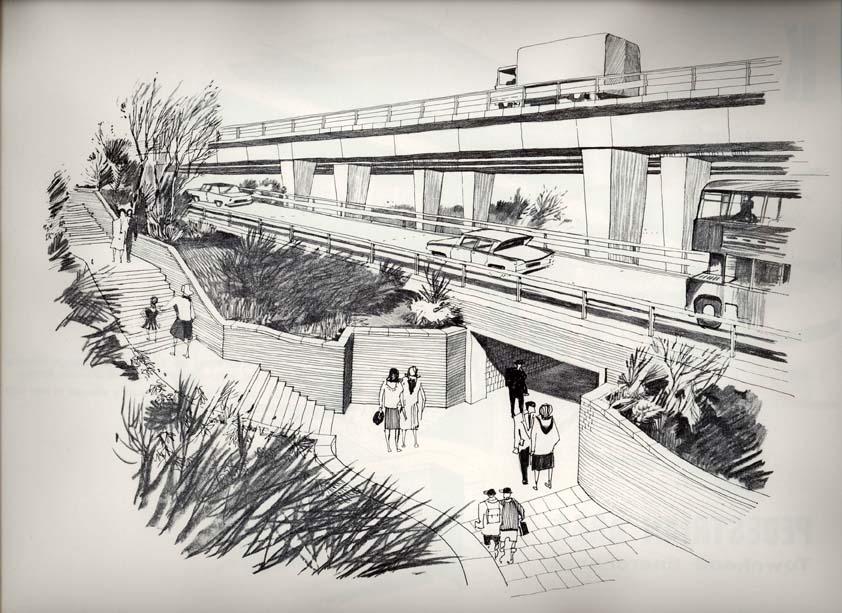
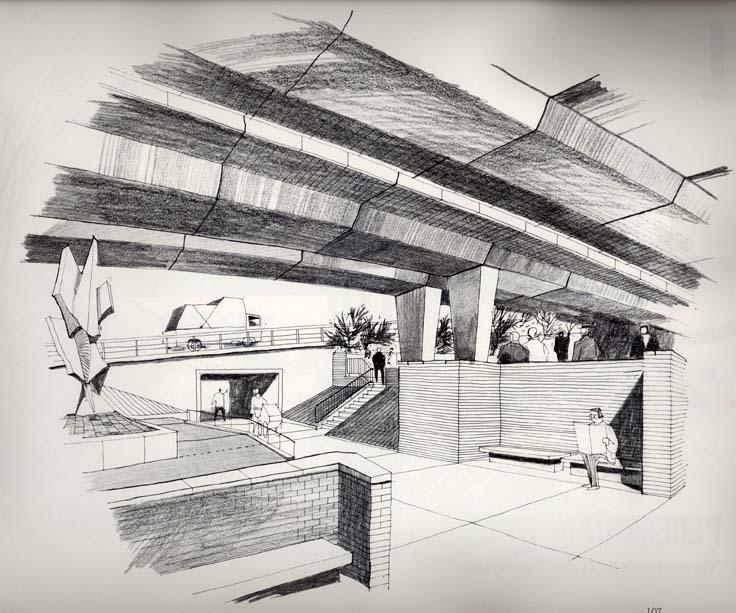
From Report on A highway Plan for Glasgow 1965.


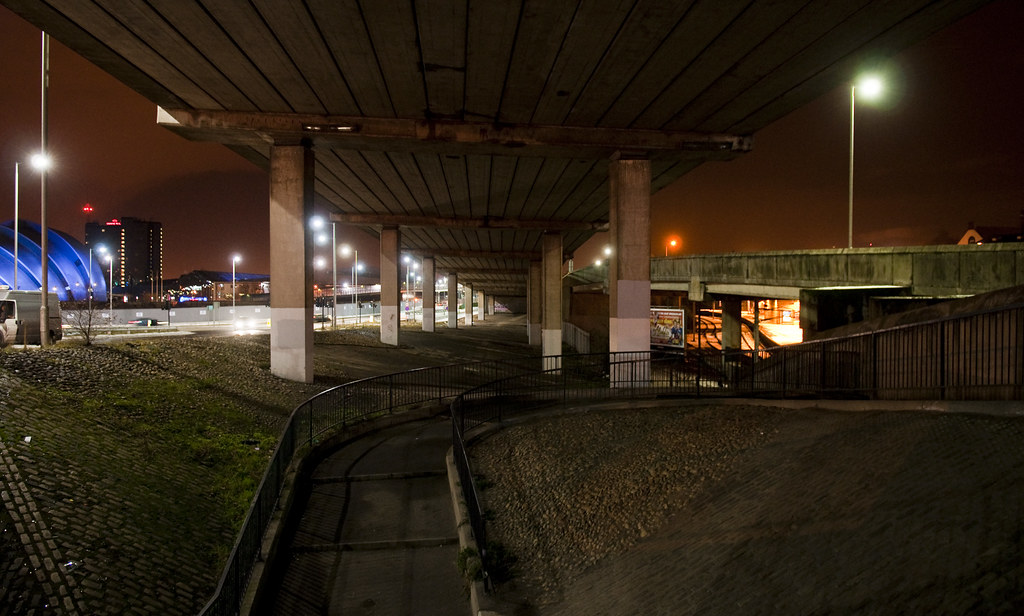
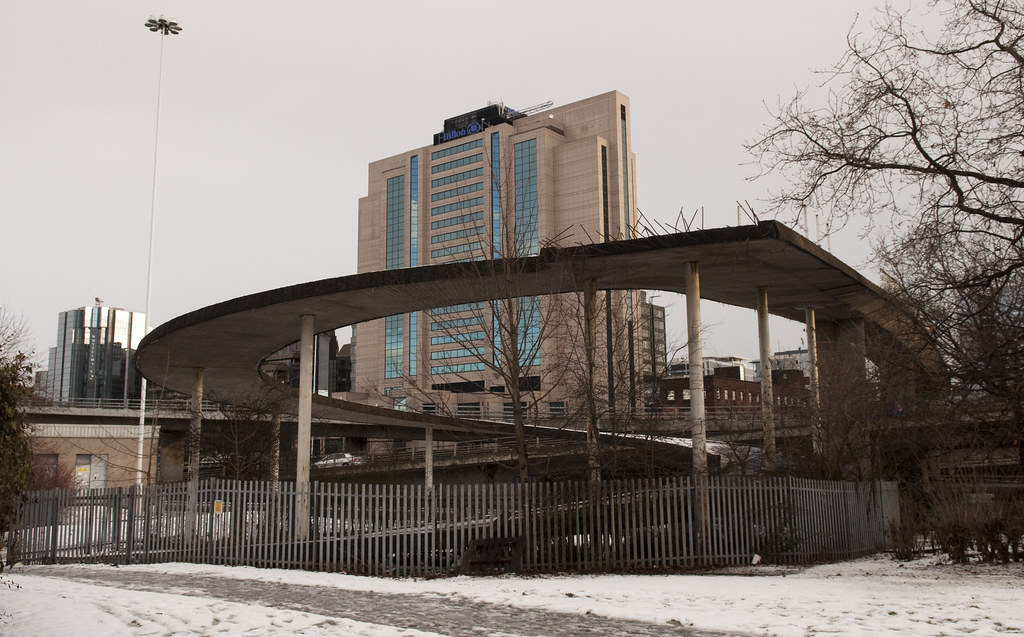
These paper-bound utopian visions, unfortunately, turned into an alienating horror in the real world.

From At War With the Motorist's splendidly psychogeographically logged visit to Glasgow: Crap cycling and walking in car sick Glasgow.


Glasgow continues on to repeat the same errors with new urban motorway and dual carriageway projects. It seems that we in Aberdeen cannot bear to be left out. As one commenter puts it: "Why would anyone want to walk anywhere when they can drive through the remains of the city at 50mph." And another: "Worth every penny, so it is. Heaven forbid that anybody might have to go anywhere, anytime at less than a respectable 60mph."

Should the Berryden Corridor urban dual carriageway be built as proposed, it will fulfil one function only - it will bring more motor traffic into the centre of town at an increased speed. From this function, effects flow: It will increase congestion; it will increase noise and atmospheric pollution; it will act as a barrier to east-west permeability and mobility for pedestrians and cyclists; it will isolate communities and it will have a detrimental impact upon the liveability of the inner part of our town north of the centre. It will thus increase social exclusion and alienation. This is the direct opposite of the study aims which, in the very first paragraph state that the project will "contribute to making Aberdeen’s transport network more efficient and sustainable over the coming years, ensuring that the city remains an attractive place to live, visit and work."


In the past, we have praised Aberdeen's surprisingly good cycling profile and we regularly revel in it's fantastic network of quiet and serene pedestrian paths which take walkers away from the stress of interacting with motor traffic.

We'd hate to have to reverse our position on this, particularly when our non-car infrastructure is beginning to gain International Fame.

Monday, 17 January 2011

First Look - Marischal College

A heartbreaking few minutes spent looking at the reconditioned frontage of Marischal College on saturday, now that the scaffolding has been struck. The Marishal College building is being re-developed as a new headquarters for Aberdeen City Council.

Looks OK from a distance...
But it seems that Greyfriars has been left untouched,
contrasting nastily with the Marischal frontage.

Moss, lichen and grubby filth on Greyfriars spire
detracts somewhat from the newly-reconditioned Marischal frontage.

Actually, the closer you get, the nastier the Marischal frontage looks.  
Mmmm. The more you look - the nastier, blotchier, more stained and uneven it looks.
Something's wrong.

Blotchy. Patchy. Uneven finish.

Stained, burned(?), blotchy. 
Stained, burned(?), blotchy, scuffed, scratched, uneven, patchy.
Earlier in the year, Aberdeen City Council's Enterprise Planning and Infrastructure Committee slashed £2.5 million from the Marischal College redevelopment project's contingency budget. The funds were re-assigned to the Aberdeen roads budget, following the harsh winter which had caused issues with the 'state of the roads'. Oops.


We pretend no expertise in these matters, but we really hope that what we've pictured above is just an intermediate stage, and that when the contractors leave the site, these issues will be resolved. We've noted similar issues at other sites around town.


On the council website, this update was published earlier in the spring:
Marischal College's stunning "new" look is being gradually revealed as refurbishment work on the landmark building continues.
While McAlpine carries out the construction work on Aberdeen City Council's new corporate headquarters, Glasgow-based LaserClean is steadily restoring the stonework to its former glittering glory.
The face of the grey granite building was steadily blackened over the years as carbon deposits polluting the air took their toll. But the listed building's true colour, which has never been seen by many Aberdonians, is being revealed by the cleaning work.
...
About 40% of that cleaning work has now been completed and decorative features which were barely discernable in the grime, including the leopard's heads which protrude from the Broad Street walls, are now clearly visible.
Marischal College Advisory and Monitoring Board convenor and council leader John Stewart said: "The difference in the colour of the granite as the cleaning work progresses is really quite striking. It is hard to believe that what most of us know as an almost black building will soon be a light grey granite again, sparkling in the sun and once again reminding locals and visitors why Aberdeen is known as the Granite City.
"Marischal College will look quite spectacular once the work has been completed, not least because of its dramatic change in colour restoring the stonework to its former glory."
Hmm. "Stunning new look", "dramatic change in colour".

Yeah, but we don't think it was meant to be brown and yellow.

Tuesday, 30 November 2010

Another Twenty-Seventh City

With Aberdeen City Council taking the steps necessary to establish a special delivery vehicle (wassat?) to manage and develop publicly-owned assets in Aberdeen worth hundreds of millions of pounds, it is unsurprising that the town's thriving ecosystem of independent journalists, bloggers and activists are restive.

Earlier in the month, Aberdeen City Council published this report (PDF) which you might want to read. Though it's pretty tough going, full of pencilneck lingo bingo type rubbish like this:
Within this backdrop, the City Development Company would seek to remediate pockets of ‘market failure’ within the City region, and to not only contribute to the sustainable ‘macro’ economic future of the area, but to facilitate with partners the capturing of value for targeted beneficiaries within a charitable / regeneration role.
Articles and opinion expressing reservations about and opposition to the setting up of what will be Scotland's first city development company have been published in citizen journalist organ "Aberdeen Voice" and political blog Lenathehyena.Facebook groups such as Friends of Union Terrace Gardens and ACSEF Must Go are, as ever, alive with dissent. Opposition politicians murmur their dark misgivings into the twittersphere. Not wanting to be left out, we thought that Other Aberdeen had better chip in. So here goes...

This new development company (to be called "One Aberdeen") is to be a public-private partnership, with the aims of attracting investment, increasing the value of taxpayer-owned land and creating jobs.

Right. Firstly, the whole philosophy of transferring real-estate assets out of council control raises existential questions about the legal entity status of this development company. We are told that the organisation is to be a not-for-profit charitable foundation. We are nonplussed by this - we would have thought that the sole justification for transferring assets out of council control would have been to set loose the unfettered zeal of the entrepreneurial profit-motive. Thus freed from the dead hand of the state local authority, liberated capital in the hands of unrestrained capitalists is operated in an uninhibited fashion to generate profit for the capitalist and in the process provide value for the consumer. So, if all profits are to remain within the development company for re-investment, where is the incentive for the capitalist to operate the assets to the peak of their potential? How will the capitalist add to his capital under this charitable arrangement?

The "One Aberdeen" charitable trust will be set up as a holding company for a "Property Company" which will be its wholly owned subsidiary. A majority (3 from 5) of the members of the Property Company's executive board will be drawn from the private sector, and it would be reasonable to assume that these individuals will be professionals from within the real-estate sector in the local area - anyone else would not be competent to hold the post from lack of contextual experience and expertise.

Since time immemorial, real estate deals have been characterised by now-you-see-it-now-you-don't misdirection and sleight of hand. Bad things are made to look good and good things are made to look bad. We at Other Aberdeen pretend to no expertise in these matters, but in order for capitalists to become interested in operating within the One Aberdeen framework, one can be sure that there will be arrangements which we cannot at first see which will enable the capitalist to add to his capital or add to the value of his capital. For instance, one way to increase the sale price of an item is to reduce the supply of that item which is available to reach the market. In the context of publicly-owned real estate operated by a board member with links to a private-sector real-estate company (which operates its own private land-bank) it would be in the interest of that private-sector company to frustrate any attempts to bring the publicly-owned land to market. As it is likely that those drawn from the private sector to operate the "Property Company" subsidiary of One Aberdeen will be professionals who currently operate within the private real estate sector in the area, it is, therefore, easy to see how conflicts of interest will arise. Should those board members not be drawn from the private real estate sector in the area, then they will be incompetent holders of their posts. This is, of course, Catch 22. If board members are competent, then they will be subject to conflict of interest. If they are not subject to conflict of interest, then they are incompetent.

Perhaps this move to shuffle non-performing assets off to another body is simply an admission of inefficiency and incompetence on behalf of our council's current Enterprise Planning and Infrastructure (EP&I) committee; they are unable to generate value from certain assets, so they're just letting someone else have a go. Fair enough, perhaps we should admire the straightforward self-critical candour implicit in the creation of One Aberdeen as an executive replacement for the major part of the business of the EP&I committee. If we look at the move from this angle, it is merely a management change, and one which will change not much. If the council are guilty of anything, they are guilty of management by vogue. A fairly outmoded vogue at that; by their own admission, this move has been under consideration by the EP&I committee for at least a decade, and this type of public private partnership has been attempted before elsewhere, with varying results. For instance: the private-sector's attempted putsch on the civic sphere in Leeds failed spectacularly in 2009; Wolverhampton Development Company was culled in the summer; Hull's development company, Hull Forward, failed at the end of September; and Plymouth City Development Company closed its doors at round about the same time.

Others have rightly drawn a portentous comparison between John Aberdein's splendid satire on civic Aberdeen "Strip the Willow" in which private enterprise has its rapacious untrammeled way with an initially supine yet increasingly insurgent polity and populace in Aberdeen. The novel seems astonishingly prescient and is a damn fine read, so we recommend it. Along similar lines, though less obviously satirical is Jonathen Franzen's "The Twenty-Seventh City" which is set in St Louis, Missouri during a period of economic decline in the mid 1980's. The novel is a fictionalised account of a real-estate speculation led attempt to revitalise the city.

St Louis had, at one time, been the fourth-largest and richest city in the USA. Highly wealthy, it sat in the centre of the continent at the confluence of the Missouri and Mississippi rivers at a strategic location linking north with south and east with west. Transportation hub and engineering powerhouse, a centre of both high technology and buchaneering risk-taking capitalism, St Louis hosted the 1904 Olympic Games and World's Fair. However, the Atlanticism of the second half of the 20th Century (along with other social and economic factors) didn't serve St Louis well, and by the 1980's, the city had declined from its eminent position to being only the "Twenty-Seventh" city of the title of Franzen's novel.

As the novel unfolds, we learn that the private-sector real-estate speculation-led attempt to revitalise the city is a great success. Through their own city development company - "Municipal Growth", business owners, land-bankers and construction industry interests gain political influence which allows them to sucessfully lobby for (among other measures) the relaxation of zoning (planning) constraints, the abolition of rent controls and the transfer of civic land-banks to private control. All of which has the desired effect: the inner city is gentrified, property values and rent receipts rise, inward investment increases, urban renewal. All spruced up and tickety-boo! Fantastic! Just like that.

However - and this is what should concern us in Aberdeen - this real-estate led renewal threw the baby out with the bathwater. Something had been lost, the ineffable St Louis-ness of St Louis was gone. The marginal, the marginalised the already disenfrancised had no place in the re-developed St Louis. The element of the city which lent the city it's color and vibrance, the creative, bohemian jazzy edgy of musicians and artists, poets and writers are squeezed out of the edges which they had occupied in the city before the arrival of "Municipal Growth". While the city is now sanitised for white-collar white-people to admire each other's choice of consumer goods, this is against a sterile background lacking in cultural context - it is a rat-race money-go-round only. Without meaning, without direction and without hope.

We should worry that here in Aberdeen, the proposed supremacy of private sector real estate interests will create a city suitable only for self-similar white-collar people - a homogenising swarm of cookie-cutter cubicle clones, an army of pre-indebted consumer/producer drones. So we must make sure to work to keep these private sector interests honest, we must be sure to scrutinise what they do and how they do it. There are plenty handbooks out there.

Like the fictional ones above and this real-life one below:

Leeds Plan B

Wednesday, 17 November 2010

Chapel Street Multi-Storey Car Park

PART 1

One of the things which first got us into this psychogeography lark was the writings of Alex Mitchell in his "Round and About" articles for Aberdeen Civic Society. In documenting one of his psychogeographcal walks, Alex tells us of the panoramic views which are available from the top-deck of Union Square's multi-storey carpark.

More recently,  noted local psychogeographer and guerilla artist Lewis Dryburgh appeared on the Fred MacAuley radio show via high-tech live link-up from the top-deck of an Aberdeen multi-storey car-park, enjoying his packed lunch and promoting his forthcoming attendance at a conference in London where he'll be talking about just this very subject.

There's clearly something in this...

So, armed only with open minds and a digital camera off we went to revel in the delights of the splendidly modernist brutalist pay-and-display municipal carparking facility which squats on the corner of Huntly Street and Chapel Street.

Béton brut

From the top-deck, we're treated to amazing views.


No motorist uses the top deck for parking.

Deserted
Someone's been enjoying a lovely snack ... Lewis?

Pizza, spesh & tabs.

As was mentioned on the Fred MacAuley radio show, because the motorists who park there prefer to use the lower levels (lest they inadvertently catch a glimpse of the sky or are exposed to the wind) the top-decks of these carparks are invariably-deserted splendid urban refuges and viewing platforms for pedestrians where the skyline of the town can be ogled in peace and tranquility, away from the street-level hurly-burly noise and pollution.

Serene

We're not even joking when we say that this aspect of the top-decks should be promoted. A handful of picnic benches could be installed and the area landscaped with a bit of container-planting. We appreciate that readers will draw a parallel between what we're suggesting and what's been proposed for Union Terrace Gardens, but we're not trying to be too-clever-by-half cynical here. The top-decks are a fantastic and extensive pre-existing resource within the heart of the city. We should make use of that resource as if it were urban green space. Even if it isn't.


PART 2

However... as with all things... not all is rosy in our putative urban garden on the top-deck. There are plenty artifacts around the place which signify the security regime to which this carpark is subject.

To intrude, deter and intimidate.

If not; lacerate, injure and eviscerate.
As we went to leave, descending the north-frontage starwell, we heard a voice shouting at us:
"Jist hud on you two, ahm wantin a word with yiz!"

This carpark has an Aberdeen City Council caretaker. Oh no! He's a jobsworth: his jobsworthy credentials confirmed by the fact that he only chose to challenge us as we were on the way out. Squatting in his bothy, pouring over the CCTV footage, he observed us. He watched what we were doing. He didn't like it. He told us that we were "bein checked up on" because "Ahv bin telt te keep an eye on things".

So, you saw us on your monitor and just assumed we were up to no good...
"Aye"

Hmmmm... in which case, why challenge us only when we were leaving - when it was perfectly clear that we'd done no damage, stolen nothing, touched nothing, interfered with nothing. Indeed (and as always) we'd behaved with a high degree of upright decorum. Surely it would have been much better to challenge us when he first saw us. Then we could have had a nice chat rather than him make insulting assumptions about us. Of course, we thought that if you've done nothing wrong - then you've nothing to worry about. Isn't that how the surveillance state was sold to us all? But by this unpleasant encounter we certainly felt we'd been punished for something.

Apparently he's been "telt te clamp doon" because he gets "a lot of Big Councillors" using his carpark.

Clamp down on what? Perfectly legal activity? What are they afraid of? Are they afraid that my act of photo-logging will scratch their car? Or is it like the First Nation people of North America who believed that to be photographed was to surrender a part of the soul? Does my act of photography devalue the car?

One of the reasons why we 'do' psychogeography is to uncover the events and relationships which are encoded within the environment of the town and the behaviours, events and relationships which in turn are moulded and promoted by that environment. Our jobsworth caretaker unwittingly reveals a number of these relationships, events and behaviours.

Do the "Big Councillors" (does that mean fat? he didn't specify) pay for their parking? Or is it a perquisite of their position; is this jobsworth merely a form of subsidised valet parking for the "Big Councillors"?

We can't imagine why so many "Big Councillors" are attracted to the area anyway.


According to the jobsworth, cars have been stolen from that car park. And so, having been "telt te keep an eye on things" the jobsworth believes that all non-conforming behaviour is challengable. The car-thiefs, it seems, can be detected by their enthusiasm for photo-location-logging.

Odd. We'd heard that over-indebted motoristis had been abandoning their heavily-financed hire-purchase cars in this facility. Quite the opposite of car theft.

Can't pay? Then just walk away.
And, as so often, as we make our way through life in the surveillance state and the empowered jobsworths it begets, we find ourselves thinking of he words of Bryan Finoki from his 'Field Guide to Military Urbanism' blog. The blog mostly refers to urban situations in war zones, siege areas, divided communities and the like - but these words are pertinent to us, now, here:
[The] contemporary city is defined by a kind of de facto psychopathology that is embodied in the very spaces and architectural rationales that order urbanization today, from gated communities to urban surveillance landscapes, to the last dying refuges of public space that have been [will be?] overwhelmed by privatization and a complete hyper securitization of the built environment at all scales.
One might ask... what is the current diagnosis and mental health state of western democracy? Or, how can the city be viewed as an architectural weapon to enforce behavior, to mandate neo-liberalism in a way, to turn a population into an obedient supporter of rampant commerce? What are the inherent narratives of power that run through spatial constructs like maximum-security prisons, shopping malls, refugee camps, suburban sprawl, and the hardened borderzones between nation-states? Is there a psychopathological connection between them? Is there a new urban archetype here to be deconstructed?

Yes. There is.