Showing posts with label Pitmuxton. Show all posts

Friday, 6 May 2011

The Allure of Strange White Powder and "On the Hash"

Often, as we walk with purpose, or as we walk with no purpose at all other than than that which is evident, we are pulled off our intended path by something we've seen, something we've thought about and so want to investigate more closely, something interesting - something mysterious, something intriguing, something we've not yet learned about. These concentrated distractions might take us to places we might not otherwise go, to see things we might not otherwise see, to do things we might not otherwise do and meet people we might not otherwise meet. Allowing a route to be determined by this form of willfully unwilled non-determinism is the kung-fu of pathfinding which can take us well off the beaten track - over, under and through - at right-angles to more usual lines of communication.

The other day, walking from Other Aberdeen's prestigious atelier in the upscale heart of downtown Pitmuxton to a bike shop near Holburn Junction, I was pulled off my route by the psychogeographical gravity-field generated by a series of anomalous ad-hoc (and curiously transient in intent) artifacts. A mysterious white powder had been deposited in little piles in strategic locations. These extemporised powdery piles led me on, intrigued - Broomhill Road, Nellfield Place, Great Western Road. On corners, by existing street-furniture artifacts, on kerbstones and in the edge between pavement and wall; these chalky deposits were spaced at around 70 pace intervals - generally visible by line-of-sight one to the next.


I couldn't help myself - I had to follow...

Powder-led across Great Western Road and down Cuparstone Row (Cuparstone, not 'cooper...'; nothing to do with barrels - this is where they used to make cups), I began to feel a bit, well, freaked out. One of the effects which picking an implement from the psychogeographical toolbox is intended to have on your experience of the urban environment is to defamiliarise you from the surroundings which you might otherwise regard as mundane and everyday. To give you 'new eyes' with which you might discern new truths. On that day, I was already in no small way pre-disconnected from the everyday, having earlier been traced and questioned by police for the completely innocent and innocuous act of taking some photographs of an office building some weeks earlier.

So, as I followed the white-powdered road, I already felt as if I didn't belong in this town; I already felt as if I was a stranger in a strange land, as if I wasn't wanted here and as if my 'sideways' walking (and thinking) was regarded as transgressive by the rest of the people and power and capital in Aberdeen. The sun was shining, the air was warm, and so defamiliarised and disconnected was I from this local area I know so well that I felt almost as if I was abroad on holiday somewhere deeply foreign. The sort of package-holiday people take to cheap destinations with questionable regimes and a repressed polity. It felt as if following the powder trail was transgressive. And, what's more, I felt like transgressing! The crumb-trail fantasy would lead me to the resistance movement! To like minded individuals! We could help each other! I was not alone!


On and down Cuparstone Row, deep into the valley of the Justice Mill Burn (or Ferryhill Burn, or Holburn, or Howburn - suit yourself) where Union Glen dives beneath the vaults of the valley-vaulting Holburn Viaduct at the true ground level of the Malt Mill, I stopped to more closely examine a white powder deposit, in this case placed up upon a granite-rubble and lime-mortar wall (and so differentiated from the fallen blossom on the ground below). I reached out and pinched some of the soft talcum-texture particles, rubbed them between finger and thumb. I thought better of doing the cop-movie thing of putting a little on the tip of my tongue. I'm not that stupid!


Fast-thumping footfalls rushing down the steepening slope behind me, running towards me, louder - closer - quicker and quicker. I whirl round on my heels, heart thumping, to see a slightly dumpy woman, early middle aged, red-faced sweaty and puffing. Her elbows tight-in to her side, fist-prim thumbs pointing skyward - jog pumping up-and-down for groupthink jog-joy. Her fringe moist-plastered to her pinky-blotched forehead, "Don't worry, it's the hash!" she half-gasped half-shouted to me as she woobled past, knees buckling, eyes wide.

But clearly, this white powder was not hash.

Then another - much the same type of pear-shaped plum-velour-swathed sweaty woman jogster who really shouldn't: "It's just flour! We're the Aberdeen Hash House Harriers!"
"Aaaaaah! I see... but..." I started.
"Can't stop - I'll be last in the pub!" she grinned over her shoulder as she disappeared into the high-contrast darkness under the granite arch of the viaduct and away. I was left alone blinking and thinking in the spring sunshine, in the quiet, beside a flour-smirched wall as her footfalls diminished to nothing, echoing distorted on the dank-vault roof of the viaduct arch.

I felt like such an idiot. The Hash House Harriers! We understand the Hash House Harriers to be an international non-competitive jogging and heavy-drinking movement. When they organise a run - 'a Hash' - the route taken is marked with chalk or other temporary marking - in this case the baking flour I was still ruminatively rubbing between thumb and fingers. Largely consisting of ex-pats and transient workers parachuted into positions in unfamiliar towns, 'the Hash' is a way for people in these positions to bond both with each other and with their location. And then they get pissed. But there is psychogeographical and communitarian value in their activities, which sometimes border on street-theatre and performance art. It's fascinating that they too, like we, regard the urban space as their playground, seeking out layers and routes which are off the beaten track. By their routes they express and entertain themselves, and contribute to the community on their own terms.

To hell with the idea of jogging, though.

Friday, 11 February 2011

New Street Lamps for Pitmuxton.

Boring alert. Trainspotting alert.

Mmmm. Indeed. At first glance, a predisposition to be interested in such things; the routine replacement of vital street furniture/infastructure does seem a little, well, obsessive. But bear with us, we've got a point to make.

There can be no doubt that the streetlamps on some of the side streets of Pitmuxton had, um, reached the end of their life.
Not looking good.


And so to rest.

Brushed burnished.

Aluminium oxidised.

At eye-level, during the daytime, we like the new aluminium standards, we like the way the bare metal oxidises into crystal forms resembling camouflage shapes, and we like the fact that the standards are zero maintenance.

However, what we don't like is the extreme white brightness of the new lamps which have been installed on the main roads. We think that not enough research has been done into the effect that this extreme bright whiteness has on the livability of our streets. One might intuitively think that brighter is better, that this will improve visibility, that this will be a disincentive to crime, that it will improve road safety etc.

But, we believe that these lights have been specified by someone who does not ever walk the streets after the sun has gone down. Counterintuitively, we've found that the effect of these lights is to increase contrast, to deepen shadows, to dazzle the eyes and so to make visibility worse.

When we walk out at night, we find that our sightlines are overwhelmed with the glare of these new lights. Oncoming pedestrians who walk towards us are wreathed in silhouette shadow, we can discern faces and clothing detail less well than was possible before because the glare of the overly bright lights has stopped down our pupils to pinpricks and has effectively blinded us to human scale detail.

Human eyes are perfectly capable of operating in low-light, having evolved over millions of years operating in naturally low-light conditions. By attempting to turn night into day and shining lights as bright as can be wrangled directly into the eyes of pedestrians, the designers of our urban environment have dismissed this human heritage. It is clear that they have chosen these ultra-bright white lights to improve contrast, rather than allow human vision to discern fine detail. The night-time town is now a place with lighting highly suited to reading traffic signs and road-markings - high contrast items. But the light which falls on the pavement is not now suitable for identifying the faces of oncoming people on foot.

This choice has been driven by the needs of car drivers traveling at speed, and so normalises high speed motoring during the hours of darkness. By choosing to design the night-time townscape exclusively for the needs of motorists, our planners have turned the town into a high-contrast environment suitable for viewing at speed from behind a windscreen. They have struck another alienating blow against the needs of pedestrians. Thanks for that.

Wednesday, 26 January 2011

Contaminated.

Unfortunately, though we greatly prefer not to, from time to time necessity brings us to the Bridge of Dee Parking and Shopping Experience. It always leaves us feeling a bit dirty (metaphorically). Today, we learned that it literally makes us dirty, inside and out. Contaminated. Polluted.

Not in the least bit dehumanising.
One day soon, we'll do a full psychogeographical exposé of the zone which sits on the broad flat floodplain of the Ruthrieston Burn. But not today - we've got more indignant fish to fry.

A few years ago, following an overwhelming inflow of transatlantic capital, farmers co-operative ASDA became an arm of joint stock/private equity Wal-Mart and expanded exponentially on their site at the Bridge of Dee. Their premises and carpark were renewed and in the process part of the Ruthrieston Playing Fields was annexed. By way of a bewildering social payment sweetener the Wal-Mart management paid to also have part of the playing fields fenced off and covered in astroturf. Something to do with the formal to the real subsumption of leisure (as well as labour) under capital, probably.

We walked past this privatised and artificialised part of the playing fields on our way back to Pitmuxton via the Old Deeside Line. And a horrifying sight transfixed us.

Eeewww!

A great deal of snow fell on Aberdeen during November and December, and that snow, having been cleared from the pathways and carparks and the astroturf surface was piled up in huge berms. Over the weeks since, these snow-piles have been melting and leaving their formerly hidden toxic payload in situ.

This cargo of filth, this residue of disgusting dirt was consigned within the snow which had pulled it, dissolved it, from the very atmosphere through which it fell and which surrounded it as it lay in drifts and piles. Hidden in the pure white drifts and blankets, this toxic lading was concealed, now revealed as the water and ice which fixed it from the sky dissipates.


As we survey the huge double-deck Wal-Mart carpark, the carpark of Boots and PC World, the carparks of B&Q and Sainsbury's, so close to the playing fields where youngsters run and shout (albeit on an artificial surface, behind a fence, their leisure bought and paid for and itself generating revenue) we need not ask the source of this polluting filth, this literal and metaphorical stain.

But what we should ask is whether it is right for young people to be exercising aerobically in such a polluted atmosphere. We will not waste our effort in calling for a reduction in the provision of parking spaces; the exigencies of local realpolitic are far more likely to acknowledge the "facts on the ground" and close the playing fields - thus allowing Wal-Mart to further expand their car-park.

Splendid.

Monday, 24 January 2011

Rubislaw Quarry. Update.

A lovely day for a look at the quarry loch.


Some months ago, we conducted a thought experiment with the water in Rubislaw Quarry Loch as the subject.

We'd been prompted by news coverage that the quarry loch had been purchased by Sandy & Hugh, friends of a friend of a relative of ours. They refused to confirm exactly how much they'd paid, only going as far as saying that it was "less than a one-bedroom flat". A reasonable answer to why anyone would want to buy such an obvious liability was, similarly, not forthcoming.

So we'd gone and had a look at the site where the great part of the stone for Aberdeen's 19th and 20th century buildings had been extracted. We were impressed by the level of water which had filled the 200 metre deep hole. Indeed, by dead reckoning from our viewpoint we could see that the level of water was higher than Aberdeen's prestigious, upscale Queen's Road, which orbits the south of the site.

This might be something to be concerned with, as we darkly fantasised at the time. [For those not familiar with Aberdeen - this site is in the very centre of the affluent and aspirational "West End" of the town. Just to the west of the town centre; an area of tree-lined avenues, stately terraces and the modernist offices of Big Oil. This is an inner urban issue.]


Returning to view the quarry loch some six months later (again, to our chagrin, neglecting to bring along the Other Aberdeen theodolite) we were forced to use dead reckoning and pour over the photographic evidence which we gathered. Loupe to eye, we can confirm that, in our opinion, the water level has risen about 1.5 metres in the last six months.

Is this really a cause for concern? Truthfully, we don't know. But what we can say is that published minutes of Queens Cross/Harlaw Community Council for November and December 2010 reveal that the Community Council has significant concerns.

It seems that since November 2010, the Community Council has been in disappointingly one-way correspondence with Sandy & Hugh regarding their intentions for the quarry loch, and seeking information on whether any progress had been achieved in their discussions with civil engineers at Aberdeen University regarding means of permanently reducing the water level.

No response has been forthcoming from the grinning new owners who say they want to "share" the quarry loch with the residents of Aberdeen. Just what form this "sharing" will take is what worries us!

Sandy & Hugh: Silence.
Living in the heart of upscale downtown Pitmuxton (down the hill from Rubislaw), as we do, we'd very much like to have an answer from Sandy & Hugh.

We can attest that the Damoclean threat of two megatonnes of water thundering down the valleys of first the Holburn, then Geldieburn then Newlands burn and Ruthrieston Burn on the way to washing the entirity of the Bridge of Dee parking and shopping experience into the Foords of Dee is an intolerable source of fretful stress to the residents of Pitmuxton, and may have an adverse impact upon the upscale and aspirational character of the neighbourhood, thus rendering it less nice. (But what really bothers us is that Ferryhill is well out of the way of this threat. Dammit.)

We'll be following the future minutes of Queen's Cross/Harlaw Community Council with close attention.

Wednesday, 8 December 2010

Geldieburn Unbound


The open area at Foords o' Dee (beside the Bridge of Dee) is looking great at the moment. This is an interesting area, with lots of histobunk and stuff, which we promise we'll examine in detail when the season improves.

That's the outfall of the Newlands Burn. By the Ruthrieston Pack Bridge.

Anyhow, when we were down there at the weekend, we were in the area where the Geldieburn outfall deposits its flow into the Dee. Unfortunately, the snow and ice prevented us from locating the outfall or from seeing the water of the Geldie actually flowing. Bah.

The Geldie outfall. Under there somewhere.
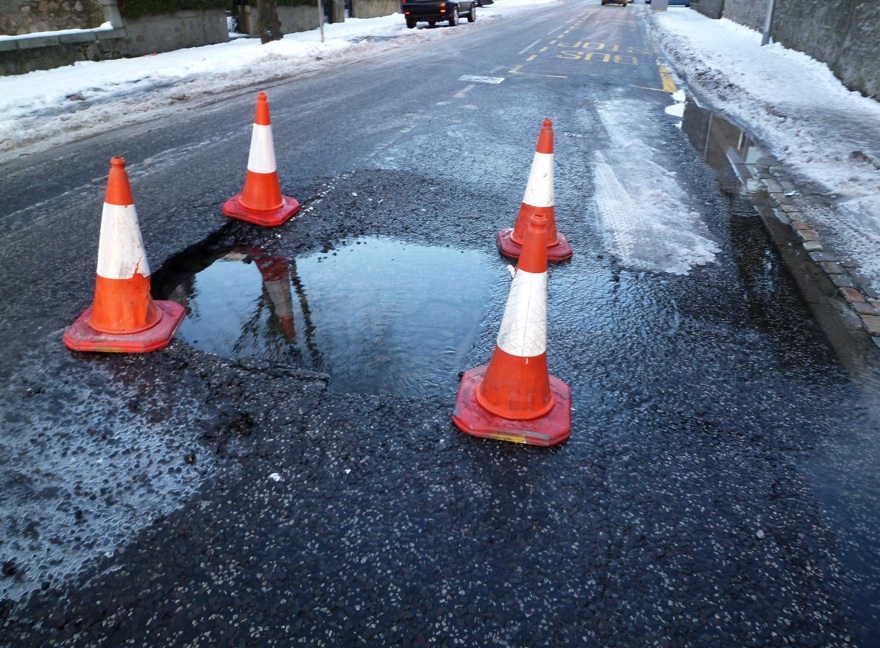
However, the psychogeographical gods were similing on us that day, and as we walked up the south-facing slope that is Pitmuxton, we noticed that Broomhill Road had been disrupted by something bad happening to the carriageway.

It's the Geldie! We did get to see it's water flowing after all!
Yay!
According to the Scottish Water engineers who showed up to try to fix it, the culvert which carries the Geldieburn underneath Broomhill Road close to Salisbury Terrace had collapsed.

By later in the day, the situation had worsened.


By monday, the culvert had been cleared and the Geldie was back in bondage, but the carriageway cannot be repaired until the temperature rises above freezing. A light control has been installed, much to the frustration of the tea-time commuters hurrying home in time for The Simpsons.


And we thought that only cyclists went through red lights!

Thursday, 2 December 2010

R. C. Matthews: Retail Development becomes Retail Wipeout.

For as long as we can remember, this corner-site on the border of Pitmuxton and Ferryhill had been occupied by an off-license. At the far horizon of our recollection it was an Agnews (at which there was always change), then a series of corporate takeovers and re-brandings: firstly Augustus Barnett, then Victoria Wine, then the shop was re-branded as Victoria Wine's downmarket sub-brand Haddows. Now, having succumbed to the loss-leading unfair competition and the monolithic procurement and promotional power of the large megamarkets, another local specialist outlet is lost. Pitmuxton is thus made that little bit poorer.

Click to see a bigger version.
The photos show that a much older signwriter-painted shop sign has been exposed during the shop refit work; "R. C. Matthews." It's fascinating that successive changes to the shop had simply crufted their new signs on top of that pre-existing sign, and it's satisfying (if saddening) to see these layers peeled back one by one in the final unravelling of retail history on this site. The "R. C. Matthews." sign is worthy of comment. It has substance. We can imagine the signwriter's care and art as he created it; his easy skill with brush and mahlstick, his efficiency of line and curve, his pride in a job well done and his worthy position as creator of townscape artifacts - see how the style of signwriting matches (but does not copy) the ceramic tile street-sign immediately above? There was no artifice in this coincidence, no branding strategy or focus-group feedback - it was just the way it was. Thus, the town created itself for the times during the retail period of R. C. Matthews.

Soon, though, the "R. C. Matthews" sign too will be gone, to be replaced by that of a hairdresser or tanning salon, these types of personal services being the predominant business model in this zone of replacement close to the town centre. Specialist retail at a community-based human scale with generations of continuity is replaced by transient services as monopoly power pulls consumer demand towards a handful of hangar-sized car-accessed retail parks only.

This story fits into an extraordinary continuity (or, rather, discontinuity) of retail development and competition. According to my old dad, R. C. Matthews was a licensed grocer which closed shortly after the Holburn Bar moved to it's (then new) purpose-built modernist block - where it remains to this day. Previously the Holburn Bar had occupied the ground floor of the neighbouring tenement block now occupied by a Co-op. Once the bar had moved out, it's former site was immediately occupied by one of the first self-service groceries in Aberdeen - a 1960's supermarket - the protozoic antecedent of today's megamarkets. Of course - with it's slick modernity and promise of convenience, speed, labour-saving efficiency and progress - this usurping business model from the United States soon condemed the old order of counter-service grocery to the past; it's days were numbered. So failed R. C. Matthews and countless other grocers around the country at that time. Now with this - the final end of it's rump; the off-license - having been at last wiped out by the descendants of the first supermarkets, the narrative arc of this story has reached its sad end.

Click for a bigger version
Thanks are due to local artist Mike Crawford for the splendid photos. We like Mike's photographic style; the grit and grime, the grain and gloom. Too often, we reckon, today's constant PR imperative is to always and firstmost indulge in a form of reality-distorting propaganda: to make bad things look good. In business and politics, entertainment and journalism we see this imperative deployed by reflex. That's why we like Mike's shots - they explicitly and expressly resist this temptation. What's wrong with a little gloom? What's wrong with a little woe? Down with Pangloss! Up with Buchstansangur! It's much more realistic.

In this case, we think that the downbeat atmosphere invoked by these photos helps to show us that, indeed, something is being lost here. Something which we may never see return...

Friday, 29 October 2010

Aberdeen's Freemen. And Freewomen. And Freeship?

While writing yesterday's post about the Doupin' Stone and its association with the Burgesses of Aberdeen, our research touched upon Aberdeen's contemporary "Freedom Ceremony" which is descended from the investiture of Burgesses; a ceremony which has its roots in the 12th century.

Whereas once the freemen burgesses were subject to a ritual humiliation hazing ceremony at their initiation, were then required to pay the monarch for their position and were also obliged to take up arms and give their lives if necessary in defense of the burgh; today, those granted the freedom of the city must merely submit to an agreeable lunch at the Music Hall or Beach Ballroom. At which lunch we doubt very much whether the initiates are required to bare their arses for a doupin'. But - hey, who knows? Maybe they are.

There's a page on the Bugesses of Guild website which gives a list of the freemen of the city invested since the 19th Century. Mostly men - but there are some women, a handful of organisations (mostly military) and one ship(!). There are some fascinating highlights, which provide telling insights into the mindsets of the contemporary city worthies who made up the awarding committees. The bestowing of titles is, of course, subject to the fashions of politics, economics and sociology. So we can, to an extent, plot the direction of these concerns in the minds of the city fathers by having a look at the list of those who have received the honour.

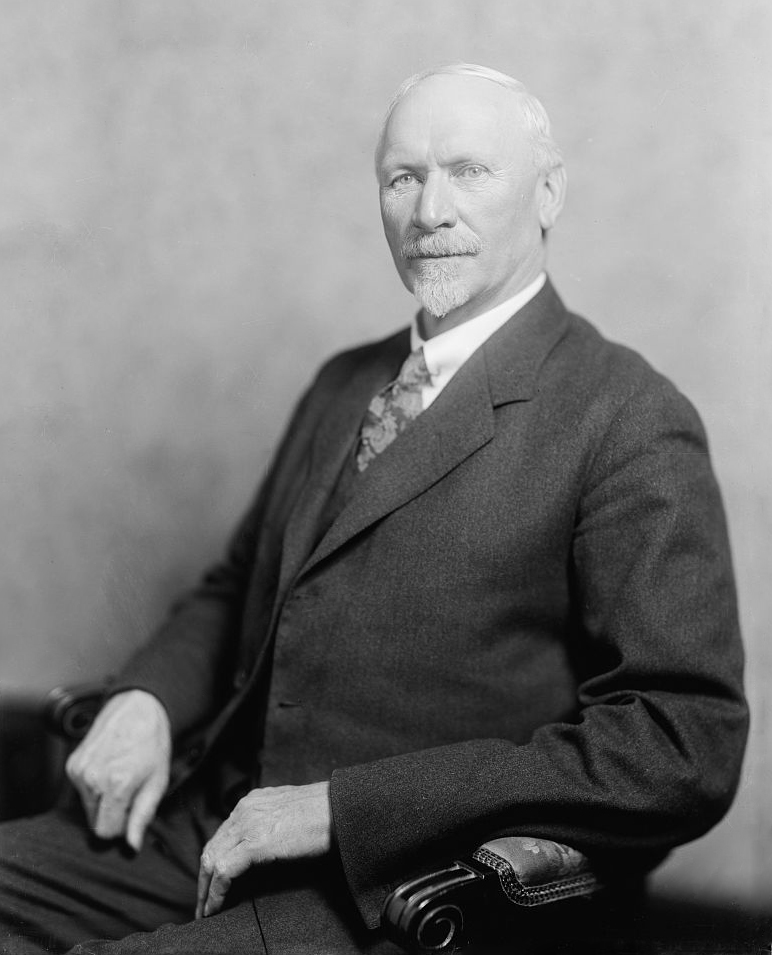
Our eyes were firstly drawn to the racist South African statesmen Jan Smuts; white supremacist and advocate of racial segregation who was invested in 1942. Of black Africans Smuts said: "These children of nature have not the inner toughness and persistence of the European, not those social and moral incentives to progress which have built up European civilization in a comparatively short period."


Smuts


He believed that black Africans were immature or incomplete as human beings, in need of the patronising guidance of white people - like 'special' children or clever pets. This was the white man's burden which he had manfully and heroically volunteered to take upon his shoulders, and for which it appears he was honoured by Aberdeen. Ugh.

In 1984, we attempted to put all that behind us by investing Nelson & Winnie Mandela. Good. Unfortunately, they did not show up for the ceremony. 


The 'Freedom' title in the modern era is, of course, purely honorary and ceremonial; intended to show that the bearer has performed exceptional service to the city and the community. People like Andrew Carnegie, who endowed our Central Library and Thomas Johnston, socialist politician, long-serving chancellor of Aberdeen University and creator of the North of Scotland Hydro Electricity Board - fantastic! Other names to be proud of include John Mallard - who was instrumental in the development of magnetic resonance imaging (MRI) and positron electron tomography (PET) - and Dugald Baird who did much for the health and liberation of women through the advancement of reproductive health, access to family planning services and obstetrics via his position of Regius Professor of Midwifery at the University of Aberdeen. (Though there is a bit of innuendo around Baird with regard to his alleged interest in eugenics.)

But the granting of honours like these can lay bare a cravenness in the awarding body - a forelock-tugging obsequiousness which hopes that a bit of the sheen of the awardee will rub off on the city. An inversion of the concept of bestowing an honor; the process becomes one of seeking the honour of endorsement by a notable figure of the dayFor this reason we see the honour being given to people who have never had anything to do with Aberdeen. People like Nelson Mandela, who we mentioned above, people like Sir Henry Morton Stanley ("Dr Livingstone, I presume") and Mikhail Gorbachev who, as far as we can see, was awarded the freedom of the city simply because he showed up one cold day in 1993. At least he did show up.

In recent years, we've also seen the honour being granted to showbusiness and sporting names; Alex Ferguson, for one. We also note that Buff Hardie, VIP (Very Important Pitmuxtonian) and some friends of his are Freemen of Aberdeen. We very much approve.
Looking Buff
In 1992 HMS Scylla, a Leander-class frigate, was granted the freedom of the city for the services she performed protecting Aberdeen fishery shipping during the Cod Wars with Iceland. Later, Scylla was deliberately sunk to become Europe's first artificial reef.


There she goes.

The awarding of the freedom to this artificial reef shows great foresight on the part of our city fathers, as today's predominant industry will, one day soon, become the world's largest archipelago of artificial reefs. Although this is not UK Oil & Gas' preferred route for the decommissioning of offshore oil and gas infrastructure - it is one which is already well-travelled. The oil-industry buzzword euphemism is 'derogation'.

Derogation in action

Wednesday, 18 August 2010

The Stately Drives of Pitmuxton

Aberdeen is Tycoon Town: if you're not a tycoon already, you will be soon. As everyone knows, tycoons usually live in lovely big houses, with grand, sweeping, tree-lined drives. It's one of the things which makes rich people so very splendid!

1862


Pitmuxton is a part of Aberdeen where once-grand houses bordered the main roads to the west and south, their sweeping, stately tree-lined drives impressing the high status of the estate-owners upon all who had eyes to see. Today, these houses and their drives are largely gone along with the social order which brought them into being.


1867
Gone though the stately drives of Pitmuxton may be, if we look closely, we can see the effect of this old order upon the psychogeographical environment of today:

This is the drive to Broomhill House today.
The house and outbuildings are gone -
replaced by lockups. But the tree-lined drive
remains - more stately than ever.

This is the gate to Newlands House today.
The house remains, but is today surrounded by
1970's flats and bungalows.
Anyway, so much for the past! What about our up-and-coming tycoons of tomorrow?

Well, it's great that planning policies in Aberdeen allow our arriving class of aspirant tycoons to rehearse their tycoon-hood by building themselves pocket simulacra of the once-stately drives of Pitmuxton.

Nice, clean lines. No dirty plants or insects or anything.
We're perplexed that they've chosen to retain the 'garden refuse'
wheelybin. There can be no filthy 'garden refuse'!
Being on the 'wrong' side of Great Western Road as it is, the vast majority of Pitmuxton is subject to none of the pesky requirements imposed upon hard-pressed homeowners by the strictures of so-called "conservation zone" planning policy.


The wheelybins balance the composition
 created by the pot-plants which flank
the front door. The whole picture is completed
by the tarmac crossover which creates a thrilling
'rollercoaster' effect for pedestrians.
The aspirational would-be tycoons of Pitmuxton are free from these petty planning niggles; free, as homeowners should be, to do what they like with their own property. Front gardens are soooooo time consuming anyway, who needs them? Some nimby naysayer meanie greenie extremist moaning minnies complain that converting front gardens to parking space a lovely driveway can be unsightly and restricts informal surveillance. They say that it radically alters the streetscape and has a negative impact on the character of the town. They moan that increased water-run off will overload drainage channels, they whine that the loss of urban green space will impact biodiversity and they bleat that pedestrians are inconvenienced by the creation of uneven pavement crossovers for cars. And lots of other stuff. There's a bunch of all this moaning here: 43 Reasons Not To Pave. Honestly, what a lot of rubbish! We think they're just jealous. Really, can't they afford a nice car?

This driveway is actually pre-fabricated sheets of plastic.
Which conveniently matches the plastic plants at the front door!


We can't understand why everyone doesn't do it. They must be 'bee-lovers' or poor or weirdos or something.

There's room for at least two silver-grey
German cars there for goodness sake!
All those flowers are sure to attract dangerous bees and other filthy wildlife - ugh!
And look at that mess on the floor!
Unfortunately, some of our proto-tycoons who're just starting out on their arc of success are obliged to live in starter-flats, which have no gardens to convert. In order to preserve appearances and not park on the road (people who use on-street parking look poor!) we recommend PaveParking:

How to do full PaveParking in Pitmuxton

Friday, 9 July 2010

March Stones 5 ABD and 6 ABD

There are a total of 67 outer march (boundary) stones, which mark the outer borders of the 'Freedom Lands of Aberdeen'. The Leopard Mag has an excellent article on the histobunk aspects of the now-you-see-it, now-you-don't real estate shenanegans involved in Aberdeen's acquisition of and disbursements to and from these assests. Worth reading. The inner march stones are a different matter - more on this later...

Anyway, outer marches: All but two of the outer march stones are situated in public places, often hidden in plain view in busy spots around the city. The two stones which are not in public places are stones 5 ABD and 6 ABD.

Stone 5 is in Pitmuxton, in someone's garden. For the sake of their privacy, we'll not say where.


Stone 6 is in Mannofield. Again, in someone's garden, so for the sake of their privacy, we'll not say where. However, the stone can be glimpsed if you peer through a fence.


One day recently, we were cycling past, and both he and she householders were working in the garden. A charming couple, they were delighted to chat about the stones - they were very knowledgeable. He beetled off into the house and emerged keen to show us their copy of the very rare and sought after 1929 trainspotter's guide psychogeographical field notes The Freedom Lands and Marches of Aberdeen, 1319-1929 by Cruickshank and Gunn. The book, apparently, came with the house.

They were happy to let us into their garden to photolog the stone properly:


An 'intermediate stone' can be seen behind the 19th century marker. We're not entirely sure what is meant by 'intermediate' - it suggests that this stone was in place between the time of the original saucer-marked stones of the 14th century and the later (mostly 19th c.) stones we see today - - we'll need to do a bit more more research.

Wednesday, 7 July 2010

Pitmuxton, you say?

Where's that?

Well, I live there. Between Mannofield and The Duthie Park. Some say indistinctly that this is 'the Broomhill area' (note: 'Broomhill area', rather than just plain 'Broomhill'). Some say 'Holburn'. I've heard 'South Ashley', I've even heard folk try to assert that they live in Ferryhill (though this was probably about property boosterism) and the council wants us to say 'Ruthrieston'. No-one's ever heard of Pitmuxton, it seems. Why not?

It's a good question, and one which goes to the very heart of Aberdeen and the character of the city and its people. Be it Royalists vs. Covenanters or Jacobites vs. Hannovarians or Pasteurella pestis vs. the human immune system - accident, stupidity, betrayal and fear have many times put Aberdeen on the losing side. Or, venality and vainglory have thrown away our honour for us and put us on the morally questionable side.

Too often, stuff has 'happened' to Aberdeen, and for shame we hide the memory of it away from ourselves. For centuries, sometimes. For instance, Aberdeen now shows no official commemoration of the blood-curdlingly shocking atrocities we were subjected to during the Civil War, because of a stupid accident and misunderstanding at Justice Mills. Is this revisionism intentional? Or merely ignorant? See here. More on this later.

Much the same is true of the 'forgotten' Lands of Pitmuxton. The devastating effect that one resident of Pitmuxton had on Aberdeen cannot be overstated. It has been the intention of the city and its burghers to erase the name and lands of Pitmuxton from history ever since.

Tucked away in a corner of 'Ruthrieston' Outdoor Centre we find this stone and commemorative plaque.


The plaque reads:

On this site stood Pitmuckston House, Demolished in 1908.

In 1309 Pitmuckston was granted by Robert the Bruce to Hugo of Aberdeen, carrying with it the Royal Office of Mayor of Fee, Collector of the Kings Revenues.
This plaque commemorates the site of Pitmuxton House. The lands of Pitmuxton were granted by Robert the Bruce to Hugo of Aberdeen in 1309: with this grant Hugo became H. M. Collector of Taxes, or Mair of Fee. The lands passed eventually to a branch of the Skene family. It was during their residence that the house was probably erected. The house and lands passed to the Allan family after 1770. It may have been during their ownership that the name of the area was changed from Pitmuxton to Pitstruan. The house was demolished in 1908.

James Gordon's map of 1661 shows "Pitimukstoun" as a fairly extensive settlement and estate with its own mill (oooh, prosperity) straddling a burn (probably the Geldie) in an area between 'Ruddristoun' and 'Ferrihill', which it dwarfs.


Yet, by 1828, John Wood's map shows no sign of the lands of Pitmuxton.


Keith & Gibb in 1862 show Pitmuxton House, with no reference to any estate, and with other, new names, such as 'South Mile End' and 'Outseats' in the very area which was once the centre of the Pitmuxton settlement. The estates of Broomhill House, Newlands, Ashley and the growing settlement of Ruthriston all nibble away towards the garden walls.

So what happened?

In 1647, a visitation of the plague killed up to 2000 people in Aberdeen; that's fully one quarter of the population at the time! Ulp. Rightly or wrongly, a resident of Pitmuxton was fingered as the 'Typhoid Mary'. The process of back-turning began.
In 1668, the Skene family of Ruthrieston acquired the lands of Pitmuxton and this process gathered pace.

In 1770, George Allan bought the house and the tree-lined drive was renamed Allan Street. The Allan family changed the name of the house to 'Pitstruan' (meaning 'place of the stream').

In 1908 the house burned down. It was not re-built. Municipal bowling greens and tennis courts today occupy the gardens. And the erasure of Pitmuxton is complete.

How can we hope to face the future and its difficult challenges and transitions, when we willfully hide the past from ourselves? When we are in denial, when we do not allow ourselves histo-psychogeographical closure?

Too many times in the past, our town has been put to the torch and its people put in the grave. Sometimes the bloody-minded intransigence of the burghers has been to blame, other times betrayal, contagion, greed, misunderstanding or cruel accident has set in train a catastrophic chain of events which led to disaster.

Today, while we don't face the sword or the torch, we do face bankruptcy and blight. We should face the future with our eyes open, ready to learn from the mistakes which we are bound to make.

That's what this blog's for.

So yes, I live in Pitmuxton.

Monday, 5 July 2010

Ferryhill Versus Pitmuxton - no contest!

As a psychogeographer, I'm often asked the intriguing and perennial question: "So, which is best then: Ferryhill or Pitmuxton?"

On the surface, it's a difficult question to answer, and one which needs careful analysis and comparison in various categories. The two neighbourhoods (once parishes, previously strongman-warlord estates) have been at loggerheads since the 14th century at least, probably longer! It goes much deeper than a simple fecht between Ferryhill and Broomhill Pitmuxton primary kids. Let's see if here and now, we can put the long-standing argument to rest.

RECREATION

Ferryhill has it's historic "The"(?) Duthie Park. Very nice we're sure. But we all know the truth is that the park has seen better days; it's quite run-down, and is in need of a bit of TLC, if not a comprehensive 're-vamp'. Let's hope that Lotto money comes through really soon!

Ewww - nasty.

Pitmuxton, on the other hand, has The Woodies, which is not run down. (Because it has no facilities which could become run down!) Moreover, The Woodies has secure car parking available, to lease. Beat that, Duthie Park!

Nice, clean signage. And an enigmatic grey box.

Lockups for lease! In The Woodies!

Ferryhill has its Albury Outdoor Centre, with it's tennis courts, bowling greens and far-too-difficult putting assault course. Nothing we don't have at the Ruthrieston Pitmuxton Outdoor Centre. But, our putting green is actually do-able and, more importantly, we DON'T have a children's play-park attached. Who wants to have that all that screaching and screaming going on when your trying to sink the winning putt on the 18th? No, no, in Pitmuxton, we put the brats where they should be - inside, at the soft-play in the Ceramic Place. Yes, inside, where they belong, out of harm's way, and well out of the way of weirdos with cameras. While they're in there, their YummyMummies can practice their PaveParking.


VIP's

It is said that parochial architect Ertchie 'Pech' Simpson stayed in Ferryhill for a while, and we're sure that there was once some Arctic explorer lived on South Crown Street. At some point.

But... and he's got it's a really big but... Buff Hardie stays round the corner from us to This Very Day!!!

CATERING

Hungry visitors to Ferryhill have to check their pockets for all their available cash and call their bankers to check available credit when hoping to eat at the, frankly overrated, overpriced and past its best Inn at the Park. (We've not been in Ferryhill House for years - we didn't 'fit in' after the re-furb in the '90's).

There are no such budget worries at Pitmuxton's famous Abergeldie Bar! The franchise-menu "Hasty Tasty Snacks in a Hurry" is suitable for all palates, and all pockets! The Abergeldie is one of the oldest hostelries in the country, with decor, and service to match - we stand for tradition in Pitmuxton! Stay late for kara-oke and (unlicenced) dancing/boxing! Pitmuxton also boasts the "cliquey" Clubhouse hotel, for that exclusive "outsiders not welcome" feel. We've never been in The Short Mile (funny name) - too scared. And, before you start, The Holburn is in Couperstone. FFS.

THE BUILT ENVIRONMENT

Ferryhill is rightly considered to be one of the 'nicest' 19th Century suburbs in Scotland; it's fine avenues and stately terraces are famed throughout the country. Ferryhill boasts the grade 'B' listed Marine Terrace, which is Georgian.

Georgian sobriety and niceties are all very well, but we prefer the grandiloquent Victorian bluster of our own conservation area in Pitmuxton at Great Western Road, which is used by Royalty and other important folk when they leave Aberdeen under fast police escort. Let's just hope that the property downturn ends soon, so that we can see some top-notch conservation in this important area!


Failing that, there's plenty spare brown-field land available to aspiring developers with the right project. Pitmuxton is the place in Aberdeen for property-opportunity!


CONCLUSION

So, on balance, we're afraid to say that poor over-rated Ferryhill is comprehensively beaten in all categories by fabulous Pitmuxton.

Better luck next century, Ferryhill!

Pitmuxton - "Fit a rare place tae bide!"