Showing posts with label city centre. Show all posts

Wednesday, 22 February 2012

Ferryhill Orbital Dérive


1. Holburn Junction

8.45 am at Holburn Junction, and the commuters in their motorcars stretch as far as perspective allows, gridlocked at the nexus-choice split-the-wind - Highland or Deeside? All the way from the Y-shaped fork junction to the right-turn to Royal Deeside at Great Western Road, the carriageway is bumper-bound stuck-still jammed with metal machines. One each to their cars - behind their windscreens, strapped to their chairs - the grim-faced commuters look as if they have just been bereaved, or have suffered some other form of intolerable injustice. But the pavements are empty and I am nearly alone as I walk towards the town centre. There is an unaccustomed hush; the usual speeding noise of the motorcars is temporarily stilled by the gridlock, the purring susurration of the idling engines is all I can hear. I feel like I am the last human being in a world of mechanisms.


Now I'm closer to the junction itself, and I can see the cause of the traffic jam. A bus-lane parker flashes his hazard lights (why?) as he just pops for a minute to an ATM or something, and in doing so renders the whole half-mile of bus lane worthless. A near-empty bus lurches out from the lane to pass the parked car, insisting its way into the stream of private motorists who do not want, oh they so do not want, to let it out. Staring straight ahead, they psychologically blank out the bus, trying to inch forward and deny it roadspace. The motor-bound expressions of the car-commuters change; the customary displays of glum ennui mutating to intolerant masks of fuming rage, indignant. Compounding their anger, the phasing of the Holburn Junction traffic lights has been changed since last I walked this way - it's a high frequency short phase now. Perhaps this is part of a traffic-management policy to discourage motorists from driving into the heart of the town centre, I don't know. One thing I do know - one thing which is plain to see - is that it has had effect on the driving style of the motorists as they approach accelerating towards the junction (not slowing down, as they should) and crashing on through the light controlled junction at amber, then red; two, three, five vehicles through at red, dropping a gear and flooring it, roaring over the junction as the pedestrian's green man shines out across the junction, beep-beep-beeping to no-one but me. It used to be that the green man meant it was safe to cross - but not now, not in this town. So the short-phasing of the traffic lights has had an effect on my behaviour too, because now I have to cross warily and looking and listening all around, as if there were no green-man pedestrian phase at all. 


Keen to study the habits of the commuting motorists, I go into the Starbucks coffee shop which has a picture window panorama of the junction. Sipping away on my americano, the repetitive spectacle of the red-light-jumpers soon pales. This town has an intractable traffic problem, along with the attendant externalities of pollution, dirt, noise, dust, ill-health and on and on. The traffic problem persists despite strategically placed park-and-ride facilities on the periphery of the town (the extensive carparks and shuttle buses remain stubbornly empty), despite high fuel prices ("high oil prices are GOOD for Aberdeen"), despite a "cycling action plan" and despite the new urbanism which is sweeping the developed world's towns, recognising that town centres are places for people, not machines. Despite all these things, traffic volumes in Aberdeen continue to rise; 20% up in the last 3 years, apparently. It starts to snow outside.

I go up to the counter and select a panini-thing. The twenty-something girl barista has an American accent and an over-pleasant, so-familiar-it's-nearly-flirtatious manner. But something in her eyes tells me it's from a script which she repeats over and over and over through her shift. She sing-song-says she'll bring my sandwich over once she's toasted it. I go back to my seat in the window and start to leaf through a magazine. I can't concentrate and my attention wanders. I scan the coffeeshop and its patrons. The place and the people remind me of something, but I can't quite put my finger on it. Not quite deja-vu - more a similarity of category. It eludes me. 

Several suited and booted young salesey types, (I'll bet it says "Sales Executive" on their business cards). Sitting each one alone, one by one they lever open their laptops and check their e-mail. And there elderly couple conversing animatedly in sign-language appear to have come in just to get out of the snow, which has now turned into a pathetically damp sleet. Another anodyne group of be-suited folk arrive and settle in for what, amazingly, appears to be a full-blown meeting - something in their manner, their clothing, their pens and pads, makes me think they're lawyers or accountants or surveyors or suchlike. The most junior of them is taking minutes and making sure that everyone got the coffee they wanted. I notice that the deaf couple haven't bought anything, and they're sitting propped on the arms of sofas near the front of the cafe. Their BSL discussion becomes more and more animated - they're silently arguing. Not wanting to intrude on private grief, I look away. A squat casually-dressed woman with scaped-back hair; she's wearing trainers and has both a small rucksack and a big holdall. She holds her mug in one fist and pours over a thick soft old novel which she keeps open with a beefy forearm. A tall slender middle-aged man in active-looking beige clothing (he looks like a geography teacher - the sort who takes his guitar on field-trips) guddles in his tote-bag and confounds my preconceptions by fishing out a copy of The Sun tabloid. By now, the deaf couple have reached an impasse in their squabble and they sit, not looking at each other, arms crossed, chins jutted, brows knitted.

My sandwich arrives, and I notice that the sleet has stopped. Aching-blue between the parting clouds, the sky shoots a barrage of winter-low golden sunlight to glance off the slick wet tarmac and paving stones, up into my face. Blue sky and golden light in our february-grey town - a delight. Wish I'd brought my sunglasses. And with that thought I recognise what the place reminded me of - it's an airport departure lounge, it's a hotel foyer, it's a nowhere un-destination - where we go while we're waiting to go somewhere else. When we want to go somewhere else.


Monday, 13 February 2012

Under

Growing up in Aberdeen, the young mind can't help but be fascinated by the under-ground (or rather, under-road) aspects of the town. Beneath large parts of Union Street, Bridge Street, The Castlegate, Market Street, Holburn Street, Bon-Accord Street and, of course, Rosemount Viaduct exist vaulted caverns which shoulder the carriageway above. The vaults beneath the Holburn and Bon Accord viaducts provide coal-cellars for the tenements which flank the structures; coal-chute covers sometimes still visible embedded in granite flagstones, anomalous amongst the concrete pavingstones. And I can especially remember being in a store-room/workshop beneath Union Street at some point during the mid-1970's. I can't remember for sure why I was there, something to do with a TV repair, but I do specifically remember the shop proprietor making great play of the fact that we were under the road. The shop premises was an electrical retailer (a local enterprise called "Alexanders") in the unit now occupied by that Anne Summers low-rent lingerie outlet. On Bridge Street, there was a sports goods shop (I can't remember the name) which had premises on both sides of the road, linked through the vault under the road. I remember a very narrow steep boxy staircase. One-at-a-time please.

A while ago, we touched on the subject a little:

>>>>>> 
Viaducts like these exist all over Europe in formerly hilly town centres with which the Victorians had their vainglorious way. Notably Edinburgh has its many viaducts and bridges with vaulted caverns below, and those vaults are put to work as entertainment venues, pop-up pubs, knocking shops, ghost-tour backdrops, etc.  Similarly, London's Oxford street is, in part, raised above the former natural topography. In parts, entire pre-Victorian streetscapes are preserved below vaults, notably the Georgian shopping street which has been preserved almost in its entirety below the Selfridges department store. We understand that this living psychogeographical fossil (for what else can we call it?) has been from time to time used as a film-set. Back home, we have heard claims of secret access, of strange artifacts and of old cottages and the like existing below the vaulted stonework of Aberdeen's viaducts, but we treat these claims with scepticism. We know that, notwithstanding the odd restaurant and nightclub, the vaults of Aberdeen are most commonly used as underground carparks, and commercial storage. However, we would love to learn of more exotic uses, of secrets forgotten, of stories waiting to be told. We would so love be proven wrong. 
<<<<<<

I was passing the door to the vaults beneath Market Street one day last week. By being on foot and keeping eyes open, you can increase your chances of being in the right place at the right time. A new air extraction system was being installed in the vaults, I chatted a bit to the HVAC guys, and they let me in...


Friday, 10 February 2012

Sunday, 22 January 2012

Unacceptably Intrusive Covert Surveillance

In the UK, it's a regrettable fact that we're used to being visually surveilled by closed circuit TV at all times and everywhere in public town-centre spaces - either by civic authorities when in public realm space, or by private security contractors when in commercially-operated space. Very often that commercially-operated urban space gives every appearance of being public realm space; a good example being the plaza on the top deck of Aberdeen's St Nicholas shopping centre, which connects pedestrian access between St Nicholas Street, the historic St Nicholas churchyard and Schoolhill/Upperkirkgate. It looks very much like public space, it provides a vital pedestrian access thoroughfare in the heart of the town and it just feels like a public realm space. But it isn't; it belongs to and is operated by Land Securities plc (LandSec, as they are known to insiders, is the UK's largest commercial property developer). Similarly, the border between public realm space and commercially-operated space is often ill-defined and it's difficult for the casual pedestrian to discern at what point his or her rights of way and freedom of assembly have been extinguished in favour of commercial exigencies. One of the most striking examples of this phenomenon in Aberdeen is the interface between the Rail Station and the Union Square shopping centre. The developers of the site have designed the commercial 'offering' (as they say) around pre-existing desire lines so that it's not easy for someone arriving by train in Aberdeen to find his or her way into public realm space without first passing through space which is part of the Union Square commercial venture and as so is operated by a private company.

Anyone who doubts that we have a good reason to be concerned about this; anyone who's prepared to trot out the old "if you've nothing to hide then you've nothing to fear" excuse for kowtowing to those who would surveil us at every possible opportunity should read this, and this, and this, and this. Oh, and this and this.

While we have serious concerns about the normalisation of blanket surveillance in urban space (at the risk of sounding starry-eyed naive) we at least preserve a hope that civil authorities do what they do in service of the greater good, on behalf of us all and answerable to our elected representatives. By contrast, surveillance undertaken by private security firms on behalf of the commercial operators of privately-owned urban space do so only in the service of profit, enhanced shareholder value (as they say). Still, though, at least we get warning of such surveillance - CCTV operators are obliged by law to display signs letting us all know that an area is covered by surveillance. These signs are indeed visible (adding ever more to streetfurniture clutter) in both town centre public and private realm spaces.

But now news reaches us via The Scotsman newspaper of an insidious new form of surveillance being 'rolled out' (as they say) across the shopping centres of Aberdeen.

Movements of shoppers tracked by 1984 phone technology
>>>>>>> 
...unsuspecting shoppers who enter a shopping centre are now often tracked on a screen by retail staff – using their mobile phone signals to locate their path through the shops. 
Many Scottish centres are using the technology – which has been adopted by property giant Land Securities, which owns a large number of major shopping centres and has installed the tracking devices in ten of them – as well as rival Hammerson, which operates the technology at the Silverburn shopping centre in Glasgow and plans to install at its Union Square development in Aberdeen this year. 
The Buchanan Galleries in Glasgow, the Bon Accord and St Nicholas shopping centres in Aberdeen and Livingston’s The Centre are also among those north of the Border using FootPath, created by Path Intelligence, which is behind a range of technology to help shopping centre bosses plan their layouts. 
Path Intelligence chief executive Sharon Biggar refused to admit whether the technology was even in use in Scotland for “data protection” reasons – although she did acknowledge that it was utilised in centres in the UK and six other countries around the world.“We are not allowed to reveal the names of any of our clients because of data protection laws,” she told The Scotsman. However, while the company fiercely protects its paying clients, it does not give shoppers the same privacy. 
The refusal to list where this technology is in use means that shoppers are unaware that they are being tracked – unless they spot the small signs alerting them to the practice. However, even if they do see the signs, there is no option for them to opt out of the scheme without turning off their mobile phones. 
<<<<<<< 
To which we'd add that the great majority of today's mobile phone handsets cannot be fully powered down without removing the battery, and so your phone will respond to a tracking ping even if you might think you've turned it off. 

This same Ms Biggar, of Path Intellegence, manufacturers of the intrusive surveillance technology, is also quoted in the Aberdeen Citizen freesheet ("BEST [sic] free newspaper in Scotland"):
"We are very open with the public. We ask our clients to have signage up where the system is operating. The signs are exactly the same as the ones for CCTV"
Yet, when we pass through Bon Accord and St Nicholas shopping centres, while we can see the signs which warn us of CCTV surveillance, we see no signs whatsoever warning us that we are to be subjected to this new form of distasteful electronic-tracking intrusion. The only indication of this novel and intimidating privacy-busting technology you get is if you manage to spot the sensors themselves. Here's one, it's about the size of a hardback book:


See if you can spot them next time you visit the Bon Accord and St Nicholas shopping centres! 

FootPath Technology 

>>>>>>> 
The Path Intelligence FootPath system consists of a small number of discreet monitoring units installed throughout the centre. These units calculate the movement of consumers without requiring the shopper to wear or carry any special equipment. The units measure signals from the consumers' mobile phones using unique technology that can locate a consumer's position to within a few metres. These units feed this data (24 hours a day 7 days a week) to a processing centre, where the data is audited and sophisticated statistical analysis is applied to create continuously updated information on the flow of shoppers throughout the centre. At any time the shopping centre management can access the data via PI's secure web-based reporting system.
The FootPath technology is the only system available on the market today that can gather information on shopper paths continuously and accurately. FootPath can be installed in one centre or across a portfolio, providing you with quantifiable information to help you monitor your centre and assess the impact of your business decisions.
[our emphasis]
<<<<<<< 
Interesting to note that the system is not closed; that is to say that it is not an discreet network within only the building it serves. Rather, the data that the system gathers is transmitted to a Path Intelligence central processing facility. (Who knows where? Most probably this function is itself outsourced to an offshore number crunching data centre.) The data, once analysed, is then distributed via the internet back to the subscriber. We cannot know whether this is local Bon Accord or St Nicholas centre management, or some central management facility of Land Securities plc. In any case, it's not just the shopping centre security contractor, nor the shopping centre management or owners who have access to information about your movements, the providers of the tracking technology also gather that data. We have to ask ourselves how we feel about this. Did you like the bit where they said that shoppers are "not required to wear or carry special equipment"? We suppose we should, at least, be thankful for that!

It is telling that, even as the operators of our shopping centres fail to notify us of the fact that this intrusive surveillance is taking place, the providers of the tracking technology make capital of the fact that the monitoring units are discreet. Why, unless they fear a backlash of public disgust and outrage, would the unobtrusive physical footprint of the tracking units be regarded as one of the benefits - the unique selling points (as they say) of this highly intrusive development in our cities? It's as if they're trying to keep their data-gathering activities as covert as possible.

Someone should tell them - if they've nothing to hide, then they've nothing to fear.


Friday, 20 January 2012

Union Terrace Gardens or City Gardens Project - A Final Thought or Two Before You Decide

OK, there's so much in the media about the ongoing controversy surrounding oil-tycoon Sir Ian Wood's vision of comprehensively redeveloping Union Terrace Gardens and imposing a new building on precious, protected green space in the heart of Aberdeen that there's not much for us to add other than to tie up a few loose ends.

If you live in Aberdeen, you'll know well that you're about to be asked to take part in a postal referendum which will determine the future of our only town-centre park. The choice will be to retain the park - Union Terrace Gardens - or endorse carbon-mogul Sir Ian Wood's City Garden Project (the real-estate boosters of the project used to call it the "City Square Project", but that name didn't play too well in focus groups). If the people of Aberdeen choose destruction of the existing park, the park will be comprehensively redeveloped, and the valley it currently occupies (much like a small-scale version of Edinburgh's Princes Street Gardens) filled with a new building which has become known as "The Granite Web". This new building appears to be a catwalk-bedecked semi-outdoor concert venue and shopping mall. We used to say "shopping centre". Do you remember when we used to say "shopping scheme"?

Existing - Union Terrace Gardens

Proposed - The Granite Web
Anyway, there's little we can add to the overwhelming dissent, disgust and indignation which characterises the discourse about the comprehensive redevelopment proposals in new media outlets and social media forums, so we present some samples here:
///
STV Local
>>>>>>>>>>
[Aberdeen] Youth Council’s official view [is] that the City Gardens Project is an environmental, social and financial gamble.
<<<<<<<<<<<
Blouin Artinfo
>>>>>>>>>>
It’s a fabled and oft-pursued “Bilbao Effect,” or in this case, High Line effect, that we strongly caution against. Recent failures to create this coveted tourist-draw include Oscar Niemeyer’s shuttered cultural center in Spain, and Rafael Viñoly’s critically pummeled “Golden Banana” in Colchester, England.
<<<<<<<<<<<

Lena the Hyena
>>>>>>>>>>

Aberdeen did have a park in its centre. It does have a park; Victorian gardens. And it is reasonable to see why someone with disposable income measured in millions might want to influence improvements to the centre of his home town (although that in itself calls into question the morality of influencing policy just because you have more money than most) but the motives behind the proposal have shifted since it was first envisaged. [...] Suffice to say that by creating a piazza (and that was the term in use at the beginning of this whole UTG episode) the city would attract business is specious. I don’t for a moment imagine that Mr Wood ever moved his business into anywhere because of the look of the place, whether or not it had a piazza, but because of the economic returns his company hoped to bank.
<<<<<<<<<<<

Moved to Comment

>>>>>>>>>>


Sterile, stale and uninspiring are just three of the words that have been used to describe the scheme – a cross between Tellytubby land and a ’70s skatepark with myriad opportunities for graffiti artists and multiple jumping off points for the suicidal. Contempt for heritage is shown by the fact that the historical features of the gardens are wiped away with the distinctive (and listed) granite balustrades going the same way as the mature trees.
<<<<<<<<<<<
We would also recommend the incisive commentary, spread out over many many posts, on the wonderful Blerr de Blerr Blerr blog from videographer of Aberdeen, Fraser Denholm

And we too have covered some aspects of our own objections to the proposed comprehensive development:
///

>>>>>>>>>>
... our personal greatest vexation with this proposed redevelopment was the way than an opportunity to anchor a progressive arts and creative sector in Aberdeen was so thoughtlessly as to appear maliciously squandered. The City Square proposals caused the collapse of the Peacock Visual Arts Northern Light initiative which would have created a new contemporary arts centre for Aberdeen and the north of Scotland.
<<<<<<<<<<<


>>>>>>>>>>
We are concerned that ACSEF's [local business-interest quango/lobbying group, boosters of the project] top-down agenda to impose one single expensive solution to what they perceive to be Aberdeen's town centre problems runs the risk of putting all our civic eggs in one heavily-indebted basket.
<<<<<<<<<<<

///
To all of which, let us add the reminder that this proposed comprehensive redevelopment and building project is on common-good land (pdf) - sometimes referred to as "burgh commons" - as established by land rights campaigner Andy Wightman in his 2011 paper Union Terrace Gardens - Historic and Legal Status (pdf). This is land which is owned exclusively by no-one and generally by everyone, and which is held by the town authorities in trust for the people of Aberdeen.  The Wikipedia entry for "burgh commons" states: "By the early 19th century, most burgh commons had been appropriated by the wealthy landowners who dominated burgh councils, and very few have survived." At the risk of appearing churlish, should we applaud the fact that the affluent capitalists of Aberdeen are at last making this effort to catch up?

"BON ACCORD CENTRE
Permission granted for entry
No public right of way constituted"
In all seriousness, though, this proposed development is of course an attempt by business interests to privatise public-realm space for profit. Or "adding shareholder value" as they tend to say - why use one straightforward word when you can use three obfuscations? Should the development go ahead, we will be able to visit these "gardens" only by the grace of the private sector owners and/or operators of the new building. Experience confirms that those private-sector operators will impose arbitrary restrictions on behaviour and appearance, and will undertake intrusive surveillance on all passing through. Indeed, our town has form in allowing the private sector to extinguish public rights. Where once a public right-of-way south from George Street continued all the way south to join with Market Street via St Nicholas Street, today a huge real-estate company called "Land Securities plc" grant permission for pedestrian access through their Bon Accord and St Nicholas Centre shopping malls only under the condition that no public right of way is (re)established. Where once we had a right of free access and passage, association and discourse, now all we have is consumer choice, that choice itself from a diminishing handful of shargar shoppies. 

When old-media outlets, such as our local press, provide a forum for the boosters of this project which would build commercial and retail premises on the site of of our only town-centre park, they inevitably invoke a loathsome and cringing insecurity, a needy aspiration to "attract" businesses and businesspeople to the town and a perceived necessity to make the town an "attractive prospect for future mobile investment". Over the last two years, ever since emission-monger Sir Ian Wood first caused the collapse of the proposed Northern Lights arts centre, which would have created a home for local creative forum Peacock Visual Arts in Union Terrace Gardens, we have had many misgivings about what comprehensive redevelopment of the gardens would mean - we have always had the feeling that the wool was being pulled over our eyes, and not in the obvious way. But it is only today, only now that the people of Aberdeen (despite already once having said "no" to carbon-magnate Sir Ian's vision) approach the final zero-hour decision time that we can put our finger on one source of these misgivings. The City Garden Project, as proposed by CO2 baron Sir Ian Wood, is not for the people of Aberdeen. It's for the much more important people who aren't here yet. It's not for the likes of you and us - we don't count, we only live here already. We are the pre-existingly inconvenient legacy community.

We therefore urge you, if you have a vote, to reject the proposed destruction of the town centre garden in favour of business profits (sorry - enhanced shareholder value). The moneymen of this town, with emission-monger Sir Ian Wood at their head, have made the mistake of believing that a town is nothing more than the sum total of all the business activity which takes place within its borders, and so they then go on to compound their error by thinking that the town should be run like a business. We at OtherAberdeen know that the truth is much much broader than that pencilneck narrow vision promoted by pollution-king Sir Ian, ACSEF and our town council. Towns and cities are communities - places for people, places for association and interchange of all kinds, not just commerce. Show them that you know this too. Vote to Retain Union Terrace Gardens.


Thursday, 22 December 2011

Have a Very Alcohol-mediated, Consumerist, Motorcentric, Advertising-driven and Illiterate, Xmas in Aberdeen!

I went to the barber. We like barbers, and we like the fact that there's a resurgence in their numbers on the streets of Aberdeen. Used to be, before the long boom, that there were lots of barbershops. Bastions of exclusive masculinity they were, where stoic-faced men and boys would sit or stand queuing around the edge of a smallish room, waiting in companionable silence or low-tone discussion for their turn on the barber's chair - impressively sturdy yet mildly frightening-looking in its functionality, sharing as it does a common ancestor with the dentist's chair. Ranged round the room - stonily staring either into the middle distance or at the chequerboard linoleum floor we would be; men together at one with the laminarity of our own smooth thoughts in that masculine mindscape which may flourish in quiet, understated and conducive spaces like the barbershop. Places like that are where best the masculine mindscape can range wide and smooth - idea upon idea distilling and concentrating, concatenating and ramifying; creative patterns merge and blossom - for it requires just that sort of continuous unity of environment and encounter for its best experience and function. The only sounds in the barbershop the whispered, measured tones of sober discussion, the hum of the electric clippers and the snick-snip of the finishing scissors, then a whispered "...and something for the weekend? Sir?" and the man currently being groomed was brushed down. He'd stand up, pay - and then it'd be your turn for the buzz-cut. No crap, no smalltalk, no faffing about, no feminisingly fragrant and functionally extraneous trichological 'product' - just an effing haircut, done expertly, quickly and cheaply by a grown man who you could trust had done exactly that same thing a million times before. You could have faith that in ten minutes flat he'd have you'd stepping out of the chair with your hair looking exactly like that of the NASA test-pilot you expected it to. What could possibly go wrong with such a simple activity, so quiet and uncomplicated a space, so straightforward a commercial relationship? 

When the long boom came, the barbershops one by one began to disappear - we thought it was natural wastage - the old barbers retired and their premises became unisex salons. Full of 'lifestyle' magazines, conditioner/gel/mousse/whatever 'product' (to be sold on commission), pop music videos, and late-teenage girls who would charge a small fortune for taking up to an hour to make a frankly bad job of cutting your hair. Sometimes these places would have aquaria. But, worst of all - oh by far worst of all - the smalltalk; the juddering discontinuity of arbitrary inconsequential crapchat, destroying the unity of the masculine mindscape. 

Now that the long boom is at an end, and the politicians and commentariat begin to  think about ways to try and tell the electorate that a return to economic growth may not actually be feasible, it's an ill wind that blows nobody any good and barbershops are returning to the urban scene in Aberdeen - we daresay it's the same story all over the country.

So, more or less on a whim, I walked into one of Holburn Street's growing number (seven at the most recent count) of barbershops which have recently begun to typify parts of the town-centre. All appeared as it should have been: chequerboard linoleum flooring; fuss-free interior; traditional-looking barber's chairs; no branded hair 'product'; a small queue of men with reassuringly blank looks. All correct. I expected that I shared a common frame of reference with barber and clientele alike. But I was wrong.

Regular readers will know that we at Other,Aberdeen believe that - rather than the ticket-price or up-to-datedness of gewgaw possessions; rather than the external veneer of mere ostentation; and rather than an overdraft of ersatz happiness from the bank of Boozy Britain, the key to well-being is to be sought in the beauty of our surroundings, the quality of our culture, the strength of our relationships and the sustainability of our activities. So I was disappointed to to be subjected to the smalltalk of the barber who first asked me what sort of car I drive. (Living in the town centre, it's not necessary for me to own a car, so I do not.) That smalltalk opening gambit having failed, the barber then asked whether I would be out drinking that night. (I do not drink.) 
"What! Not even at Christmas?" 
< No. > 
"Are you not even going to take a drink on Christmas Day?" 
< No. I don't use it. > 
Eyebrows raised, and head shaking, the barber blew a breath out from between pursed lips: "Pffft".

Next I was asked what I expected to "get" for Christmas (I was not asked what I would be giving). And then, once my hair was cut and I had paid, I was handed a little seasonal promotional 'gift'; a barbershop-branded beer-bottle opener: "In case you change your mind and decide to have a wee cheeky beer or two over the festive season". The fact that I do not use alcohol simply could not, would not, fit into the barber's world view, especially at Christmas! 

Walking back home, I reflected on how misunderstood the straightforward desire for simplicity can be. At this time of year especially, and with the western world's economies undergoing the convulsions of phase change to a low- or no-growth future - we hope that simple, unmediated pleasures, unfreighted with commercial content and free from reliance upon fragile critical dependency networks become valued once again. I quickened my step, eager for the simple pleasures of hearth and home on that winter day. The day's consignment of Christmas cards awaited me in the vestibule. Among them, this gem:


Where to start with this copyright busting, advertising-subsumed, commercially complicit piece of seasonal "cheer", parasitising as it does upon the mass-culture iconography which has developed around the secondary arbitrage market for car insurance? Perhaps it is enough to simply point out that the producers of this Christmas card have mis-spelled "meerkat".


With Season's Greetings to all our readers!


Other, Aberdeen


Tuesday, 11 October 2011

Invasion


>>>>>>>>>>>
These abhorrently visually-intrusive recent additions to our stock of spacially-intrusive street furniture in Aberdeen are supposed to improve the air quality in our town.


<<<<<<<<<<<<
http://www.aberdeencity.gov.uk/nmsruntime/saveasdialog.asp?lID=39452&sID=5034

Aberdeen City Council
Air Quality Action Plan 2011

VMS [variable messaging system] is currently used in Aberdeen to provide drivers with general car parking guidance, enabling them to avoid driving unnecessarily looking for car parking spaces. Further VMS signs have recently been implemented around the City on key corridor approaches advising of incidents/events that may affect their travel onwards. ACC [Aberdeen City Council] is also to use the VMS to post general air quality messages, particularly on peripheral City routes. These messages should raise awareness of air quality, especially during air pollution episodes [sic].
(our emphasis)


//////////////////_____________


But the system exists solely for the benefit and convenience of motorists. It marshals and directs them with the maximum possible state-of-the-art technological efficiency towards the surfeit of parking spaces available in the town centre. We cannot remember seeing this variable messaging system ever displaying a total number of fewer than two thousand vacant parking spaces available.

How can this be? This is a contradiction to the aim, we cannot reduce the harm cause by motoring by encouraging more motoring. For this system, which demonstrably has the increase of driver convenience as its entire reason for being, serves as an invitation for irresponsible motorists to bring cars into the very centre of the town. So the system acts as a disincentive to active travel or modal shift. This system normalises the bringing of noisy polluting vehicles into the town centre. It provides both permission and facility. The message sent by this Variable Message System is: "If you are a motorist, you are very welcome in the centre of this town - look; see how much space we have made available for you. Don't worry about climate change, don't worry about air quality. This town doesn't - it will pander to you, don't worry... don't worry..." We very much doubt that the promise to "post general air quality messages" to "raise awareness... during air pollution episodes" will ever suggest that the motorist reading the message is contributing to the problem and should leave the car at home. No - secure in their hot, locked, filth-belching, noisy metal boxes - motorists are comforted and enabled by this system.

This is wrong. Motorists must be made to worry, life must be made difficult for them in town centres. To offer motorists facility and sanction for their harmful and selfish activity is no way to reduce pollution, no way to cut down on dangerous carbon emissions. A better policy which would result in improved air quality in this town and a reduction in its carbon budget would be a policy which sees the removal of this car parking guidance system, accompanied by a complete ban on creating any more parking spaces and the phased closing down of existing parking facilities.

Thursday, 29 September 2011

Marischal Frontage Affront Outrage. Reconditioning and Conditioning

-----§§§-----


http://otheraberdeen.blogspot.com/2011/01/first-look-marischal-college.html
<<<<<<<<<<<<<<<<


reader comments...

Johanna said...
Have you gone back now, that the building is totally finished and the brickwork is dry???

The reason it looks blotchy was when you took the photos,
it had not long finished raining and the facia [sic] was drying out, hence it being blotchy....

//////////----------
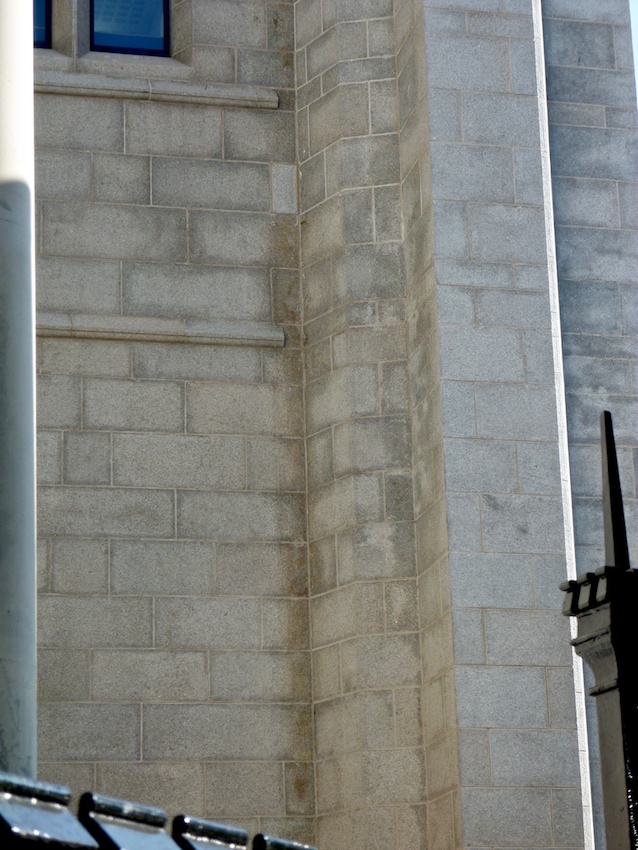
Firstly, Johanna thanks for your comment, but no; that's not right, it hadn't been raining. And yes; we have returned many times. Most recently on this beautiful dry hot bright Indian Summer afternoon today. Photos were taken - see below. The state of the facade has definitely not improved. If anything, the bright sunlight today threw the awful condition of the frontage into sharper relief than we'd seen before.

But that's old news now. What mostly surprises us about this matter is the denial which our fellow townspeople continue to exhibit when discussing the [botched] reconditioning of the Marischal College frontage and how [bad] it looks. As we said after our second visit:


http://otheraberdeen.blogspot.com/2011/04/marischal-college-second-look.html 
From a distance, or if you're passing through Broad Street in a vehicle, it looks OK-ish. Perhaps that's all that matters to whoever wrote the specification or managed the job on site. We prefer to take a slower, measured and more contemplative and up-close approach to our life within the urban realm, and it is this unhurried and ruminative attitude which has allowed us to notice problems at Marischal. We say that the standard of the work at Marischal is a scandal. We all should be outraged. But it seems we are at variance with the times, for when we try to discuss this issue with our fellow townsfolk, very few of them seem to have noticed. Or if they have, they deny that it's an issue.
----------//////////////


While we were there this afternoon, we sat on one of the benches beside the risibly literal new statue of Robert the Bruce, taking the time to look carefully and allow the atrocious state of the frontage to sink into our consciousness; taking the time to think about it and to think about and discuss between us what it means. During this rumination, we couldn't help but overhear some of the comments of the passers-by, comments which struck us with the cognitive dissonance of their stark contrast to what was actually being looked at. "Lovely," said the passers-by... "stunning"... "pristine"... "former glory"; it was as if a press release was being read out loud. We felt like strangers in a strange land where up is down and black is white. Joanna's comment above is not the first contact of its kind we've received on this matter, but it is one of the more polite. The fact that Aberdonians are willing, indeed keen, to disbelieve demonstrable facts and are happy, in the face of incontrovertible evidence, to openly contradict those facts or to make improbable excuses for them says much more about the situation of these Aberdonians than it does about the uncomfortable actualities themselves.

This is epiphenomenal. Which is to say that what we can learn about Aberdeen's people through their willing and wilful self-delusion on this matter tells us more about how Aberdonians fit themselves into the wider societal context than it does about their abilities as architecture critics. It tells us about the perceptual filters which these people are happy to don rather than confront a disappointing or difficult truth. It tells us of a false consciousness and an almost Pavlovian conditioning to which these people have, willingly or unconsciously, submitted or been subjected. This conditioning has rendered the populace compliant, unquestioning, malleable and directable. We can't help but wonder if there are other matters, matters more serious than the mere fucking up of a building reconditioning project, about which the Aberdonian public are willingly misled and are happy to wilfully misunderstand.
And we can't help wondering, thinking of the future, what other obfuscations of inconvenient truths will this emperor's-new-cloths-blind population be happy to swallow whole? And what beliefs, however egregious and incorrect, might be planted in the conditioned-compliant group-consciousness? And, in defence of these beliefs, what actions will those people be happy - eager, even- to take?

---ooo0ooo---


Thursday, 22 September 2011

World Car Free Day - Aberdeen

@sustrans
Happy #worldcarfreeday everyone*. Let's continue to help create permanent change to benefit pedestrians and cyclists: bit.ly/15PLL8

////////////////////>>>>>>>>>>>>>>
Every September 22, people from around the world* get together in the streets, intersections, and neighbourhood blocks to remind the world that we don't have to accept our car-dominated society. 


 (* = except in Aberdeen, Scotland)