Showing posts with label Berryden Road. Show all posts

Tuesday, 22 November 2011

Why a Third Crossing is Wrong - We Try to Explain Electricity to a Cat


-------oo0oo-------


Our attention has been drawn to the "Why a Third Crossing is Wrong" blog at thirddoncrossing.wordpress.com, in which a community activist in Tillydrone logically sets out the reasons why Aberdeen City Council and their business-community sponsors are wrong to push ever onward with their antiquated proposals for a damaging new bridge (the "Third [sic - see below] Don Crossing") over the River Don at Tillydrone. This new motor-vehicle bridge, if built, would form part of the much larger grand project to build a new (but paradoxically, as we have explained, very old-fashioned) radial expressway in Aberdeen, pointing directly at the heart of the town centre. We've touched on some of the aspects of this new radial expressway once or twice before.

We admire the systematic and thoroughgoing approach demonstrated by the author of Why A Third Crossing is Wrong (let's call it "WTCW") - but of course, the damoclean situation which the Tillydrone (and wider Aberdeen) community finds itself in demands nothing other than all the rigour that can possibly be mobilised in opposition to this road and bridge project which will slice the community in two. The case against the building of this new road and bridge is set out logically and assiduously on the pages of WTCW and the perspicacity and professionalism of the content pages (which are in the form of submissions to the forthcoming public enquiry into the compulsory purchase orders associated with the scheme) does credit to the Tillydrone community. We congratulate the author of the WTCW blog and we recommend it to our readers: go and have a look

Being familiar with some of the issues surrounding the proposed Third Don Crossing, and after reading the WTCW blog, we were reminded of a recent piece on Copenhagenize in which motorists using a street through a community in Ferrara, Italy are referred to as parasites:

<<<<<<<
What a great word. The host organism is, of course, the city off which they feed. The streets outside my flat as I write this are relatively free of parasites. The ones that plague Copenhagen aren't your traditional parasites. They aren't noctural. They desert their host organism on migratory patterns, scurrying back to their formicaries in the afternoons, only to return to feed upon their host in the morning. To continue their infestation and causing all manner of illnesses that the host organism is unable to defend itself against. 
Traffic pollution with its toxic emissions and noise pollution, a lower perception of safety for pedestrians and cyclists, traffic accidents that kill and maim, reduced property prices and so on. 
Parasites. It's a brilliant way to describe the motorists who roll down these streets, contributing nothing to the liveableness of my neighbourhood and others, hardly making a dent in the economic well-being of the shops, paying their taxes in other municipalities. Rumbling past, spouting the residue of their combusted fossil fuels behind them to the funky tunes on their radio while they text away on their telephones. 
>>>>>>>>>


WTDC says:

<<<<<<<
The academic consensus is that growth in car transport and road haulage mileage should be discouraged as it is not sustainable socially, environmentally and economically and that there should be a ‘modal shift’ to other sustainable forms. i.e. there should be a decoupling of road transport from economic growth.
I am not alone in interpreting that the root of the problem of congestion is the over dependence of the North East on car transport and this is evident by the fact that congestion in and around Aberdeen is not only confined to the Haudagain and Bridge Don ‘pinch points’. I consider that the development will perpetuate this condition by encouraging car usage resulting in more congestion and continuing the progressive marginalisation of sustainable transport alternatives.
Reading through the documentation so far is leading me to the conclusion that there is a bias in the interpretation of the studies leaning towards the conclusion for the need of a road traffic bridge. There appears to be over emphasis on the benefits, understatement of the consequences and the ignoring of alternatives.
>>>>>>>>>


OtherAberdeen's regular readers will of course know that our position is uncompromisingly against the use of motor-vehicles as a personal transport mode in the centre of Aberdeen (or any town centre). Policies which discourage cars in urban centres and reallocate roadspace away from motor traffic are mainstream throughout continental Europe and are being adopted even in the USA to the great benefit of local economic prospects and urban social profiles, but when we publish blog-posts demanding that similar policies be adopted here, we generally get a whole lot of quite nasty abuse. 

So… it's a tough nut to crack… Going hard at the technical aspects of specific projects, as WTCW does, and as RoadSense (for instance) are doing with regard to the forthcoming orbital motorway project (the Aberdeen Western Peripheral Route, or AWPR), is vital - for without these efforts and others like them, 'facts on the ground' would change rapidly and irreversibly, as road-building proposals are presented as plans, and plans are presented as faits accomplis. But it's troubling that efforts like these have to be made at all, for they are fighting a rearguard action against a democratic deficit. And as we have pointed out before, the current road-building obsession in Aberdeen is an atavistic desire for the realisation of plans which were first drawn up in the centre of the car-crazy twentieth century, before the externalities of motor-centric policies were understood. Car-dependency (or is it car-addiction? - so hard to tell the difference) as pointed out by WTCW is endemic in this part of the world.

We believe that the underlying problem lies in the mind-set of the polity here (just offering an opinion like that expressed in the previous sentence can provoke reams of abuse). It's a problem of framing, of context. We said, in the conclusion to our "Woonerf for the Denburn Valley" piece:
"…once our scheme is up and running … who would ever want to take their car all the way into the town centre ever again?"
And among the responses we got was one from someone who said:
"Yeah, exactly. That's the serious danger of schemes like these which remove road capacity"
The point being that, here, in this town, in this area, more cars on more roads is ipso facto regarded as being the desirable outcome. This is the context - the frame - in which we try to make the case for sustainable and active transport. You might as well try to explain electricity to a cat. The framing, the prevailing mindset, makes the case for any alternative to motor-transport practically impossible to promulgate. For example, take the forthcoming "Berryden Corridor Improvements" [sic] project, which forms part of the same radial expressway as the Third Don Crossing. The use of that word 'improvements' is telling, for it is the consequence of an a priori assumption on behalf of planners that more cars on more roads in the city is a good thing. So the  use of that word 'improvements' can be seen as a political deployment of language; for who could credibly oppose something which is an 'improvement'? The questions that exercise us at OtherAberdeen are, firstly: Why is car-dependency endemic here? And secondly: What is to be done? What can be done to break the frame, change the context?

---§---

Why is car-dependency endemic here?

Historically and broadly-speaking, economic progress and improvements in living standards have been accompanied by an increase in car ownership and use. This is understandable. The affluent society, status displays, the growth of suburban living and commuting, the upgrade cycle, etc. All other things being equal (and in the absence of civic policies to discourage motoring) economic growth provokes more motoring; cause and effect. It appears that our policy-makers have got this back-ass forwards; mistaking cause for effect they now believe that more motoring on more roads is a primary cause of economic growth. This is a cargo cult.

OtherAberdeen has explored the impulse for hierarchical status-display through motoring and, while that's an effect that's evident everywhere in the UK, we feel that the extreme affluence of the upper percentiles of the Aberdeen population has a disproportionate psychological 'pull' effect on those 'below' them in the hierarchy, many of who mistake affluence for wealth and so cannot understand that aspiration is not the same thing as acquisition. "Aberdeen is Tycoon-town, / If you're not a tycoon yet, you will be soon." So, aping the transport choices of the hyper-affluent, the people of Aberdeen and its hinterland are delighted to put more cars on more roads, because to them it demonstrates that Aberdeen is a town on the up-and-up, a town that's going somewhere (even if that's only to the shops for a pint of milk).

Related to that upper-percentile affluence is, of course, the fact that the predominant industry round here is concerned with oil extraction. An acquaintance, defending his excessive motor-mileage said he was "supporting the local economy" by using so much petrol. He wasn't joking. But there's a bit more to it than that: Aside from the impacts upon urban liveability, aside from the detrimental personal and social effects of sedentary lifestyles, and aside from the impact on the perception of safety and desirability of switching to other transport modes, excessive motoring also contributes to climate change (motor transport causes about a quarter of UK carbon emissions). As motor transport and the oil extraction industry are critically co-dependent, so it is psychologically impossible for a motorist in Aberdeen to integrate the fact that motoring is harmful into his or her world view, for that is the same thing as acknowledging that our town's success (such as it is) is based upon that same globally harmful thing. If you want to get Aberdeen people to admit that motoring is harmful, you are asking them to admit that the North Sea oil industry is harmful, and that, by extension, Aberdeen itself is harmful. As Upton Sinclair (author of "Oil!" filmed as "There Will be Blood") said:
"It is difficult to get a man to understand something when his salary depends upon him not understanding it!"
---§---

What is to be done?

We've mentioned that asking people in Aberdeen to switch to a mode of transport which is less amenable to hierarchical status displays is hard going.

<<<<<<<
Having spent a lifetime on the upgrade cycle gathering those letters and numbers on the boot-lip of their car - those glyphs and cartouches which so shorthandedly signify their importance - to then tell them that it was all for nothing and that they must abandon these status-displays is to so undermine the foundations of their world-view that they cannot integrate it into reasonable discourse. You might as well tell them that everything they believe in and hold dear is demonstrably wrong, and that everything they think they have achieved and hope to go on to attain is just an illusion. It's like telling a toddler that Santa doesn't exist, and taking away their lollipop at the same time. The reaction you get is not good.
>>>>>>>>

In an ideal world, the fact that there is no 3rd Don Crossing would be seen as an opportunity. For instance, in both Oxford and Cambridge, high levels of active and sustainable transport are the norm. In Oxford's case, this was policy-driven. There it was decided in the 1970's that the urban environment in the town centre was simply too precious to expose to the detrimental effects of motor-traffic. Park-and-ride was pioneered in Oxford, but - crucially - it was accompanied by a moratorium on the creation of new parking spaces in the town centre. No new public car-parks, and - even more importantly - no employee carparks for businesses. While we have excellent P&R facilities for Aberdeen, they are fatally undermined by policies which continue to attract large numbers of motor journeys into the heart of the town.  Cambridge benefitted from a different dynamic; though, paradoxically, it was a lack of dynamism which has lead to today's happy outcome. In that town, civic neglect meant that they missed out on the late 20th century enthusiasm for inner-city ring-roads and radial expressways and the like. What turned out to be benign neglect meant none of that sort of motor-pandering infrastructure was installed, and - the ancient town centre being largely unsuitable for motor-traffic - the people of Cambridge took to bikes (or, rather, never got off them). Today, Cambridge has the highest modal share for cycling in the UK. It's worth emphasising that this is not the result of a specific pro-active-transport policy, but rather is the outcome of doing very little to encourage motoring.

////////////////////

But where does that leave the likes of us active-transport advocates in Aberdeen? In Aberdeen, it leaves us out on the edge; that's where. Sniping from the fringe, marginalised, a hated out-group, seen as dogs-in-mangers; anti-progress, anti-business, anti-Aberdeen. But, of course, we are none of those things.

Additionally, we are highly skeptical of the compromises offered by groups such as Get-About, and Aberdeen Cycle Forum - because what they ask is that sustainable and active transport be considered, be included in strategic plans which are largely about putting more cars on more roads. And they get exactly what they ask for - tokenistic half measures, afterthoughts and unsuitable infrastructure tacked onto major road-building projects. Where these groups fail is in their acceptance that active and sustainable travel is 'in addition to' business as usual, whereas, if campaigns for active and sustainable travel were successful, there would be significantly less pressure on existing road capacity, and calls for more roads would simply evaporate. For active and sustainable transport is not 'in addition to' business as usual - rather, it is 'instead of' business as usual. The policies of GetAbout and the like have failure built in, for they first acquiesce unquestionably to the a priori calls for more roads, and then seek to piggyback on that.

We note that Aberdeen City Council's plans for the Third Don Crossing bridge and its feeder roads include some tokenistic cycle paths, some of which are labeled as being 'segregated'. You'd think we'd be pleased, yes? Well we're not, because this labelling demonstrates that road-planners in this town have completely misunderstood what segregation of facilities for cycling should actually encompass. We couldn't put it any better than the Lo Fidelity Bicycle Club, so we'll leave it to them and their discussion of what "Going Dutch" would mean for UK cycling infrastructure:

<<<<<<<<

The fact is that ‘Going Dutch’ does mean having segregation everywhere! But there’s one fundamental caveat; The British assume segregation to mean ‘segregating cyclists from the road to ’improve traffic flow’ for motorised traffic’ whereas the Dutch mean ‘segregate motorised vehicles from people to improve movement for everyone’.
Through the years, the British have created a lot of bypasses, relief roads, motorways, urban expressways and the like. The Dutch did the same but ensured that it became an utter pain in the buttocks to get across the town being bypassed in a car, in effect forcing motorised traffic to use the new infrastructure built. The British didn’t and are still paying the price with heavily congested town and city centres. In fact we keep using it as some perverse justification to build more bypasses, relief roads, motorways, urban expressways and the like.

>>>>>>>>

Here
Quite. Here, in Aberdeen, we have both plans for a new orbital motorway bypass and a new radial expressway (as well as other radial access 'improvements' for motor transport). Additionally, so great is the fear that the orbital motorway bypass road will reduce traffic flows into and through the town centre, that NESTRANS (the North East of Scotland Transport Partnership - a political/business quango) document "Optimising the Benefits of the AWPR" (pdf) includes specific provision for measures  to 'improve' radial flows of motor traffic towards and through the town centre. This is the direct polar opposite of the more modern transport planning we see in continental Europe (in particular Netherlands and Denmark) where, as the Lo Fidelity Bicycle Club point out, yes indeed they have bypasses and motorways and the like, but it is this infrastructure itself which forms the major plank of the segregation policy. 
Elsewhere
For these roads fulfil the policy of segregating cars from people, keeping motor-traffic flows away from where people want and need to be. And so, in this way, urban centres - centres for entertainment, residences, commerce and community - are allowed to fulfil their correct urban function as human-scale places for people, rather than machine-scale places for cars. Were our forthcoming orbital motorway bypass project to be accompanied by policies which would prevent radial flows of motor traffic into and through the centre of our town, there would be no greater advocates of it than we. But it is not, so we are not. 

Here
Incontrovertible evidence has been mounting for some time now, demonstrating beyond doubt that motor-centric policies to encourage ever-increasing numbers of motorcar journeys into the centres of towns are wrong. Wrong for the environment, wrong for personal health, wrong for the community and wrong for business sustainability. Indeed, we were delighted to notice that a raft of recent studies encompassing places as diverse as The Netherlands, Germany, Australia, Canada, Swizerland and the United States shows policies which cater for bicycle transport are better for local business than those which cater for motor transport.

<<<<<<<
 ...a study from the Dutch city of Utrecht which found that whilst bicycle-based consumers spend less per transaction, they make more visits and spend the most collectively. This isn’t the only connection – a German study found similar results, calling cyclists ‘better customers’ due to them making eleven trips per month compared to seven for motorists. And the Swiss are in on it too, where research into parking space profitability found that each square metre of bicycle parking generated €7500 compared to €6625 for cars.
>>>>>
Elsewhere.


When will Aberdeen get the message? In the past, when they didn't know what else to do, physicians used to allow fevers to run high - kill or cure. Perhaps the motor-centric policies of Aberdeen - with our forthcoming orbital motorway, accompanied as it is by this new bridge and other access projects at Haudagain, 3rd Don Crossing, Bridge of Dee replacement, Berryden 'Improvements', and a great big new carpark where Union Terrace Gardens used to be are an attempt to provoke just such a crisis - for once these projects are complete, large volumes of high speed traffic will power unimpeded into the heart of our town, causing atrocious levels of noise and chemical pollution, heavy congestion and destroying liveability for the communities the expressways bisect. Once this crisis is upon us, policy will - must - inevitably shift, for there will be nowhere left for new roads to be built.

Or will there?

Tunnels Vision for Aberdeen Transport
(a must-read)

If we tolerate current plans, the risible nonsense of grandiloquent proposals for tunnels and monorails and god-knows-what-all will surely follow. For that reason, as well as everything else above, we wish the Tillydrone community and the author of Why a Third Crossing is Wrong every success in their resistance.

But finally, there is another reason why a "Third" Don Crossing is "wrong". For, having successfully framed the discourse - the promoters of this scheme have managed to get us all to use the name "Third Don crossing" when referring to it. But it is not - if this scheme goes ahead - this will be the sixth bridge over the Don in Aberdeen. Count them.


-------oo0oo-------


Tuesday, 14 June 2011

GOT A WEE POSTCARD FROM THE CENTRE OF THE 20th CENTURY


<<<<<<<<<<<<<<<<<
http://otheraberdeen.blogspot.com/2011/05/20th-century-boundary-stones-acb.html
2011.05.30

...suppose we should really get ourselves along to the local studies department at the Central Library and see if we can look at a mid-20th century map for clues to where we might find others of these 20th century boundary stones, but hey - this isn't a job! (Nevertheless - if anyone's got a copy of such a map that they can let us have we'd be really grateful.)

<<<<<<<<<<<<<<<<<<<<<<<<<<<<<<<<


20th century boundary X Inbox Reply


from xxxx@yyyyy.com
to otheraberdeen@gmail.com
date Fri, Jun 10, 2011 at 9:44 PM
subject 20th century boundary
att 1 Attachment 421kb


Hi, saw your request for a map with indication of Aberdeen's boundary before 1975 and thought that this might help. (SEE ATTACHED)


Regards
xxxxxANONxxxxx
<<<<<<


1 Attachment 421kb proposals.jpg

#######################################

As so often happens in life, when we go looking for one thing, we find something else; something more distracting, perhaps. Something enlightening, something fascinating.

In this case the map document "THE-CITY-AND-ROYAL-BURGH-OF-ABERDEEN, Survey and Plan ~ 1949, ROAD COMMUNICATIONS. PROPOSALS" opens up a door into the minds of the post-war town planners and their fever-dream visions of the future; it is a wee postcard from the centre of the car-crazy 20th century. It isn't really a map (maybe it's a "mind map") rather it's a disingenuous presentation of a schematic diagram made to look like a true map. It takes quite serious topological liberties with topographical realities. Having thrown topographical reality to one side, our post-war planners dared to dream big.

Three ring-roads; a gyratory system at Holburn Junction/Rose St/Thistle St; much of Ferryhill demolished for an inner city motorway (in all but name); a high-speed radial expressway cutting Cragiebuckler in two to link Countesswells Road at Hillhead with Queens Road at Hill of Rubislaw (the undeveloped green corridor for this pupative expressway exists to this day). Three ring roads. 

Even in their wildest car-crazy dreams the post-war planners in London only ever envisaged a maximum of four concentric ring-roads for the capital.

pic from Wikimedia Commons
Predict and Provide
Predict (traffic levels) and provide (capacity beyond that) was the tenet of these mid-century promethean would-be road-builders: iconoclasts, they would destroy the city to create it anew. A new order beckoned and all round the world the social, economic and political decks were being shuffled. The externalities of unchecked motor vehicle growth had not yet impinged upon the considerations of these utopians, instead they saw a future painted in the broad bold strokes and interplanetary proportions of what we today recognise as being nothing but science-fiction. So (concurrent with Dr Beeching's noticing that railways were old fashioned and best done away with) in his 1963 report "Traffic in Towns" Professor Sir Colin Buchanan mused:


In the future: the British Empire's
borders extend all the way to Venus


The possibility most usually canvassed is that within a measurable time some kind of individual jet-propulsion unit will be developed, of which a rudimentary form has already been tried out in the U.S.A. for military use.  
But sensible Sir Colin went on to question the individual jet-pack's viability as a means of daily transport for commuters, and concluded, therefore, that the only possible future was one of comprehensive grand-plan redevelopment to make more and more room for cars - Jellicoe's "Motopia".


The way it turned out for us at the
Denburn Road "improvement".

But Prof. Buchanan did reach ahead of his time and recognise that increases in road capacity can actually exacerbate congestion problems:
The problems of traffic are crowding in upon us with desperate urgency. Unless steps are taken, the motor vehicle will defeat its own utility and bring about a disastrous degradation of the surroundings for living... Either the utility of vehicles in town will decline rapidly, or the pleasantness and safety of surroundings will deteriorate catastrophically – in all probability both will happen.
At the time these words were written, they were not, but the mechanisms of network-induced demand are now well known, are within the body of established empirical science and are regarded as The Fundamental Law of Road Congestion. Indeed, in the United States, where much highway (motorway and dual-carriageway) infrastructure is now approaching obsolescence, planners are discovering that removal of these artifacts from the centre of the car-crazy 20th century has major economic and social benefits for cities.


>>>>>>>>

Professors Gilles Duranton and Matthew Turner analyzed travel data from hundreds of metro areas in the U.S., resulting in what they call the most comprehensive dataset  ever assembled on the traffic impacts of road construction. They write:
For interstate highways in metropolitan areas we find that VKT [vehicle kilometers traveled] increases one for one with interstate highways, confirming the “fundamental law of highway congestion” suggested by Anthony Downs (1962; 1992). We also uncover suggestive evidence that this law may extend beyond interstate highways to a broad class of major urban roads, a “fundamental law of road congestion”. These results suggest that increased provision of interstate highways and major urban roads is unlikely to relieve congestion of these Roads.
>>>>>>>>>>>>>>>>

Milwaukee spent $25 million to demolish the 1-mile-long Park East freeway, while it would have cost $100 million to rebuild that 30-year-old freeway.  Removing the freeway opened 26 acres of land for new development, including the freeway right of way and surface parking lots around it, which have already attracted over $300 investment in new development, in addition to stimulating development in surrounding areas.

San Francisco increased nearby property values by 300 percent by tearing down the Embarcadero Freeway and opening up the waterfront, stimulating the development of entire new neighborhoods.

Niagara Falls is removing the Robert Moses Parkway in order to slow people down and encourage them not to drive as far.  Just as building this parkway encouraged tourists to take longer trips and drive right through to Niagara Falls, Canada, removing this parkway is meant to encourage tourists to take shorter trips and stop in Niagara Falls, New York.

~~~~~~~~~~~~~~~~~~~

But such counter-intuitive cognitive-dissonance-inducing facts do not go down well here, where we plan the Aberdeen Western Peripheral Route "special category" bypass road (a motorway in all but name) and the Berryden Corridor "Improvements" (an urban dual-carriageway radial expressway scheme).

Notable amongst the justifications and rationalisations for work on both the new ring-road and the new urban dual carriageway are promises of "improved journey times". This flies in the face of the UK Department for Transport which, as long ago as 1996 adopted guidance documents stating that cost-benefit studies on new road building schemes must assume that elasticity of demand may be as high as 1.0 with respect to speed. Which is to say that the average trip length increases as much as speed increases: building roads which reduce journey times merely serves to lengthen the average trip taken; with the same amount of time being spent behind the wheel, the number of driver-miles increases. The very essence of induced demand.

>>>>>>>>>>>>>>>>

Reducing journey times in and around and to and from the North East not only improves quality of life for individuals but helps retain and attract businesses who need reliable connections to their markets in order to survive.

<<<<<<<<<<<<<<<<<<<
Aberdeen City Council
Frequently Asked Questions


How does losing a part of school playground improve health?


The alignment of the carriageway alongside the school was chosen in order to meet the design requirements for roads and to avoid the demolition of property on the other side of the road. The design of roads in an urban environment can be restrictive and at times compromises have to be reached.


<<<<<<<<<<<<<<<<<<<
Aberdeen City Council
Frequently Asked Questions


Why are you creating a motorway through the city?


The dual carriageway route proposed for the Berryden Corridor permits a number of transport modes and can be successfully integrated into an urban environment. It will have a speed limit of 30mph like the majority of the urban roads in Aberdeen. The Berryden Corridor Improvement Project makes up part of an integrated transport system for Aberdeen City, which includes projects such as;


  • The Aberdeen Western Peripheral Route (AWPR), the construction of which will reduce unnecessary traffic travelling through Aberdeen, freeing up capacity in the city centre 
  • Union Street pedestrianisation and its associated traffic management.  
  • A number of studies to investigate how to better manage and improve the transport system around the city [...] 
  • Feasibility studies to investigate cycle routes on the Anderson Drive, Inverurie Road and King Street/ Ellon Road corridors. 
  • A Bus Action Plan 
  • A freight action plan 
  • A Car Parking Strategy, which aims to increase charges in the city centre and extend the controlled parking zone.
[...]

 All of this assists the Council in meeting its policy and environmental commitments.


###########


Poised like an arrow pointing at the heart of the city centre, the new urban dual carriageway will deliver high volumes of high speed traffic into the centre of our town, and through the agencies of their action plans, studies and strategies our planners expect us to believe that this will "assist" schemes like the 30-year-promised pedestrianisation of Union Street. Pedestrianisation and modal switch to cycling, walking and public transport is achieved by discouraging motor traffic, by re-allocating aspects of the urban environment away from cars, not by ushering in more.


>>>>>>>>>>>>>>>>>>>


Comments


Alex Mitchell said...


We only have to observe the bleakness & utter desolation of the entire length of East/West North Street, from Mounthooly to the Castlehill roundabout, to realise the destructive futility of this outdated slash-and-burn approach to town planning, with its demented prioritisation of an accelerated flow of vehicular traffic above every other consideration. How many streets, houses and communities were destroyed to accommodate the East/West North Street urban motorway? And there is a cluster of nice little residential streets such as Caroline Place near the former Rosemount Church, really a kind of urban village, standing in the way of the proposed Berryden Junction!


<<<<<<<<<<<<<<<<<<<<<

The number of cars, buses and lorries using the key roads in and out of [Aberdeen] has fallen to its lowest level for years.
Surprising new figures suggest traffic levels on Aberdeen’s congested major roads may be dropping after reaching saturation point. Experts linked the findings to the growing use of trains and bikes in an age of increasing environmental awareness and economic austerity, as well as commuters sharing cars or finding quieter routes in to work.
Transport chiefs warned against complacency and said the city’s bypass must be delivered, as well as a third bridge over the Don and a solution at the notorious Haudagain roundabout.
Councillors in Aberdeenshire were certain commu-ters had not witnessed a reduction in rush-hour congestion, even if vehicle totals on the roads had fallen.
Data from Transport Scotland, under freedom of information legislation, reveals the five-day weekly average number of vehicles using Aberdeen’s trunk roads for every month in the last 20 years.
After huge growth during the 1990s, the traffic volumes appeared to stabilise over the last decade and have even started to fall.


>>>>>>>>>>>>>>>>>////////////


After Aberdeen's traffic density had reached a maximum a few years ago, it then subsided back and our town planners and their business sponsors decided that attracting more traffic to the town centre should actually become the desireable outcome. And so they dusted off those ill-conceived plans from the centre of the car-crazy 20th century and today they push on ahead with a re-hash of the 1949 plans for orbital motorways and urban dual carriageways. They seek to induce demand, to pander to the car-dependent addiction of the polity. Is this the most car-sick town in Europe?

The solipsism of the roadbuilders' logic is circular tail-chasing devastation.

1960's
Is there going to be too much traffic? Better build urban dual carriageways and motorway ring-roads.


2010's
Is there not going to be enough traffic? Better build urban dual carriageways and motorway ring-roads.


<<<<<<<<<<<<<<<<<<<<<<<<<
http://en.wikipedia.org/wiki/Automobile_dependency


Automobile dependency implies that cities where automobiles are the predominant transport deny their residents not only freedom of choice about the way they live and move around the city but also that the culture of automobile use has produced a kind of addiction to them. The analogy is made with addictions to harmful substances and activities because of the well-known law of diminishing returns in relation to increasing use or participation: the more that is used, the less of the desired effect is gained until a point is reached where the substance or activity has to be maintained to remain 'normal', a state of dependency.
When it comes to automobile use, there is a spiralling effect where traffic congestion produces the 'demand' for more and bigger roads and removal of 'impediments' to traffic flow, such as pedestrians, signalised crossings, traffic lights, cyclists, and various forms of street-based public transit such as streetcars (trams).
These measures make automobile use more pleasurable and advantageous at the expense of other modes of transport, so greater traffic volumes are induced. Additionally, the urban design of cities adjusts to the needs of automobiles in terms of movement and space. Buildings are replaced by parking lots. Open air shopping streets are replaced by enclosed shopping mall. Walk-in banks and fast-food stores are replaced by drive-in versions of themselves that are inconveniently located for pedestrians. Town centres with a mixture of commercial, retail and entertainment functions are replaced by single-function business parks, 'category-killer' retail boxes and 'multiplex' entertainment complexes, each surrounded by large tracts of parking.
These kinds of environments require automobiles to access them, thus inducing even more traffic onto the increased roadspace. This results in congestion, and the cycle above continues. Roads get ever bigger, consuming ever greater tracts of land previously used for housing, manufacturing and other socially useful purposes. Public transit becomes less and less viable and socially stigmatised, eventually becoming a minority form of transportation. People's choices and freedoms to live functional lives without the use of the car are greatly reduced. Such cities are automobile dependent.


~~~~~~~~~~~##################~~~~~~~~~~~~~


An tiny little old lady tries to cross the road at the t-junction, peering round the wing of the big silver-grey SUV to try to check it’s OK to cross, and to try to make herself seen to the motor traffic using the junction. She waits, and waits, and waits.

Inside the house, a rivulet of running sweat tickles as it begins to trickle down his spine between his shoulderblades as he flollops into the sofa and reaches grunting over his belly swapping the clunky chunk of the black plastic carkey electronic transponder for the skybox remote control. Flips to EPG; pagedown pagedown pagedown. Pagedown. Huh! Nothing - saturday lunchtime. He puts the sweat-finger smeared remote down on the sofa arm and, getting his breath back after walking from the car, puffs hard, blowing his cheeks out. His eyes swivel first, then his head, then his body to look out the window. There it is. He got it two years ago, he knows the exact date, it’s the exact same age as his youngest daughter; his wife was in the maternity unit. She was there while he got his baby. Got the cherished plate transferred over from the older model (this one’s a serious upgrade) LYN 684, that’s in honour of his wife - she likes that.

Saturday and sunday its OK to park it there - no traffic wardens about at the weekend. He loves his end-terrace house (now after about five years he’s got it just the way he likes it), but it has its problems. To his chagrin, traffic regulations mean that, because his house is on the t-junction, he can’t pave over the front garden and turn it into a parking bay, the way his neighbours have done. That’s harsh, particularly as those same traffic regulations have double-yellows immediately outside the house - so he can’t park there; can’t park where he can see the car from the sofa - one eye on the adverts, the other on the Audi. Sometimes he even has to park round the corner up to a hundred metres away. That can be quite a walk, particularly for his eldest daughter - she’s six now, and not used to such distances. But, come the weekend, the wardens retreat and he parks his own car outside his own house, just as he should. To hell with the double yellows: Ford’s in his flivver; all’s well with the world. He can look at it as much as he wants. If he could, he’d park it in the living room.

What’s that? In the corner of his field of view, somebody’s near his car! It’s just as well he parked it there so he can see who’s interfering with his property! He levers himself up and, pulling the airtex front of his too-small poloshirt back down over his paunch, waddles to the bay window. It’s an old lady, just standing. Standing right beside his car, her right hand out by her side, as if she might touch the bonnet at any moment. He hammers his fist on the windowpane - nothing. Face reddening, slack-jawed, wide-eyed he thumps again, bangbangbangbangnbang! Still nothing. Is she ignoring him? He squeezes slather-footed between sofa and TV and hurries out the door, down the hall, out the front door. He looks at the car but he can’t see the woman. Where is she?


References:


http://www.marchandmeffre.com/detroit/index.html
http://www.wesleyjohnston.com/roads/belfasturbanmotorway.html
http://www.hiddenglasgow.com/forums/viewtopic.php?t=642
http://en.wikipedia.org/wiki/Traffic_in_Towns
http://hc110-2.blogspot.com/
http://dc.streetsblog.org/2011/05/31/study-building-roads-to-cure-congestion-is-an-exercise-in-futility/
http://www.nottingham.ac.uk/transportissues/uktp_history.shtml
http://www.preservenet.com/freeways/FreewaysInducedReduced.html
http://waronthemotorist.wordpress.com/2011/01/15/crap-cycling-and-walking-in-car-sick-glasgow/#more-768

Friday, 21 January 2011

Urban Dual Carriageways. The Future from the Past.

As our council continues pushing ahead with measures to "enhance" traffic flow at speed into the heart of the town centre to the exclusion of other transport options via the controversial "Berryden Corridor" (pdf) urban dual carriageway project, we continue to be nonplussed that such a discredited policy for traffic management continues to even be considered, let alone implemented.

It is telling that the report linked above is titled "Berryden Corridor Improvements", thus prejudicing it's own conclusions. That the creation of extra road-space exclusively for motor transport is an "improvement" is a conclusion which is increasingly seen as mistaken. We have written on this subject on one or two occasions before.

We so very much wish that it were true that congestion could be solved by the simple, seemingly common-sense expedient of building more roads. But, unfortunately, world-wide and decades-long experience of the building of relief-roads, bypasses and linkroads confirms without even a hint of doubt that it is not.

Note the "Proposed foot bridge over railway line".
Thanks for that.
As if this new pedestrian link will compensate for loss of
pedestrian permeability throughout the length of this new "corridor"

all the way from Woodside Fountain to Skene Square.

More and more, in every part of the world from Australia through Asia to Europe and even including the USA where the car is King, it is realised that more roads means more congestion and that the only thing which will reduce congestion is a policy which delivers fewer journeys undertaken by car.

It's a cliché and a truism to say that one of the definitions of madness is doing the same thing over and over again, and expecting different results. So why do we expect that building additional road capacity will have a different effect this time? It will not; it will merely impoverish us by further devastating parts of our town which are already suffering blight and degeneration.

We are reminded of lessons unlearned elsewhere:

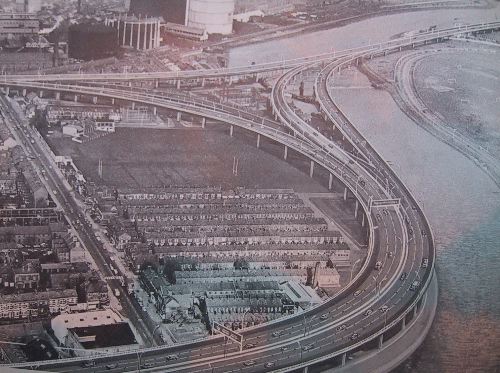
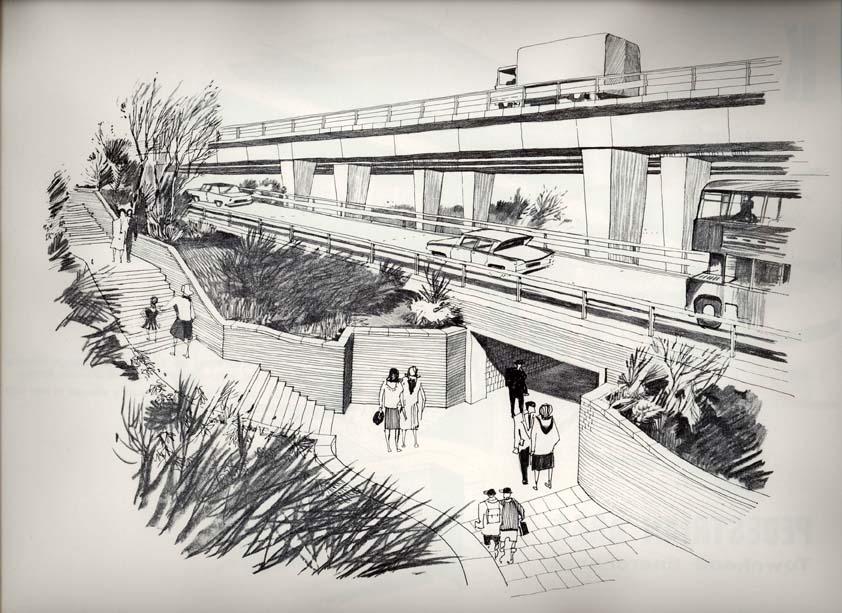
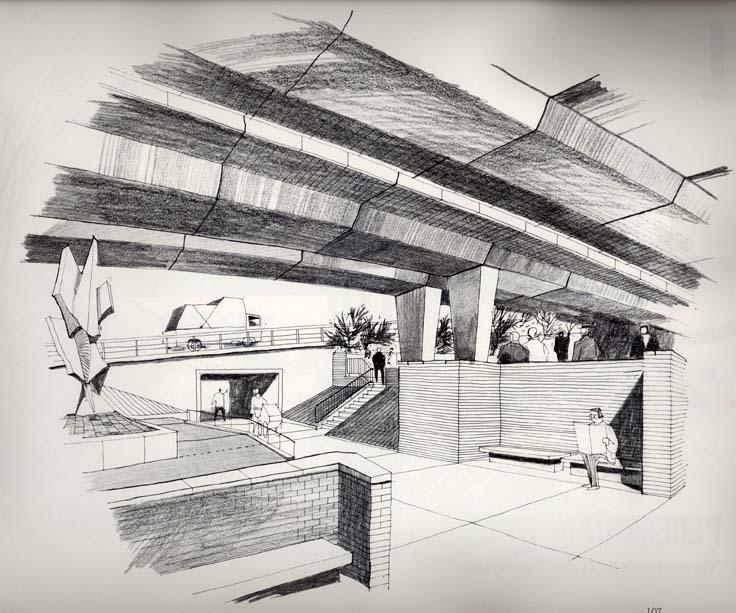
From Report on A highway Plan for Glasgow 1965.


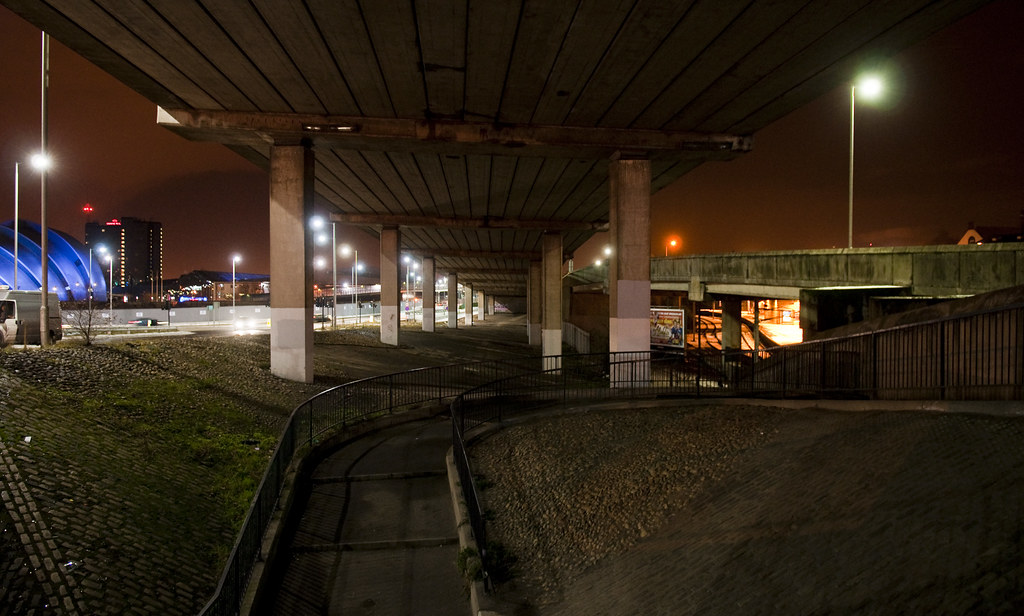
These paper-bound utopian visions, unfortunately, turned into an alienating horror in the real world.

From At War With the Motorist's splendidly psychogeographically logged visit to Glasgow: Crap cycling and walking in car sick Glasgow.


Glasgow continues on to repeat the same errors with new urban motorway and dual carriageway projects. It seems that we in Aberdeen cannot bear to be left out. As one commenter puts it: "Why would anyone want to walk anywhere when they can drive through the remains of the city at 50mph." And another: "Worth every penny, so it is. Heaven forbid that anybody might have to go anywhere, anytime at less than a respectable 60mph."

Should the Berryden Corridor urban dual carriageway be built as proposed, it will fulfil one function only - it will bring more motor traffic into the centre of town at an increased speed. From this function, effects flow: It will increase congestion; it will increase noise and atmospheric pollution; it will act as a barrier to east-west permeability and mobility for pedestrians and cyclists; it will isolate communities and it will have a detrimental impact upon the liveability of the inner part of our town north of the centre. It will thus increase social exclusion and alienation. This is the direct opposite of the study aims which, in the very first paragraph state that the project will "contribute to making Aberdeen’s transport network more efficient and sustainable over the coming years, ensuring that the city remains an attractive place to live, visit and work."


In the past, we have praised Aberdeen's surprisingly good cycling profile and we regularly revel in it's fantastic network of quiet and serene pedestrian paths which take walkers away from the stress of interacting with motor traffic.

We'd hate to have to reverse our position on this, particularly when our non-car infrastructure is beginning to gain International Fame.