Showing posts with label redevelopment. Show all posts

Tuesday, 21 February 2012

The Charm Agenda, Charm Offensive, Offensive Charm


A whole month after our "Final Thought" about the planning debacle surrounding Aberdeen's only town-centre green space - Union Terrace Gardens - events conspire to make liars of us, and we're obliged to offer yet more "final thoughts".

CHARM

I was leafing through the most recent edition of Tyler Brûlé's Monocle "cultural briefing" magazine the other day. (Yeah, yeah, I know.) But we very much like Tyler's takes on urbanism, on transport and on modernism (in architecture and design). Since he turned the 'lifestyle' magazine market inside out when he launched Wallpaper in 1996, his editorial push has been characterised by a purity of vision and a earnest championing of good taste and human scale urban design - quality, authenticity and integrity in urbanism. Looking at his magazines, you might think that postmodernism never happened.

The most recent edition of Monocle points out that, as we're getting accustomed to having tough economic forecasts thrust in front of us, and as politicians and mass-media pundits struggle to begin to think about how they might approach - as they eventually must - the necessity of starting to condition the general public to the fact that a return to economic growth may not actually be possible - certain brands, businesses, regions and people seem not to be merely surviving, but rather thriving despite the economic crisis. The magazine devotes an editorial and an entire globetrotting section with travelogues (dérives) and essays (polemics) all turned to the examination of that special quality which allows some to float easily to the top to enjoy the oxygen of prosperity while others sink in the stifling mire of economic depression. Tyler's travel writers, photographers, philosophers, and graphic artists are flung to the four corners of the earth and return to identify this fundamental ingredient of resilient success. They conclude that this vital essence is charm.
>>>>>>
It's a set of attributes got by doing things based on human feelings and not because a focus group says it sounds good or the numbers seem to add up when you pile them on to an Excel sheet. The reason we think this word [charm] is key in 2012 is because it adds the DNA for longevity into brands, business and neighbourhoods
[…]
Honesty, integrity, simplicity … are other words that help all manner of firms thrive, but oddly, they never seem to make it past the door of a business school. That's because these things can't be taught; you have to genuinely possess these qualities.
[…]
Charm is unquantifiable, which is why management consultants and MBA graduates overlook it. Decisions about the future of a town, building or business that are made in the boardroom don't consider the importance or charm. … And yet charm is arguably the most important factor for securing repeat business, which in today's financial climate is invaluable.
Charm is fragile too - it's not something you can buy (think Dubai), it takes time to nurture and requires safeguarding because, once lost, it's near impossible to reinstate.
<<<<<<<<
So you can see that this resonates with today's urban planning tumult in Aberdeen. Since the intervention of oil-tycoon Sir Ian Wood in 2008 caused the collapse of the project to build the Northern Light (a contemporary art centre) in favour of his own vanity-stroking City Square Project (as was), the discourse in Aberdeen has been characterised by a singular lack of charm. Accusation and counter-accusation have flown in an increasingly polarised debate as the polity is subjected to the spectacle of a process which has been distressingly divisive. Misdirection, misinformation, sock-puppetry, DPR, website hacking, vexatious allegations, character assassinations and other dirty tricks have all been rumoured to have been used by one side or the other or both. Allegedly. We have been disappointed but unsurprised to see a lack of balance in the local press, who have continued to act as editorial mouthpieces for the boosters of CO2-supremo Sir Ian Wood's project, their pro-development articles hitting their own front pages with predictably metronomic regularity. But then, we've long since aired our disappointment about how our Aberdeen newspapers are operated.

In our opinion, the distasteful aspects of this process which will in effect privatise commonly-held land, were inevitable. When carbon-bigwig Sir Ian Wood first announced his intention to outbid the creative and performing arts community in Aberdeen he set our teeth on edge by going on record and saying:
Eighty percent of the people who spend time in [my] square will have no interest in the arts.
So breathtaking an expression and expectation of philistinism, both patronising and dismissive, used by the emission-king Sir Ian Wood as a justification for why his scheme would be preferred by the people of Aberdeen over the Northern Light scheme, was inevitably seen by the creative arts community - both producers and consumers with curator-types in between - as an opening pre-emptive strike in a dirty war for the soul (both metaphysical and urban-physical) of our town. Thus was the wind sown, and now we reap the whirlwind as the time has arrived and the people of Aberdeen are now making a decision on whether or not the park gets bulldozed. A postal referendum is in progress at this time. What emission-monger Sir Ian Wood first called "The City Square Project" has been re-branded "The City Garden Project". You can see what they did there.

THE SUPERFICIAL CHARM OF BOILERPLATE

One of the many aspects which has characterised the moneymen's push to foist their debt-creating real-estate land-grab and building project on the people of Aberdeen is the use of pubic relations (PR) consultancies who are involved in projecting a presence (we think that's the kind of thing these sorts of people tend to say) for the City Square Garden Project. Posters, flyers, web, social media, radio, tv and print. It's all been very slick and impressive. If you think that a corporate branding and impression management (as they say) exercise can ever be impressive, that is. Many people do in these hyperreal times, more's the pity.

A couple of weeks ago, I asked one of the social media manifestation aspects of the City Square Garden Project a straightforward enough genuine question. Here's what I asked:
>>>>>>>
One of the things which is a perennial spectacle in Aberdeen, in the city centre, is the sunset gathering of starlings - vectoring in from all directions and amorphously flocking in the sky above Union Street. The spectacular flock (numbering tens of thousands of birds) swoops around the city centre, gathering strength of numbers as subsidiary flocks join, before groups break off and dive beneath Union Bridge to roost.
  
The RSPB and the BTO (British Trust for Ornithology) state that: "starling numbers have fallen by 66 per cent in Britain since the mid-1970s. Because of this decline in numbers, the starling is red listed as a bird of high conservation concern." 
And the RSPB also note that the Countryside Act (1981) makes it illegal to intentionally kill, injure or take a starling, or to take, damage or destroy an active nest or its contents. They say that preventing the birds from gaining access to their nests may also be viewed as illegal by the courts. And indeed, the provisions of the Scottish Nature Conservation Act (which supersedes and modifies the Countryside Act) are more stringent yet when it comes to bird habitat protection, making it an explicit offence to: "obstruct or prevent any wild bird from using its nest". How can this be avoided by the plans as proposed? 
How will the project circumvent the provisions of the Countryside Act and the Scottish Nature Conservation Act? How will the promotors of the project deal with this issue? Has the City Garden Project been in touch with the RSPB and the BTO?  If they have not already contacted the RSPB/BTO, why not?
<<<<<<<<<<
The response from the City Square Garden Project's social media manifestation:
>>>>>> 
We love the birds too and want to see them remain in the city centre. What is exciting about the new gardens is the fact that new eco-systems and habitats will be created by the larger gardens with a greater diversity of plants and wildlife. 
<<<<<

Ugh. Firstly, when I read that, I had the feeling that I'd been mugged. It's that superficial charm of the PR "handling" thing that they do by the numbers; that thing that's straight out of the first year media studies playbook where they 1. gushingly agree ("yes we love birds too, see - we're just like you!") - then 2. deflect by issuing handwaving boilerplate ("the new thing will be EVEN BETTER"); all without addressing the serious and genuine specific concerns I'd expressed. At the time of writing, I've seen no genuine response to my questions from the City Square Gardens Project PR people. 

The thing about charm is, it cannot be faked. We can all tell when a corporate entity has a "workshopped vision" rather than a genuine opinion. We are used to the cant of the scripted interactions we must suffer with call centres and checkout till operators. We can even now detect when the script has been drafted in order to appear unscripted. It's wearing, it's tiring, it's disheartening. We live now in an age of flesh-robots consulting decision-tree boilerplate scripts. Where are the real people? What are their genuine opinions? It's doubly disheartening to realise that the real people promoting this real-estate venture (in this case, emission-king Sir Ian Wood and a group of 50 anonymous(ish) - certainly faceless - businesspeople who are bankrolling the PR initiative) reckon themselves to be so lacking in genuine charm that they must retain a PR consultancy to generate a continual outgushing of superficial charm boilerplate in order to deflect public attention away from them, and away from key questions and problems with the project. I suppose, at least, we should congratulate the group of fifty anonymous(ish) businesspeople for their self-knowledge. 

A HAPPY IMPRESSION OF BLACKMAIL

A correspondent pointed us towards the blog of local(ish) PR practitioner Ken McEwan, in which the PR-man contends that  - unless the people of Aberdeen consent to carbon-mogul Sir Ian Wood's real-estate development scheme which would destroy Aberdeen's only town centre green space - there will be no further investment of any kind in Aberdeen. When he asserts: "This is an all or nothing package" he's kind-of saying "Vote Yes to the comprehensive redevelopment of Union Terrace Gardens or the rest of the city gets it!" 

Of course, the PR-man avoids any use of the words "loan" or "debt", choosing to use the words "investment" and "funding" instead. But leaving that aside, and also leaving aside the arguable thrust of the "all or nothing" assertion, what we find most enlightening is the posture that this PR-man is happy to be seen to be taking. To us, it seems that he appears to be revelling in creating the impression of a kind of civic-development blackmail. Aren't these PR-types charming?

CO-OPTED

When we last wrote about this subject, we got a bit of criticism for our use of language like "emission-king" and "pollution-mogul" when describing carbon-baron Sir Ian Wood. Some people thought we ran the risk of undermining the work of the various voluntary groups who are working to retain Union Terrace Gardens. We responded by saying that we would happily consent to the destruction of Union Terrace Gardens were the pre-eminent CO2-magnate Sir Ian Wood to renounce his role in the extraction of oil and gas and denounce the oil industry for the atmosphere-threatening activity which it demonstrably is. We said that we were not interested in coalitions, particularly when membership of a coalition might compromise our principles. It's a matter of perspective - for what use will a small city centre park be should the thermohaline circulation system collapse? How will Union Terrace Gardens in their current form help the hundreds of millions of people who will be displaced from low-lying coastal regions as sea levels rise? When ever will the many hundreds of thousands who will be killed in resource-wars to come be able to enjoy the peace and tranquility of a sunken garden in a provincial northern town? 

So we were saddened when the major grouping of volunteers which is working to retain Union Terrace Gardens announced that they have received the beneficent backing of oil-tycoon Jimmy Reid (yes, another one, another tycoon). We wrote about the intransigence of these pollution-millionaires before, in the context of the financial collapse of the potentially atmosphere-saving carbon capture and storage pilot plant at Longannet power station. 

In a press release, carbon-grandee Jimmy Reid, publicity-friendly MD and Chairman of Balmoral Group said:
>>>>>>
I and many of my business contemporaries, are committed to establishing a fund which will help bring the gardens back to their former glory. Without destroying our heritage, and without putting Aberdeen City further into debt, it would not be difficult to breathe fresh life into the park. Improved access, new planting, cleaning and restoration, park wardens and live events could all be relatively easily and cost effectively achieved.
<<<<<<<

We were sickened by the sycophancy which Jimmy Milne's announcement provoked from some members of the groups who want to retain Union Terrace Gardens. And we were troubled by this talk of a fund set up by faceless businesspeople to run a public park. But, again, these are side issues. More important to us is that we certainly don't want our activism (such as it is) to be co-opted weight-of-numbers-wise (as it runs the risk of being) in support of the consent-manufacturing activities of the pollution-magnates and their climate-jeopardising activities, whatever their views on the direction of urbanism, new or old. Such are the dangers of coalition membership. Which oil-tycoon do you prefer? We prefer neither.

Spot the difference


SOUR GRAPES

The whole spectacle of this fight for the future of a small park has split opinion in this town. It has marginalised the creative sector, it has damaged the arts and it has polarised discourse. It has served as a window-dressing diversion away from the necessity to build a truly sustainable industrial future for Aberdeen based upon the exploitation of renewable energy sources. The atmosphere of hostility and distrust is poisonous to the enjoyment of this town for its own sake, something which is one of the avowed aims of the whole OtherAberdeen blog. And now the polity of the whole town has been manoeuvred into the false dilemma of being forced to endorse either the vision of one oil-tycoon or the other. We feel a need to distance ourselves from this spectacle, for sometimes the grapes really are sour.

Friday, 20 January 2012

Union Terrace Gardens or City Gardens Project - A Final Thought or Two Before You Decide

OK, there's so much in the media about the ongoing controversy surrounding oil-tycoon Sir Ian Wood's vision of comprehensively redeveloping Union Terrace Gardens and imposing a new building on precious, protected green space in the heart of Aberdeen that there's not much for us to add other than to tie up a few loose ends.

If you live in Aberdeen, you'll know well that you're about to be asked to take part in a postal referendum which will determine the future of our only town-centre park. The choice will be to retain the park - Union Terrace Gardens - or endorse carbon-mogul Sir Ian Wood's City Garden Project (the real-estate boosters of the project used to call it the "City Square Project", but that name didn't play too well in focus groups). If the people of Aberdeen choose destruction of the existing park, the park will be comprehensively redeveloped, and the valley it currently occupies (much like a small-scale version of Edinburgh's Princes Street Gardens) filled with a new building which has become known as "The Granite Web". This new building appears to be a catwalk-bedecked semi-outdoor concert venue and shopping mall. We used to say "shopping centre". Do you remember when we used to say "shopping scheme"?

Existing - Union Terrace Gardens

Proposed - The Granite Web
Anyway, there's little we can add to the overwhelming dissent, disgust and indignation which characterises the discourse about the comprehensive redevelopment proposals in new media outlets and social media forums, so we present some samples here:
///
STV Local
>>>>>>>>>>
[Aberdeen] Youth Council’s official view [is] that the City Gardens Project is an environmental, social and financial gamble.
<<<<<<<<<<<
Blouin Artinfo
>>>>>>>>>>
It’s a fabled and oft-pursued “Bilbao Effect,” or in this case, High Line effect, that we strongly caution against. Recent failures to create this coveted tourist-draw include Oscar Niemeyer’s shuttered cultural center in Spain, and Rafael Viñoly’s critically pummeled “Golden Banana” in Colchester, England.
<<<<<<<<<<<

Lena the Hyena
>>>>>>>>>>

Aberdeen did have a park in its centre. It does have a park; Victorian gardens. And it is reasonable to see why someone with disposable income measured in millions might want to influence improvements to the centre of his home town (although that in itself calls into question the morality of influencing policy just because you have more money than most) but the motives behind the proposal have shifted since it was first envisaged. [...] Suffice to say that by creating a piazza (and that was the term in use at the beginning of this whole UTG episode) the city would attract business is specious. I don’t for a moment imagine that Mr Wood ever moved his business into anywhere because of the look of the place, whether or not it had a piazza, but because of the economic returns his company hoped to bank.
<<<<<<<<<<<

Moved to Comment

>>>>>>>>>>


Sterile, stale and uninspiring are just three of the words that have been used to describe the scheme – a cross between Tellytubby land and a ’70s skatepark with myriad opportunities for graffiti artists and multiple jumping off points for the suicidal. Contempt for heritage is shown by the fact that the historical features of the gardens are wiped away with the distinctive (and listed) granite balustrades going the same way as the mature trees.
<<<<<<<<<<<
We would also recommend the incisive commentary, spread out over many many posts, on the wonderful Blerr de Blerr Blerr blog from videographer of Aberdeen, Fraser Denholm

And we too have covered some aspects of our own objections to the proposed comprehensive development:
///

>>>>>>>>>>
... our personal greatest vexation with this proposed redevelopment was the way than an opportunity to anchor a progressive arts and creative sector in Aberdeen was so thoughtlessly as to appear maliciously squandered. The City Square proposals caused the collapse of the Peacock Visual Arts Northern Light initiative which would have created a new contemporary arts centre for Aberdeen and the north of Scotland.
<<<<<<<<<<<


>>>>>>>>>>
We are concerned that ACSEF's [local business-interest quango/lobbying group, boosters of the project] top-down agenda to impose one single expensive solution to what they perceive to be Aberdeen's town centre problems runs the risk of putting all our civic eggs in one heavily-indebted basket.
<<<<<<<<<<<

///
To all of which, let us add the reminder that this proposed comprehensive redevelopment and building project is on common-good land (pdf) - sometimes referred to as "burgh commons" - as established by land rights campaigner Andy Wightman in his 2011 paper Union Terrace Gardens - Historic and Legal Status (pdf). This is land which is owned exclusively by no-one and generally by everyone, and which is held by the town authorities in trust for the people of Aberdeen.  The Wikipedia entry for "burgh commons" states: "By the early 19th century, most burgh commons had been appropriated by the wealthy landowners who dominated burgh councils, and very few have survived." At the risk of appearing churlish, should we applaud the fact that the affluent capitalists of Aberdeen are at last making this effort to catch up?

"BON ACCORD CENTRE
Permission granted for entry
No public right of way constituted"
In all seriousness, though, this proposed development is of course an attempt by business interests to privatise public-realm space for profit. Or "adding shareholder value" as they tend to say - why use one straightforward word when you can use three obfuscations? Should the development go ahead, we will be able to visit these "gardens" only by the grace of the private sector owners and/or operators of the new building. Experience confirms that those private-sector operators will impose arbitrary restrictions on behaviour and appearance, and will undertake intrusive surveillance on all passing through. Indeed, our town has form in allowing the private sector to extinguish public rights. Where once a public right-of-way south from George Street continued all the way south to join with Market Street via St Nicholas Street, today a huge real-estate company called "Land Securities plc" grant permission for pedestrian access through their Bon Accord and St Nicholas Centre shopping malls only under the condition that no public right of way is (re)established. Where once we had a right of free access and passage, association and discourse, now all we have is consumer choice, that choice itself from a diminishing handful of shargar shoppies. 

When old-media outlets, such as our local press, provide a forum for the boosters of this project which would build commercial and retail premises on the site of of our only town-centre park, they inevitably invoke a loathsome and cringing insecurity, a needy aspiration to "attract" businesses and businesspeople to the town and a perceived necessity to make the town an "attractive prospect for future mobile investment". Over the last two years, ever since emission-monger Sir Ian Wood first caused the collapse of the proposed Northern Lights arts centre, which would have created a home for local creative forum Peacock Visual Arts in Union Terrace Gardens, we have had many misgivings about what comprehensive redevelopment of the gardens would mean - we have always had the feeling that the wool was being pulled over our eyes, and not in the obvious way. But it is only today, only now that the people of Aberdeen (despite already once having said "no" to carbon-magnate Sir Ian's vision) approach the final zero-hour decision time that we can put our finger on one source of these misgivings. The City Garden Project, as proposed by CO2 baron Sir Ian Wood, is not for the people of Aberdeen. It's for the much more important people who aren't here yet. It's not for the likes of you and us - we don't count, we only live here already. We are the pre-existingly inconvenient legacy community.

We therefore urge you, if you have a vote, to reject the proposed destruction of the town centre garden in favour of business profits (sorry - enhanced shareholder value). The moneymen of this town, with emission-monger Sir Ian Wood at their head, have made the mistake of believing that a town is nothing more than the sum total of all the business activity which takes place within its borders, and so they then go on to compound their error by thinking that the town should be run like a business. We at OtherAberdeen know that the truth is much much broader than that pencilneck narrow vision promoted by pollution-king Sir Ian, ACSEF and our town council. Towns and cities are communities - places for people, places for association and interchange of all kinds, not just commerce. Show them that you know this too. Vote to Retain Union Terrace Gardens.


Monday, 31 October 2011

Last night I dreamt I went to Stockethill again.


---§§---

Last night I dreamt I went to Stockethill again. It seemed to me I stood by the granite steps leading to the path, and for a while I could not enter, for the way was barred to me. Then, like all dreamers, I was possessed of a sudden with supernatural powers and passed like a spirit through the barrier before me. The path wound away in front of me, twisting and turning as it had always done. But as I advanced, I was aware that a change had come upon it. The development spectacle had come into its pomp by some sudden empowerment and by brutal turn and JCB track had destroyed the gentle footpath with concreted ballast fenceposts for commercial hoardings, ripping to a shred the poor thread that had late been public right of way and its little steps and rustic benches. And finally, there was elm and beech; mature, tall and stately; secretive and silent. Surely even commerce could not mar the perfect beauty of those twenty-five metre trunks? The development spectacle can play odd tricks upon the fancy, and suddenly, looking at the aspirational promotional hoarding depicting mocked-up aspirational couples laughing in perfection outside their perfect new aspirational houses, it seemed to me that all might be as it had been, not one month before. And then a cloud came upon the sun and hovered an instant like a dark hand before a face. The illusion went with it. I looked upon the desolate tree-stumps, with no whisper of the past about their forever-gone canopies. We can never go back to Stockethill again.


Wednesday, 26 October 2011

An Open Goal, An Uncontested Scrum

If you're familiar with local planning issues in Aberdeen, skim this first couple of paragraphs. If you're not, then you might be surprised to learn that in Aberdeen we have a sunken town-centre park called Union Terrace Gardens (very much like a pocket-sized version of Edinburgh's Princes Street Gardens) which is under threat of redevelopment for the sake of business profits. The vision of one man (oil tycoon Sir Ian Wood), this proposed redevelopment has been branded as the "City Gardens Project" and is being 'driven' forward by local business development quango ACSEF (Aberdeen City and Shire Economic Future) along with some other local tycoons. Visit the website if you want.

Other than a scrubby swatch in the centre of a large roundabout on the Inner City Ring-Road, Union Terrace Gardens is the only open green space in the centre of our town. We've covered some aspects of this proposed redevelopment before, and we've even proposed our alternative 'vision' for what could be done to improve and safeguard (rather than destroy or jeopardise) this open green space in the town centre. Against stiff opposition, the business-orientated boosters of this commercial annexation of public space have pushed forward, ever onward - and last week opened an exhibition of the competing submissions to the international design competition which they had taken it upon themselves to organise with public funds. Members of the public are invited to view the proposals for the destruction of the gardens and are asked to vote for which of the six on offer they prefer. No minimum intervention option to restore the park to its originally-intended amenity is offered. Radical change is presented as a fait accompli.

Concept #1.
For visual interest, we've sprinkled this post with images from the submissions to the design competition, which we got from STV local. You can download big PDFs of the full submissions and read all the usual starchitect boilerplate for yourself from design competition gatekeeper Malcolm Reading Consultants' website here.

Interviewed on local TV channel STV, ACSEF-styled "heritage expert" Malcolm Reading himself, interviewed at the VIP-only opening of the exhibition which showcases the six competing designs, said:
>>transcript
It's a testament to Aberdeen haha really, in a sense of er it is a world city and these are world class design teams who're interested in building in this city. I, eh I think its a - its a - really it is, it is, a testament to an interest in design quality about what cities are going to be like in the twenty-first century [sic]
Concept #2
OK. Notwithstanding what's written specifically below, we're not going to examine the various proposals. To do so would be redundant, for friend of OtherAberdeen Fraser Denholm has already examined the six proposals and has written a blistering critique in his trademark style, which we endorse. Go and read it here.

Right, did you read it? Good. So we continue...


1. STARCHITECTS & THE BILBAO EFFECT

http://en.wikipedia.org/wiki/Starchitect
With urban generation from the turn of the twentieth century picking up, economists forecast that globalization and the powers of multi-national corporations would shift the balance of power away from nation states towards individual cities, which would then compete with neighbouring cities and cities elsewhere for the most lucrative modern industries, and which increasingly in major Western Europe and US cities did not include manufacturing. Thus cities set about 'reinventing themselves', giving precedence to the value given by culture. Municipalities and non-profit organizations hope the use of a Starchitect will drive traffic and tourist income to their new facilities. With the popular and critical success of the Guggenheim Museum in Bilbao, Spain, by Frank Gehry, in which a rundown area of a city in economic decline brought in huge financial growth and prestige, the media started to talk about the so-called "Bilbao factor"; a star architect designing a blue-chip, prestige building was thought to make all the difference in producing a landmark for the city.
Concept #3

http://www.thedailybeast.com/newsweek/2010/06/11/starchitecture-a-modest-proposal.html
NEWSWEEK
The trend [named] “the Bilbao Effect” after the huge success of Frank Gehry’s 1997 Guggenheim Museum Bilbao in Spain—is just about over. 
The phenomenon of using iconic architecture to promote a city, an institution, or a real-estate development was a product of the economic boom that began in the late 1990s and ended with the recession in 2008. As Western economies begin to recover, extravagant, eye-popping architecture is giving way to a subtler new aesthetic. In the U.S. and Europe, architectural values are shifting from can-you-top-this designs toward more efficient, functional building. Innovation and experimentation are increasingly directed at sustainability and new technology. For a younger generation of architects in particular, “the spectacle building is kind of a dinosaur,” says Rosalie Genevro, director of the Architectural League in New York.

Two years ago, the Boston Globe article 'Marking the End of the Bilbao Decade' said: "…times dictate a shift away from vanity projects" and asked: "have we reached the climax and termination of a whole era in architecture?…" And now, Maria Misra writing in last month's Prospect magazine says: "We can expect the monstrous regiment of 'starchitects' who have strewn crass monuments to their [and their clients'] own narcissism across our cities to embrace a more sober, elegant and functional style…"

Concept #4
Alas, here in Aberdeen we must suffer the detritus left after the retreat of the waves at the high-water mark. In our tycoons we have a reservoir of not only the single minded monomania but also the narcissism necessary to power the last of the starchitects forward on one final vanity project, one last triumph of the will. And just as fast-fashion garments are remaindered unsold stepwise through the logistical chain all the way north through the towns and cities of the UK until at last they wash up last-gasp last-chance-to-sell in the shops of Aberdeen (next stop Africa!), so we see the last gasp of this will to "wow factor architecture" expire in our town centre.


2. THE OPEN GOAL

Whatever your feelings about the quality (or otherwise) of the conceptual proposals for the destruction of Union Terrace Gardens, it's important to realise that it's the choice of site that's the problem. We must be careful not to confuse context with content. Imagine, for instance, that these proposals instead were for a building/gardens project to be sited at:
  • Mounthooly Roundabout / West Nth st. (Brownfield/transport land-use at present) 
  • Timmer Market/Hannover St car park (Brownfield/transport)
  • Denburn Health Ctr (Brownfield)
  • Holburn Valley North Slope at Justice Mill Lane (Recently redeveloped brownfield - now commercial)
  • Site of Union Square (Recently redeveloped brownfield - now retail)
We imagine that, on any of these other sites, the starchitect proposals would have been "grasped with open arms" [sic, per ACSEF] by the people of Aberdeen.

Concept #5
But, of course, the great big open goal which the tycoons and their bagmen have missed is the site of the now empty and soon to be derelict St Nicholas House, former headquarters building of Aberdeen City Council. Leaving our own feelings aside, the building is (rightly or wrongly) generally regarded as a much-loathed buck-tooth turned rotten, an eyesore in the heart of our town. Were the tycoons to have proposed a city garden or civic square on that site, they would have been pushing at an open door and been assured of the wholehearted support of the vast majority of Aberdonians. They would have reaped the benefit of citizens' goodwill for years to come (along with all the consent thereby manufactured for their atmosphere-jeopardising hydrocarbon production activities - but that's another story). How could they miss so obvious a wide open goal? What's wrong with them? We thought they were supposed to be clever.


3. AN ILL-DEFINED CONTEXT LEADS TO A FALSE PREMISE

As mentioned, this project is being forced onward by local enterprise quango ACSEF (Aberdeen City and Shire Economic Future) on behalf of the oil-tycoons for who's interests they provide the necessary administrative fig leaves. But the name ACSEF itself points to the problem these people have in defining the necessary content for our local community and wider society as they and we collectively face an uncertain future, for they have a demonstrable problem in defining the context in which they work. The name ACSEF - Aberdeen City and Shire Economic Future - is a misnomer, for these people concentrate their efforts on maximising benefits for local business (which is the concern of discrete private individuals, and is limited in its time horizon by reporting seasons and tax-return basis periods) rather than the local economy. The local economy, which is by definition the entirety of the local area, its land, its people, its society, its natural and human resources, its knowledge, its potential and its limitations - in addition to its businesses - is not delimited by time horizons either in the past or the future, and is much larger in scope than can be encompassed by mere business concerns. Thus, by viewing everything through the myopic lens of business, ACSEF blithely have alienated significant sectors of local discourse, which they simply cannot see.

So, having established that, we examine sceptically ACSEF's assertions that this redevelopment project is a "fundamental plank" necessary for "businesses and investment to secure jobs for our children and grand-children" and is required to "transform the economy". All this, somehow, from a small city centre park. It's clear that the problems facing the economy are several orders of magnitude more grave than any which might be solved by a real estate deal involving a town centre park. Again, from Prospect Magazine, from back in 2008 - close to the start of the current economic difficulties:

Gelrald Holtham writes:
The freeing of capital movements in the 1980s combined with the collapse of communism, releasing billions of new workers into the world economy, has recreated a global reserve army of labour. That in turn has contributed to a rise in the share of world GDP accounted for by profits and an accompanying decline in the share accounted for by wages. Such a development easily leads either to over-investment by businesses or a shortfall of aggregate demand. When wages lag, spending can keep up with output only by an expansion of consumer debt.
[...]
Since Keynes was unfashionable and Marx unmentionable, no-one asked what this would mean for the level and pattern of demand.
[...]
Yet here was the central problem with the globalised system. If profits and output rise persistently faster than wages, who will buy the output? A lack of effective demand, in Keynesian terms is averted for a time [by the expansion credit], but ultimately shows up in a problem of "the realisation of capital". 
So we in the developed world find ourselves here: globally defective demand caused by an imbalance between wage and profit rates, made worse by a collapse in the availability of the very consumer credit which had masked the problem for a decade or more, and severely aggravated by the necessity to pay down that debt at both national and personal levels.

But here, in our small corner, those who have taken it upon themselves to secure an 'economic future' for Aberdeen believe (or, rather, would try to have us believe) that a real-estate deal involving a small public park and benefitting a handful of local construction companies and property developers will fix it. It will not, of course. The imbalance between wages and profit took decades to reach this crisis point and so it will take comprehensive attitudinal shifts in society; a change in the local, national and international conversation, and a widespread paradigm shift to remedy this imbalance. It's tasteless in the extreme that a local business development quango should use the global crisis as a smokescreen for what is, in fact, a project to privatise - for the benefit of a tiny handful of already-affluent local business-people - a relatively small (but high-value) patch of what has been community-owned land since the middle-ages.


Concept #6

4. THE STING, AN UNCONTESTED SCRUM. "CHOICE ARCHITECTURE"

Above, when we pointed out the 'open goal' we mocked the boosters of the City Gardens Project for their choice of site. But maybe, just maybe they are cleverer than we give them credit for. We are particularly worried about the Concept #6 proposal, with it's bizarre monolith. Go and look at it again (pdf). Maybe we're just paranoid, but we worry nonetheless. Throughout this entire controversial debacle, we've had the feeling that we're being scammed in some way - and not the obvious one - that this whole thing is some sort of shell game. Large real estate deals have always and everywhere been characterised by the now-you-see-it-now-you-don't misdirection of bad-things-made-to-look-good and good-things-made-to-look-bad conjuring. Our concern is that this Concept #6 has been chosen for us, pre-selected. On internet chat forums, blogs and social networking sites, we're all too busy having a damned good laugh at its egregious MONOLITH to notice that this is, indeed, the only proposal which 1. nearly fits the tycoon Sir Ian Woods' parameters and 2. is said to have a 'feasible payback strategy'. We're all too busy being misdirected by the big flashing red herring MONOLITH to notice the 13000 sq metre three-storey public car-park which sits beneath the MONOLITH, and the unspecified area of private car-park which occupies the airspace above the Denburn Road dual carriageway to service the parking needs of the workers in the the 7000 sq metre commercial offices which straddle the valley and 'add to the urban grain' along the eastern slope of the Denburn valley.

For this design, rather than take the approach of all the other designs which are, in fact singular, genuinely monolithic buildings filling the valley. Concept #6 is actually modular, consisting of several discrete buildings which can be pick-mixed to suit. And, indeed (MONOLITH aside) to the vast majority of the public, proposal #6 looks OK. The gardens -particularly the natural [sic] amphitheatre - are shown to be left more-or-less untouched. With a push and a rush, we might envisage this proposal being adopted as Aberdeen City Council favourite, with the proviso that the horrid monolith part is left out (thus making it 'even' cheaper). Of course, the ever-promised arts centre was intended for location in the monolith - but you can't make an omelette without breaking eggs! So, in the end what we get is Concept #6 sans monolith (sans arts centre) but including its large development of commercial offices straddling the Denburn at Union Bridge and several new blocks of offices along the eastern slope of the Denburn valley. These commercial developments along with the large new carparks occupying the current 'dark' area of the gardens and over the Denburn Road dual carriageway. These commercial enterprises, carparks and offices, forming the 'payback strategy'. Brilliant!

We have heard members of the public mentioning that the #6 concept has nice things included in it - for instance the extension of the gardens to encompass the William Wallace statue and the inclusion of a spur which appears to extend greenery a hundred metres north as far as Woolmanhill. It has also been pointed out that the Concept #6 plans include the re-greening of Golden Square. But the 'nice' things about this proposal are merely the (very cheap) quid pro quo for developing the currently green backlands of Belmont St for commercial offices and turning fully one third of Union Terrace Gardens into a multi-story carpark.

Surely we need hardly point out that the extension of the park to Woolmanhill and Wallace, and the greening of Golden Square do not require the polity of Aberdeen to give consent to a real estate deal which will see the rest of the Denburn Valley at Union Terrace and Belmont Street fall prey to overdevelopment. Yet, having been presented with a fait accompli, we fear that people will feel compelled to choose the 'least worst' option. The 'least worst' option - we have heard and read a number of our townsfolk opine - is option #6.

And so the moneyed interests which would benefit from this privatisation of common land are offered an uncontested scrum. Amazing. We have heard a great deal from the promoters of this project about "World Class Architects". We have no particular comment on their competence as architects in the usual sense of building design. But we must offer our complements on the developers' heresthetical skills in the design of the "Choice Architecture" which is being presented to the people of our town. World Class.


Submission #6 - Multi-storey carpark on common ground

Submission #6 - Overdevelopment of Belmont backlands

Submission #6 - Overdevelopment of Belmont backlands


Thursday, 29 September 2011

Marischal Frontage Affront Outrage. Reconditioning and Conditioning

-----§§§-----


http://otheraberdeen.blogspot.com/2011/01/first-look-marischal-college.html
<<<<<<<<<<<<<<<<


reader comments...

Johanna said...
Have you gone back now, that the building is totally finished and the brickwork is dry???

The reason it looks blotchy was when you took the photos,
it had not long finished raining and the facia [sic] was drying out, hence it being blotchy....

//////////----------
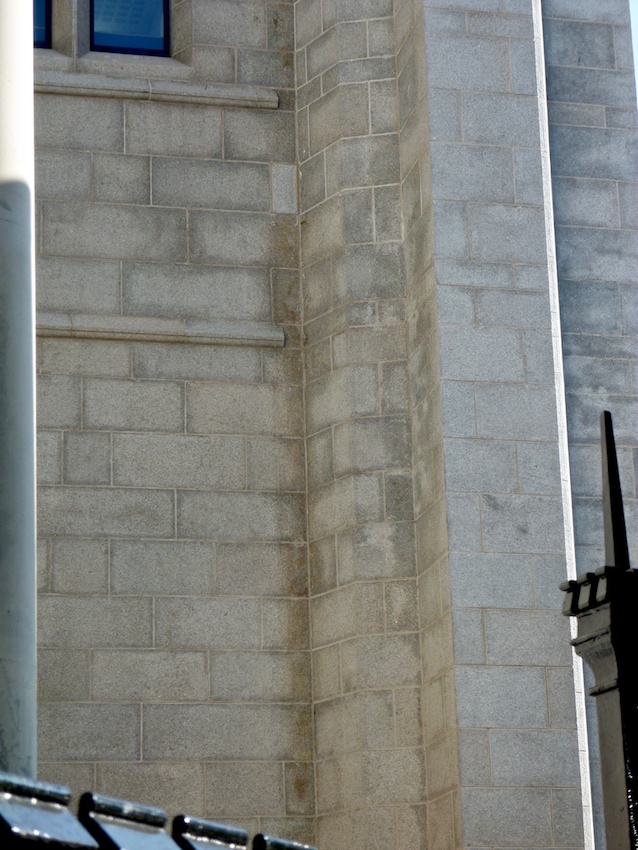
Firstly, Johanna thanks for your comment, but no; that's not right, it hadn't been raining. And yes; we have returned many times. Most recently on this beautiful dry hot bright Indian Summer afternoon today. Photos were taken - see below. The state of the facade has definitely not improved. If anything, the bright sunlight today threw the awful condition of the frontage into sharper relief than we'd seen before.

But that's old news now. What mostly surprises us about this matter is the denial which our fellow townspeople continue to exhibit when discussing the [botched] reconditioning of the Marischal College frontage and how [bad] it looks. As we said after our second visit:


http://otheraberdeen.blogspot.com/2011/04/marischal-college-second-look.html 
From a distance, or if you're passing through Broad Street in a vehicle, it looks OK-ish. Perhaps that's all that matters to whoever wrote the specification or managed the job on site. We prefer to take a slower, measured and more contemplative and up-close approach to our life within the urban realm, and it is this unhurried and ruminative attitude which has allowed us to notice problems at Marischal. We say that the standard of the work at Marischal is a scandal. We all should be outraged. But it seems we are at variance with the times, for when we try to discuss this issue with our fellow townsfolk, very few of them seem to have noticed. Or if they have, they deny that it's an issue.
----------//////////////


While we were there this afternoon, we sat on one of the benches beside the risibly literal new statue of Robert the Bruce, taking the time to look carefully and allow the atrocious state of the frontage to sink into our consciousness; taking the time to think about it and to think about and discuss between us what it means. During this rumination, we couldn't help but overhear some of the comments of the passers-by, comments which struck us with the cognitive dissonance of their stark contrast to what was actually being looked at. "Lovely," said the passers-by... "stunning"... "pristine"... "former glory"; it was as if a press release was being read out loud. We felt like strangers in a strange land where up is down and black is white. Joanna's comment above is not the first contact of its kind we've received on this matter, but it is one of the more polite. The fact that Aberdonians are willing, indeed keen, to disbelieve demonstrable facts and are happy, in the face of incontrovertible evidence, to openly contradict those facts or to make improbable excuses for them says much more about the situation of these Aberdonians than it does about the uncomfortable actualities themselves.

This is epiphenomenal. Which is to say that what we can learn about Aberdeen's people through their willing and wilful self-delusion on this matter tells us more about how Aberdonians fit themselves into the wider societal context than it does about their abilities as architecture critics. It tells us about the perceptual filters which these people are happy to don rather than confront a disappointing or difficult truth. It tells us of a false consciousness and an almost Pavlovian conditioning to which these people have, willingly or unconsciously, submitted or been subjected. This conditioning has rendered the populace compliant, unquestioning, malleable and directable. We can't help but wonder if there are other matters, matters more serious than the mere fucking up of a building reconditioning project, about which the Aberdonian public are willingly misled and are happy to wilfully misunderstand.
And we can't help wondering, thinking of the future, what other obfuscations of inconvenient truths will this emperor's-new-cloths-blind population be happy to swallow whole? And what beliefs, however egregious and incorrect, might be planted in the conditioned-compliant group-consciousness? And, in defence of these beliefs, what actions will those people be happy - eager, even- to take?

---ooo0ooo---


Wednesday, 6 July 2011

Bizarre Opaque Transparency from Aberdeen City Council.


////////////////////---------
>>>
Local government transparency 


 Getting council business out in the open will revolutionise local government and enable the Big Society. Transparency is the foundation of accountability. Local people should be able to hold politicians and public bodies to account over how their council tax is being spent, and decisions made on their behalf. It is also a powerful means of promoting efficiency, without requiring the heavy-handed intervention of an unaccountable bureaucracy.


>>>>>>>>>>>>>>>


>>>
City Garden - Project Monitoring Group

The role of the Project Monitoring Group is to oversee the City Garden project's progress and ensure that Council's interests, and that of the majority of Aberdeen citizens, are protected as the project progresses.

>>>>>>>>>>>>>


////////////


>>>>

City Garden Project Monitoring Group

Note of Meeting held at 9.30am on Friday 20 May 2011
Committee Room 5, Town House


<<<<<<<<<<<<<


>>>>


Sanitization and Redaction

Sanitization is the process of removing sensitive information from a document or other medium, so that it may be distributed to a broader audience. When dealing with classified information, sanitization attempts to reduce the document's classification level, possibly yielding an unclassified document. Originally, the term sanitization was applied to printed documents; it has since been extended to apply to computer media and the problem of data remanence as well.
Redaction generally refers to the editing or blacking out of text in a document, or to the result of such an effort. It is intended to allow the selective disclosure of information in a document while keeping other parts of the document secret. Typically the result is a document that is suitable for publication, or for dissemination to others than the intended audience of the original document. For example, when a document is subpoenaed in a court case, information not specifically relevant to the case at hand is often redacted.

Government secrecy

In the context of government documents, redaction (also called sanitization) generally refers more specifically to the process of removing sensitive or classified information from a document prior to its publication, during declassification.

Secure document redaction techniques

The traditional technique of redacting confidential material from a paper document before its public release involves crossing out portions of text with a wide black pen, followed by photocopying the result. This is a relatively easy to understand process and has only minor risks associated with it. For example, if the black pen is not wide enough, careful examination of the resulting photocopy may still reveal partial information about the text, such as the difference between short and tall letters. The exact length of the removed text also remains recognizable, which may help to guess plausible wordings for shorter redacted sections. Where computer-generated proportional fonts were used, even more information can leak out of the redacted section in the form of the exact position of nearby visible characters.

<<<<<<<<<<<<<<<<<<<<<


----ooo0ooo----


Regardless of the rights or wrongs, transparency or opacity, paranoia or caution which has motivated our elected local council representatives in our and their appointed executives minor provincial county town to undertake this 'redaction', it just looks bad. As one online commenter said:
Nice to see that everything is transparent so as to avoid the feeling of conspiracy and underhanded activity. Good confidence-building job. As ever.
But we have another point: the fact that this has been done should give us pause; should make us consider whether or not these people are suitably qualified, skilled, competent and suitable individuals to be trusted with the execution of this controversial project. We say this because we are not investegative journalists, we are not computer geeks, and we are not cryptologists - but nonetheless we managed to obtain quite by accident unredacted copies of the texts as we were preparing this post. Here are full, redacted copies of the minutes. If anyone wants copies of the unredacted text, you can contact us at otheraberdeen@gmail.com and we'll be delighted to oblige.


EDIT

Following our reportage of this hilarious mis-step, a local newspaper published this article, the and most of the redaction has been removed from the online copies of the minutes.
Thanks to blogger rxpell for the scan.


http://www.aberdeencity.gov.uk/nmsruntime/saveasdialog.asp?lID=38882&sID=16279

No blanks in that one.

http://www.aberdeencity.gov.uk/nmsruntime/saveasdialog.asp?lID=38884&sID=16281

The law firm name 'Brodies' has been blanked.

http://www.aberdeencity.gov.uk/nmsruntime/saveasdialog.asp?lID=38886&sID=16283

Again, the law-firm name 'Brodies' has been blanked.

We wonder why?