Showing posts with label livability. Show all posts

Thursday, 28 April 2011

A Turning of the Tide

A little while ago, we pointed out that the banner pic at the top of the Other Aberdeen blog has a significance beyond what might be apparent. We might change it one day, so here it is on this post:


There it is: Aberdeen's North Pier, Breakwater, Guiding Light and Harbourmaster's Tower photographed at the exact moment of the turning of a very high tide at the mouth of the Dee.

We've just returned from a few days on business in London, and were amazed to find out that while we were away a metaphorical tide had appeared to have turned in Aberdeen:

  • The Bon Accord Baths, it has been reported by Aberdeen City Council, are set to gain a tenant. The preferred bidder for the lease is to transform what we believe to be this truly iconic building into a stylish new arts centre. Not only are we are delighted that this internationally important building has a future but we are also very pleased that its new use will be as:
a new home for theatre, art and dance studios, a music recording studio and practice rooms for up-and-coming artists. The building could also host half-term holiday clubs for children and workshops for people of all generations, disabilities or backgrounds.
  • The future of The Belmont Picturehouse has been secured. A town-centre cinema valued for providing an alternative programme to the unchallenging anemic diet of Hollywood blockbusters available elsewhere, this arthouse cinema had been under threat of closure after the collapse of lease negotiations between the council (owners of the building) and potential new operators. A petition signed by more than 4500 cinemagoers was instrumental in making the council aware of the affection in which the Belmont Picturehouse's patrons held the cinema.
  • We learned of plans for a commercially-operated convenient car-share "car club" scheme in Aberdeen's town centre. Currently operating successfully in 46 other towns and cities across the UK, car clubs like these allow residents all the flexibility and envirnomental benefit of on-demand motor-vehicle use without the unnecessary environmental, economic and urban-detrimental overhead of actually owning a car - like a taxi you drive yourself. Take a smart BMW to a relative's wedding, take a Transit van to the tip. Brilliant.
Broadly speaking, a car club is an organisation that owns or leases, and maintains, a fleet of cars from which its members can book a vehicle whenever they need it. The club pays for tax, insurance, servicing, cleaning and fuel, whereas members pay a joining fee and a subsequent fee for each journey made ... Studies by Carplus, a national charity supporting responsible car use, have shown that 10% of car club members will give up owning a car or sell a second family car or defer owning a car in the first place. Typically, this results in ten vehicles slipping off the radar for each car club vehicle. The environmental benefits are evident, and individuals are encouraged to consider more closely whether they really need a car, or (more likely) whether they really need a second one.
All small things, yes, but taken together they represent incremental victories for those of us who hope to see Aberdeen build a broad base of creative capital within a new, livable, progressive, human-scale implementation of urbanism. This in turn will provide the foundation for a creative-arts-based regeneration of our city and a virtuous cycle of further iterative progress for the urban livability agenda - both of which being main interests and aims of this blog.

So often at Other Aberdeen we feel we are swimming against the tide. It has been nice to return from a few days away and find that we are, for the moment at least, going with the flow.

Fractal Dimension of Delight or Despair

It never ceases to amaze us how many times we see patterns repeat and laws of nature apply at various scales.

Economic growth progresses in cycles and epicycles, history repeats, social phenomena come and go and come again, normal distribution applies and self-similarity at all levels is exhibited in all phenomena; natural and artificial, historical and cosmic; all manifestations of reality are subject to the same forces which act upon them, whatever their location, whatever their scale, whatever we believe to be their wider subjective importance or otherwise.

As we engage in our psychogeographical praxis in and for Aberdeen, we find that the fractal dimension also extends to the urban realm (of course it does!), it being necessary only for us to slow down for the resolution of our senses to increase. In this way we seek and find the delight which forms the texture of our lives in the urban context. We connect forward and back the small to the large, the past to the future, the specific to the general and vice versa; this helps to lead us towards an independent and autonomous understanding of the world which we walk through; that being our ultimate aim both for ourselves and for all our fellow townspeople.

However, there is a negative corollary: Where by finding the connection between the specific to the general across orders of magnitude of scale we find delight, we might also find a warning for and from Aberdeen's urbanism. We saw this photo of a gardening contractor's van on the "Writing From Scotland" blog:


The wider significance of the fact that the garden contractor who's van this is believes that their Aberdonian clients would regard the removal of practically all greenery from their gardens and its replacement with blockwork and gravel as being a desirable outcome should be obvious to regular readers.


With thanks to Christine Laennec at Writing From Scotland for permission to reproduce the photo.

Monday, 11 April 2011

Second-Generation Psychogeography, Six Senses, Stuff and Subjectivity

An old friend contacted us and delighted us when he let us know he’d syndicated a feed of the Other Aberdeen blog onto the website of Edinburgh-based band Tramplord, along with this précis of our work:
Other Aberdeen is second generation psychogeography. It is a subjective encounter with the urban environment; but it is also an encounter that acts for solutions.  The experiments aren't those of the old fashioned flaneur who is playing with the rules, but are done with the urgency - not of artistic madness or vanity - but of people working for a better city.  This is not wine glasses and maps, no boy. In fact, wine glasses and maps are childrens' toys; and this is a mature psychogeography.
If you think of psychogeography as the anarchic and playful stuff of the 50s, 60s and beyond, this is OK.  But all the early psychogeographers learned from their drunken experiments was this: Experimenting in a subjective mode enlightens the individual psychogeographer no end yes! but it won't change Jack Shit in Babylon.
Other Aberdeen is also blessed with a brilliant subject.  Aberdeen is an unusual place, sometimes at variance with the UK in terms of all sorts of ideas and trends.  Things are always happening there. Worlds collide.  And all that.  It's a funny old corner of the world.

"Worlds collide ... funny old corner of the world..." So true. We very much appreciated the appreciation, and we revel in the tag: “second generation psychogeography”.

Notwithstanding the fact that if you study something too closely it can lose meaning through lack of context, we’ve been pondering just what this “second generation” is, what is it (what are we) for, and how does it do what it does? That is to say: what are our tools, how do we use them, and what do we hope to achieve?

It should be clear to regular readers that what we hope to achieve at Other Aberdeen is a subjective improvement in the livability of our town. Our aims are no more complex nor less ambitious than that. We aver that by picking certain psychogeographical implements from the toolbox anyone can cross the boundary between merely inhabiting an urban space and actually living in it. By actually making the conscious choice to live in (rather than merely occupy) our urban spaces we can re-root ourselves as human beings and re-boot urbanism within an often alienating urban environment. That process will, in its own turn, reduce the alienating overburden which is the legacy of the decades-long misunderstanding of urbanism which so often characterises urban realm spaces in the UK.

Desire line interchange. Hub?
Foremost amongst the methods we use is walking. Simple as that; and from that we bootstrap a whole range of subsidiary strategies - tools, if you will - which we use to explore and assimilate the urban environment within the context of getting on with all the other content of our lives. For instance, a relative of mine had a hospital stay recently (he’s fine now). Arranging and co-ordinating hospital visits between myself and friends and family members became a bizarre exercise in mostly telling people that I really really didn’t need a lift to travel the 2 kilometers between my home in Pitmuxton and Aberdeen Royal Infirmary. Regrettable though it is to have a relative in hospital, over the two weeks he was there, I took the opportunity to walk the streets, lanes, foot-paths and desire-lines of Queen’s Cross, Rubislaw, Mile-end, Raeden, Mid-stocket, Westholm, Foresterhill, Woodend, Summerhill, Mannofield and Rosemount in large, looping routes which descended into valleys of all-but-forgotten watercourses, traversed redundant farmyards now hemmed-in by Victorian terraces and ascended in the footsteps of historical quarry workers on their privileged rights-of-way to the high granite-bearing ridge along which the Anderson Drive trunk-road now runs. If time was short, and a direct route was necessary, my motor-centric car-dependent fellow hospital visitors were just amazed to find that I could walk the route from my front door to hospital bedside in only 10 minutes more than it had taken them in a car.

And this leads us to the secondary (but no less important) tool: time. To be alive in the 21st century urban environment is to be a privileged denizen of the most amazing labour-saving device yet conceived and realised by civilisation; the city itself. The urban construct is entirely for our convenience - we should use and exploit it as such, rather than allow it to oppress and use and exploit us. For instance, it amazes us that anyone submits themselves to the inhuman ordeal of physically going to the supermarket these days, when a month’s grocery shopping can be achieved in ten minutes and a couple-of-dozen clicks online. Of course, we’d much rather have human-scale independent-trader local shops or market-stalls for our unhurried grocery shopping - such a set-up creates community and a sense of place, encourages interpersonal discourse, provides diversity and bestows opportunities for the spontaneous generation and discovery of delight. We’d like to have all that; but in this town, in this era, we don’t. Maybe one day independent traders will return to the urban environment of Aberdeen. We wish.

Anyhow, the point is, with time on our hands, when we go outside to take part in the life of the town, we can take our time. We try to organise our lives so that we have time to take the time to think. The time to feel. The time to think about how we feel.

And, when we walk the town with time on our hands, something else happens. We find a centre within ourselves. We find that we re-discover our senses. We see the urban environment; we hear both the roar of the traffic and the songs of the birds; we touch walls ancient and modern, and the branches of trees brush our heads; we smell cut grass and Sunday gravy, sometimes Torry fish and Kingswells sharn; and yes we even taste - we taste the car-farted sulphurous particulate, wafted along major city roads and pooling in hollows.

The topography tells tales.
It says: "Take a closer look!"
And then, when we notice that our senses are alive in the urban environment; that we have all-stimulating surroundings - if we only choose and allow ourselves to be stimulated by them - something else again happens. Something very human and delightful and surprising indeed. We’ve seen travelogue and anthropological histobunk programmes on the telly discussing the Austrailian Aborigines or Masai or Bedouin or First Nation Americans maybe, and marveling at their sense of direction, their navigational abilities. Wow - no maps; wow - no satnav. We begin, in our own small way, to feel a little bit of that sense - that ability. The ability to orientate within a topography, the ability to estimate an incline, the recognition of three-dimensional landscape features. Is it too much to call this a sixth sense? Certainly we have in the inner ear an organ of orientation which is an inclinometer and gravimeter, and we have proprioception - the ability to intuitively know the relation of the various parts of our bodies to each other (this is the sense that allows you to touch the tip of your nose in the dark). We believe that when we take these three additional para-senses (orientation, gravity-awareness, body-self-sense) together in toto as we move through the urban landscape it allows us access to a mindscape in which there is an enhanced possibility of just noticing stuff. Stuff that you wouldn’t notice if you were preoccupied with something else, stuff you wouldn’t notice if you were in a rush, stuff you wouldn’t see if you weren’t looking and stuff you mightn’t expect to notice unless your mind was open to the possibility. Delightful stuff. You might discover a town that appears in parallel to the reality that others think they know - the town that is at right angles to, over, under and through the impositions of map-planned thoroughfares which disrespect the human-scale desire lines.

Water is wealth. Or, at least, it used to be.
Probably will be again one day
The stuff you notice might be geographical, topological or architectural. The stuff you notice might be historical; our heritage is all around us in a dynamic and continuous process. Or the stuff you notice might be contemporary or anthropological - modes of behaviour. But, notice stuff you will. You might begin to decipher the events and intentions, the hopes and disappointments, the stories of capital and community which are encoded within the built environment and its relationships. By thinking about this stuff, these things, we define them - and we lay down guidelines for how we (and others) might think about them in the future. There is no such thing as objective truth - all artifacts and concepts are subject to the excise tax extracted from their universal meaning by their entry through our personal gates of subjective perception. The most we can ever really define with personal certainty and the most we can therefore reasonably ask is: how do we feel?

What we do at Other Aberdeen is record how we feel about things in the urban environment - what these things do to us (collectively) by what we (collectively) do to them. This psychogeographical process is reflexive, and it is the very reflexivity of this process which furnishes the opportunity for iterative improvement in the urban environment. We seek a new understanding and practice of urbanism for Aberdeen based upon a desire to improve its livability. That would make us feel much better about remaining in this fascinating town with all its little and big stories; all its little and big artifacts; all the places and all the people - woven together where the past meets the present and gathers its forces to generate the future, however uncertain.

We are all part of that process, part of the story of the town - that participatory process is what Other Aberdeen's for. Today, many people seem to think that a town is merely the sum of all the business activity within it. Other Aberdeen's mission is to demonstrate that this is wrong-headed.

This town is so much more than that.

Friday, 11 February 2011

New Street Lamps for Pitmuxton.

Boring alert. Trainspotting alert.

Mmmm. Indeed. At first glance, a predisposition to be interested in such things; the routine replacement of vital street furniture/infastructure does seem a little, well, obsessive. But bear with us, we've got a point to make.

There can be no doubt that the streetlamps on some of the side streets of Pitmuxton had, um, reached the end of their life.
Not looking good.


And so to rest.

Brushed burnished.

Aluminium oxidised.

At eye-level, during the daytime, we like the new aluminium standards, we like the way the bare metal oxidises into crystal forms resembling camouflage shapes, and we like the fact that the standards are zero maintenance.

However, what we don't like is the extreme white brightness of the new lamps which have been installed on the main roads. We think that not enough research has been done into the effect that this extreme bright whiteness has on the livability of our streets. One might intuitively think that brighter is better, that this will improve visibility, that this will be a disincentive to crime, that it will improve road safety etc.

But, we believe that these lights have been specified by someone who does not ever walk the streets after the sun has gone down. Counterintuitively, we've found that the effect of these lights is to increase contrast, to deepen shadows, to dazzle the eyes and so to make visibility worse.

When we walk out at night, we find that our sightlines are overwhelmed with the glare of these new lights. Oncoming pedestrians who walk towards us are wreathed in silhouette shadow, we can discern faces and clothing detail less well than was possible before because the glare of the overly bright lights has stopped down our pupils to pinpricks and has effectively blinded us to human scale detail.

Human eyes are perfectly capable of operating in low-light, having evolved over millions of years operating in naturally low-light conditions. By attempting to turn night into day and shining lights as bright as can be wrangled directly into the eyes of pedestrians, the designers of our urban environment have dismissed this human heritage. It is clear that they have chosen these ultra-bright white lights to improve contrast, rather than allow human vision to discern fine detail. The night-time town is now a place with lighting highly suited to reading traffic signs and road-markings - high contrast items. But the light which falls on the pavement is not now suitable for identifying the faces of oncoming people on foot.

This choice has been driven by the needs of car drivers traveling at speed, and so normalises high speed motoring during the hours of darkness. By choosing to design the night-time townscape exclusively for the needs of motorists, our planners have turned the town into a high-contrast environment suitable for viewing at speed from behind a windscreen. They have struck another alienating blow against the needs of pedestrians. Thanks for that.

Thursday, 27 January 2011

Cognitive Dissonance, Churnalism, Think Tanks, Category Errors and Social Division

We couldn't help but wonder at the brain-clanging contradiction of some of the news about and affecting Aberdeen this week.

Firstly, on Monday, we had very upbeat local press and TV reports "Aberdeen to lead in economic recovery" This is from local TV station STV.
Aberdeen has been named one of the “cities to watch” as it is predicted to help Scotland come out of the recession and be protected from the effects of the Government's spending cuts.
The Grantite city is best-insulated from the economic impact of the government's spending squeeze and the best-placed to grow out of the economic downturn, the Center for Cities said.
Well, that sounds like great news! We noticed that local newspaper The Press and Journal (P&J) displayed street banners which said something like "Aberdeen: The Economic Dynamo That Will Pull UK Out Of Recession". (To be as fair as possible, the actual headline was marginally less hubristic "Aberdeen a key city to power UK recovery". Yet the following day we saw: City council confirms 900 jobs to go. And the day after: Double-dip fears grow as recovery nosedives. So, what's really going on? This needs a closer look...

The articles on the Monday spoke to and of a certain hubristic character in Aberdeen, one which we've mentioned before, and one which novelist Christopher Brookmyre fingered in his novel A Big Boy Did it and Ran Away.
Europe's Oil Capital. Honestly. The first time he heard the expression, he'd assumed it was a bit of self deprecatory humour. That was before he learned that there was no such thing as self-deprecatory humour in Aberdeen, particularly when it came to the town's utterly unfounded conceit of itself. It was a provincial fishing port that had struck it astronomically lucky with the discovery of North Sea oil, and the result was comparable to a country bumkin who had won the lottery, minus the dopey grin and colossal sense of incredulous gratitude. The prevalent local delusion wasn't that the town had merely been in the right place at the right time, but that it had somehow done something to deserve this massive good fortune, and not before time either.
We remember similar reportage in May last year when Aberdeen was given a "Top Rating" in an international survey for quality of life. What the local press failed to report then was the context of the survey. While rightly saying that "London is the only British city placed higher than Aberdeen", what the report did not say was that only 2 towns in Scotland were included in the survey; Glasgow and Aberdeen. In the the rest of the UK, the report only included the four towns Belfast, Birmingham, London and Oxford. We all know that the results would have been very different if had included the likes of Manchester, Edinburgh, Cambridge, Bath, Bristol, Cardiff, Leeds, York, Norwich, Brighton, Portsmouth, Southampton, Leicester, Swansea, etc. all of which were excluded from the survey.

Moreover, a little look at what exactly the purposes of the survey were proved enlightening. The survey was undertaken by global human resources consultancy employment agency Mercer. One of the activities of Mercer being to set up global moves for expatriate employees for whom they are agents. The quality of life survey is produced by them to help employees demand 'compensation' from their employers by way of hardship payments. The baseline is 100. Aberdeen's ranks below that 100 base. We might therefore provide our local press with an alternate headline:
Human Resource experts recommend hardship payments for international workers coming to Aberdeen.
But that wouldn't play well to our civic hubris reality distortion field, would it?

Returning to this week's overblown press reports of Aberdeen's economic dynamism, we note that the stories were prompted by this press release from the Centre for Cities "think tank". We can see that both the STV and P&J reports have simply cut-and-pasted text from the press release into their reports. This process is known as "churnalism", a practice exposed in depth in Nick Davies book Flat Earth NewsThe book was reviewed at the time in The Independent Newspaper as painting "a damning picture of a dysfunctional national press which is spoon fed by government and PR agencies and incorporates wire copy into stories without the most cursory fact checking." Clearly this practice is as widespread, if not more so, in the regional press as in the national.

The Centre for Cities think tank (or "policy institute") declares itself as independent and non-partisan. Fair enough. In the same declaration they say that they are committed to improving the economic performance of UK cities - but there is no immediate mention of the social, environmental or communitarian aspects of the urban sphere. Cities are, of course, more than just the sum of the businesses which operate in them. The Centre for Cities does recognise this, and in their report "Grand Designs" heralds and recommends a wholistic approach to urban liveability, which they recognise as a prerequisite of improved economic performance. They say:
  • Local and national politicians should accept that using regeneration plans to ‘go for growth’ hasn’t worked in every urban neighbourhood and can have negative as well as positive consequences on a city’s economy and residents.
  • A new way forward might mean building a park rather than a science park, or turning tiny terraces into larger homes, rather than knocking them down and building one bed flats. Communities should be given the power to decide on plans, testing out the neighbourhood planning approach expected in the Localism Bill.
Naturally, we approve. These recommendations are, of course, in contrast to initiatives announced and facts on the ground here in Aberdeen. And, unfortunately, in the Cities Outlook 2011 report (PDF), the Centre for Cities has looked only at the broad statistics which relate to economic performance without looking at the context in which those statistics sit.

For instance, the report is completely correct to point out that unemployment is low in Aberdeen when compared to the national average. But this is also true of other areas which are either rural or have a large agricultural hinterland and, therefore, primary-sector economies. Orkney, for instance, has lower unemployment than Aberdeen. It doesn't make Aberdeen a place with an especially dynamic or diverse and nimble economy. Check out our earlier post about Dutch Disease. Primary sector economies (agriculture, fisheries and resource extraction) have a lower equilibrium (or 'natural') rate of unemployment than economies based upon manufacturing, retail and services. In this second category a higher equilibrium rate of unemployment is required to maintain the profit rate. As the economy approaches full employment, wages are bid up and a crisis of profitability ensues (UK 1960 - 1973). In primary sector economies, no such 'reserve army of labour' is required, as wages are determined by yields and commodity prices, while the profit rate remains constant.

The Cities Outlook 2011 report compares Aberdeen with Milton Keynes, Reading, Leeds and Bristol. We feel that this is not comparing like with like. These other cities have diverse economies based on businesses which operate in secondary sector (value-added manufacturing) and tertiary sector (services). These four other cities create their prosperity and wealth via the judicious operation of capital combined with innovation which creates value. In Aberdeen, our primary sector economy dictates that we primarily sook what wealth we have from beneath the seabed, the value of that wealth being determined on international markets which no amount of local innovation or judicious operation of local capital will influence.

The Centre for Cities made a category error when they linked Aberdeen with these other four cities. Our local press has compounded and exaggerated this error, and indeed today continues to do so, calling for next generation broadband connectivity to "let Aberdeen lead [the economic] recovery". We are exasperated that this boosterism based upon fallacy continues to characterise our town, both in the local press and amongst credulous bloggers who's cupidity is such that they allow it to amplify their gullibility.

Now, let us not be misunderstood, there's much to be proud of in the business sphere in Aberdeen. But there's no need to try to enhance these good things with slavish cant which actually misrepresents reality. To do so devalues that which is genuinely good and praiseworthy. To do so undermines our standing amongst our competitor regions. And to do so undermines calls for the greater support from central government which will be necessary if we are to progress successfully through the transition to renewable energy. The rebalancing of our economy means changing from reliance on primary sector activity into exploiting secondary and tertiary sectors in the burgeoning renewable energy market. This will not be easy.

Despite all this, the reports are right to an extent. High oil prices do mean that the immediate and medium terms looks like being a profitable time for our local primary sector industry. However, affluence for some is not the same thing as wealth for our town as a whole. Aberdeen is already one of the most socially divided towns in the UK, with the most uneven income distribution in Scotland. The immediate economic prospects for our town suggest that this trend will only continue.

A handful of extremely wealthy tycoons and their executives will give our town a veneer of affluence, while the remains of the city and its society rot away beneath. Outsiders like the Centre for Cities might continue to see the veneer. Aberdonians will have to live with the rot.

Friday, 21 January 2011

Urban Dual Carriageways. The Future from the Past.

As our council continues pushing ahead with measures to "enhance" traffic flow at speed into the heart of the town centre to the exclusion of other transport options via the controversial "Berryden Corridor" (pdf) urban dual carriageway project, we continue to be nonplussed that such a discredited policy for traffic management continues to even be considered, let alone implemented.

It is telling that the report linked above is titled "Berryden Corridor Improvements", thus prejudicing it's own conclusions. That the creation of extra road-space exclusively for motor transport is an "improvement" is a conclusion which is increasingly seen as mistaken. We have written on this subject on one or two occasions before.

We so very much wish that it were true that congestion could be solved by the simple, seemingly common-sense expedient of building more roads. But, unfortunately, world-wide and decades-long experience of the building of relief-roads, bypasses and linkroads confirms without even a hint of doubt that it is not.

Note the "Proposed foot bridge over railway line".
Thanks for that.
As if this new pedestrian link will compensate for loss of
pedestrian permeability throughout the length of this new "corridor"

all the way from Woodside Fountain to Skene Square.

More and more, in every part of the world from Australia through Asia to Europe and even including the USA where the car is King, it is realised that more roads means more congestion and that the only thing which will reduce congestion is a policy which delivers fewer journeys undertaken by car.

It's a cliché and a truism to say that one of the definitions of madness is doing the same thing over and over again, and expecting different results. So why do we expect that building additional road capacity will have a different effect this time? It will not; it will merely impoverish us by further devastating parts of our town which are already suffering blight and degeneration.

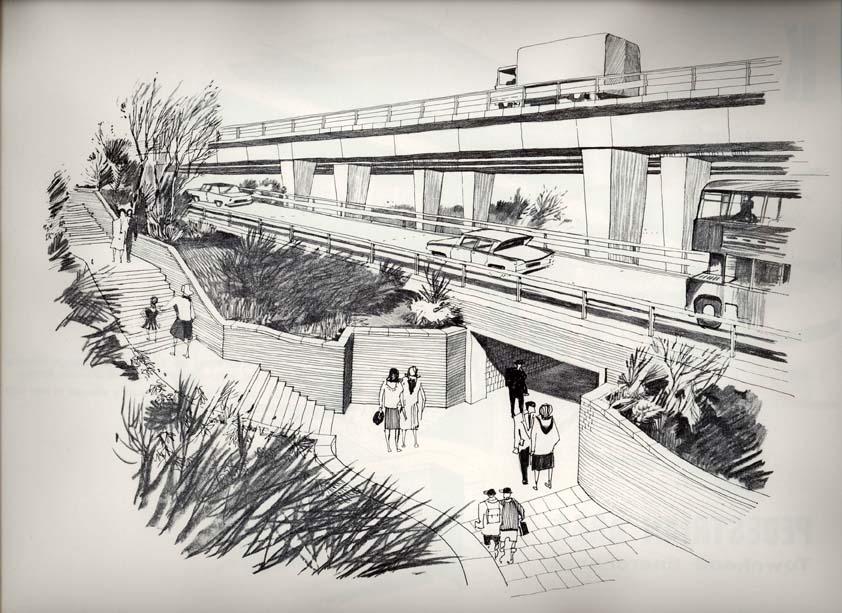
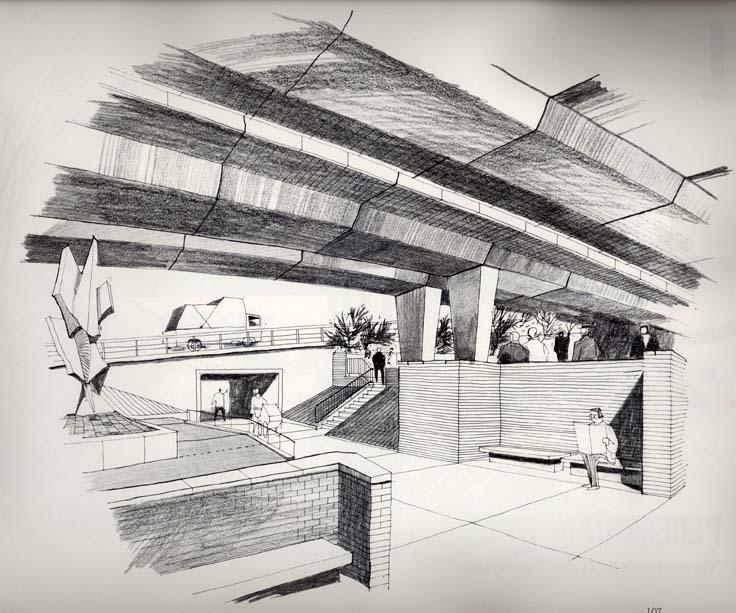
We are reminded of lessons unlearned elsewhere:

From Report on A highway Plan for Glasgow 1965.


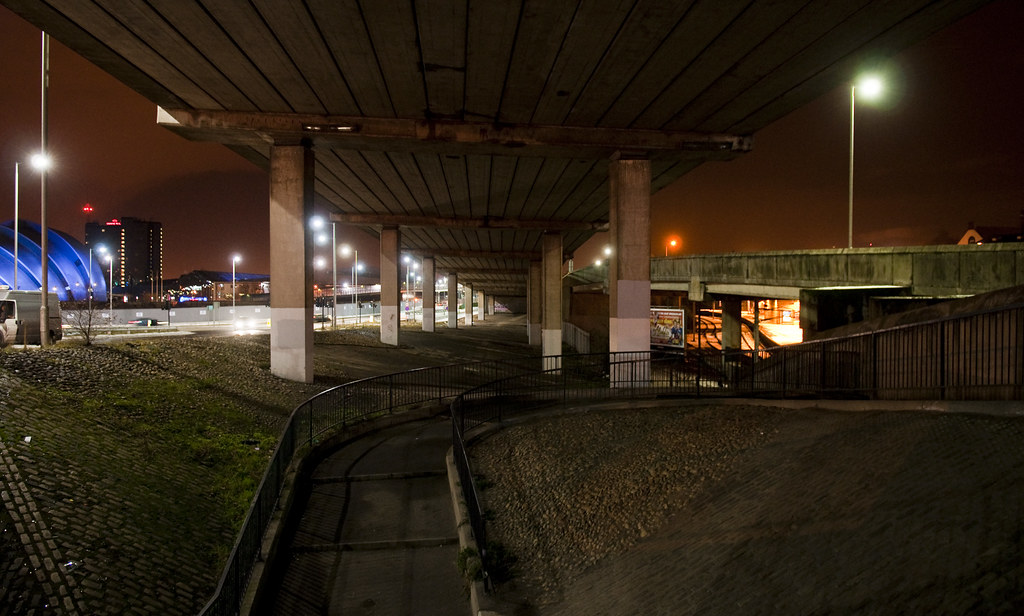
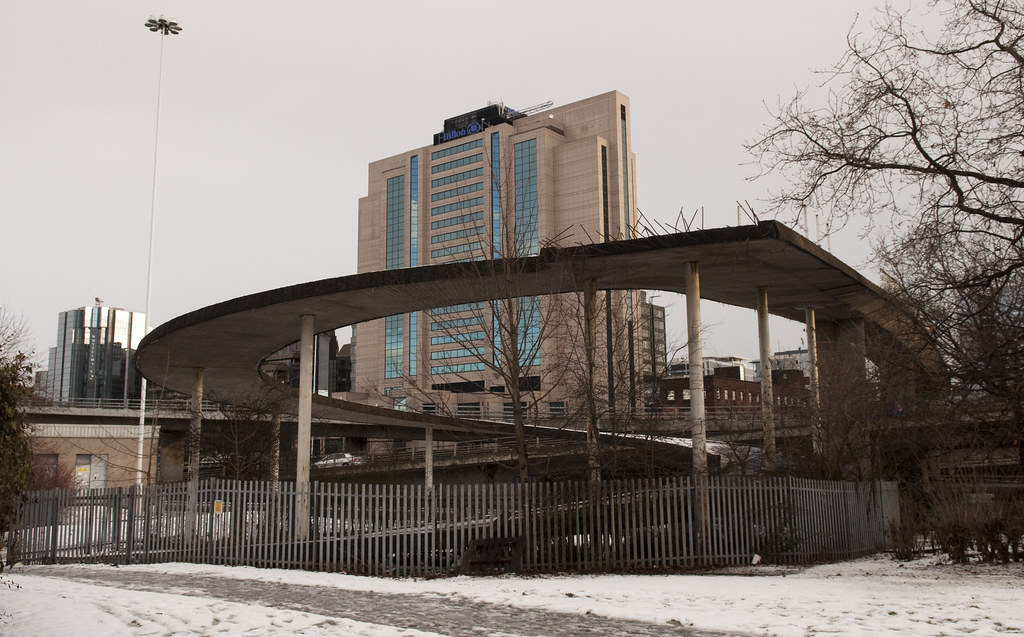
These paper-bound utopian visions, unfortunately, turned into an alienating horror in the real world.

From At War With the Motorist's splendidly psychogeographically logged visit to Glasgow: Crap cycling and walking in car sick Glasgow.


Glasgow continues on to repeat the same errors with new urban motorway and dual carriageway projects. It seems that we in Aberdeen cannot bear to be left out. As one commenter puts it: "Why would anyone want to walk anywhere when they can drive through the remains of the city at 50mph." And another: "Worth every penny, so it is. Heaven forbid that anybody might have to go anywhere, anytime at less than a respectable 60mph."

Should the Berryden Corridor urban dual carriageway be built as proposed, it will fulfil one function only - it will bring more motor traffic into the centre of town at an increased speed. From this function, effects flow: It will increase congestion; it will increase noise and atmospheric pollution; it will act as a barrier to east-west permeability and mobility for pedestrians and cyclists; it will isolate communities and it will have a detrimental impact upon the liveability of the inner part of our town north of the centre. It will thus increase social exclusion and alienation. This is the direct opposite of the study aims which, in the very first paragraph state that the project will "contribute to making Aberdeen’s transport network more efficient and sustainable over the coming years, ensuring that the city remains an attractive place to live, visit and work."


In the past, we have praised Aberdeen's surprisingly good cycling profile and we regularly revel in it's fantastic network of quiet and serene pedestrian paths which take walkers away from the stress of interacting with motor traffic.

We'd hate to have to reverse our position on this, particularly when our non-car infrastructure is beginning to gain International Fame.

Thursday, 20 January 2011

Building Societies to Pawnbrokers. Doughnuts to Donuts.

Timely and perceptive article in today's Financial Times (registration required):
The changing face of Britain’s high streets
Today’s high street is very different to a snapshot of the average one in October 2008, a month after the Lehman collapse.
Building societies, recruitment agencies, estate agents and pubs have vanished from neighbourhood shopping streets, according to data compiled by the Ordnance Survey, the national mapping agency.
However, not everybody is shutting up shop. High street bookmakers were the only category to see significant growth, with their numbers up 5 per cent over the two-year period.
Demand from pound shops, pawnbrokers and bakers is also in evidence, demonstrating the increasing social stratification of the high street as wealthier shoppers drive to out-of-town retail parks and malls.
And saucy FT comment here:
Lombard: Bookies inherit the high street
The meek will inherit the earth, but the bookies are inheriting the high street.
Building societies, temples of prudence staffed by priestesses in polycotton, are closing branches by the thousand. Betting shops are springing up instead, luring the populace with the cash-gulping idols that are fixed-odds gambling machines.
We've certainly noticed this happening in Aberdeen. Pawnbrokers, pay-day-advance moneylenders, pound shops and plush-looking bookies (bookasinos) all join the dots with vacancy, dilapidation and blight to plot a psychogeographical picture of our transvolving town.

The British doughnut, a lump of indifferent carbohydrate with jam in the middle, describes rich inner-city development surrounded by acres of gloom.
Easy credit money flows into city-centre apartment and commercial development in the 1990's and early 2000's. The near-centre residential and light-industrial zone which surrounds the centre is abandoned. That was then, but now...
The “doughnut effect" ... confusingly describes the opposite phenomenon to the “donut effect” that American planners talk of. The American donut, a sugary ring with an empty centre, is a fine metaphor for the rich suburbs around a collapsed inner city.
...the British  "Doughnut Effect" of the 1990's and 2000's turns out to be a chimera, a bubble blown by easy finance and collapses into the American "Donut Effect" after all. Confusing.


However, in Aberdeen we are optimistic that not all is lost. We have noticed some multiple grocery retailers (Tesco, Sainsbury, Co-op) beginning to re-occupy medium-sized and small town centre and local node sites. These car-park-less small scale need-responsive shops are designed not for customers to buy a month's worth of food, but rather just to pop in for something which is needed today. The large multiples are going back to the future and re-inventing the corner shop. Indeed, the Co-op's TV advertising campaign seeks to make capital of the fact that that, as a customer on foot - buying food fresh whenyou need it - you reject car culture and contribute to the pleasant livability of the town and your own well being and quality of life. But then, the Co-op are just a bunch of communists

As opposing forces both seek to hollow out and re-occupy the town simultaneously, we are thrilled by the dynamic of this unfolding urban narrative. We are particularly interested in the fact that Tesco, for one, seem to be playing on both sides.

We truly have no idea where to place our bets on how it will land.

Tuesday, 18 January 2011

Granite Crisis!

Over the years that we've lived in Aberdeen, we've noticed a tendency amongst the population: an odd attachment to "The Granite" and a willingness to fetishise it beyond reason. We find it odd, because there's nothing unusual in a town to being so homologous in its predominant construction material - most are.

Let's be sure not to be misunderstood. The architecture of late 19th and early 20th Century Aberdeen is unquestionably magnificent and praiseworthy. But this is now the early 21st Century. Architectural alternatives to the still-prevailing Victorian paradigm do actually exist and we should not be afraid of them. Indeed it's true that the dove-grey and shimmering stone from Kemnay and Rubislaw and other quarries is a very high quality building material, but - in the final analysis - a building material is all it is. And now there's none left that can be economically extracted. Alternatives do exist; we should, similarly, not be afraid of them either. Indeed, our irrational attachment to "The Granite" might now have more psychogeographical drawbacks for us than it has benefits.

We are nonplussed that every so often there's talk of a "Granite Museum" (!). We are perplexed that Big Oil manages to manufacture consent amongst the population by paying documentary-film lipservice to our town's granite heritage. And we are downright confused that "matching" granite for new development is sourced from far-flung quarries on the other side of the world. Why is it necessary that new buildings ape the old in every possible respect? If there's one good thing to be said about Stewart Milne's risibly Disneyesque Dalhebity House, it's that he chose to transcend the granite paradigm, build it from sandstone and so perhaps set a precedent which will allow our town to move on.

Next, we are faintly embarassed that Aberdonians continue to boast of Marischal College: "The Second Largest Granite Building in the World." Honestly, "second largest". It's like that Community Chest card you get in Monopoly: "Congratulations, you have won second prize in a beauty contest". It's an insult. We insult ourselves with this bathetic and vainglorious hubris.

We also feel that -  just as the Georgian/Victorian fakery of kilt and highland games and gathering of the clans to this day helps keep Scotland down: in its place, in the past - likewise this fetishisation beyond reason of our granite heritage has the potential to act as a brake upon the realisation of a progressive Aberdeen of the future.

But finally, and most importantly, (and it is important that we admit this), The Granite is now, after a hundred years in situ, mostly just a disgusting mess.

Truly horrid

Disgusting

Embarrassing (click the pic to see the full-size HORROR!)

Foul
We have already discussed on more than one occasion the difficulties and pit-falls which are experienced when building owners attempt to clean their facades. Aberdeen is turning yellow with the failures.


And then, if a building is successfully cleaned, it merely serves to highlight the grimy dilapidation of its neighbours.
Dirty to the left, as if new to the right.
Given all this, we think it's now time to think the unthinkable, time to slaughter a few sacred cows. Now is the time to break this restrictive tabu.

We are prepared to offer a radical solution:


Paint these troublesome buildings

A precident already exists in Aberdeen. Rather than clean modernist concrete buildings, many have recently had their fascias painted. Johnstone House in Rose St. is the first which comes to mind, and we think that Shell's Aztec Ziggurat at Altens Farm Road recently got the treatment too.

Baby blue Johnstone House
Indeed, Aberdeen has some modernist tower blocks which combine concrete elements with granite rubble decorative insets. These have been painted. Nobody moaned.

before


after

Looks great. As if brand new.
The benefits of painted facades for Aberdeen's troublesome granite buildings are manifold: The building's facade becomes flexible and easily and cheaply refreshable - changeable to suit fashion or function, whim or caprice; we could at last move away from our dour "Granite City" image and become something altogether more attractive and approachable - the "Ice Cream Pastel City by the Sea"; in the fulness of time, this could become a distinct new aspect to our heritage - unique in the UK - perhaps at long last we would gain the spot on the tourist map which we deserve.

Here are some examples from Do You Know:

Of course, not all of these will be to everyone's taste, but that's part of the beauty of the idea - it's diverse, thought provoking, de-familiarising and playful. And, once you've made the leap to decide to paint a building, you have literally rendered it's appearance infinitely changeable.


[Puts on flame-proof boiler-suit]

Thursday, 4 November 2010

An Apple of Gold in a Basket of Silver

Recently, there's been a lot of controversy about the proposed redevelopment of Union Terrace Gardens in the centre of Aberdeen.

As far as we can see, the 'City Square Project' is (was?) a speculative real-estate development proposal which would transform the garden in the city centre into an underground car-park and label its roof a 'civic square'. This reminded us of Aberdeen's Golden Square. Which now has it's own website. Yay!
(Maybe they'll get some content sorted out before the registration lapses next year.)

Golden Square in the 1867 Ordnance Survey 
Golden Square today
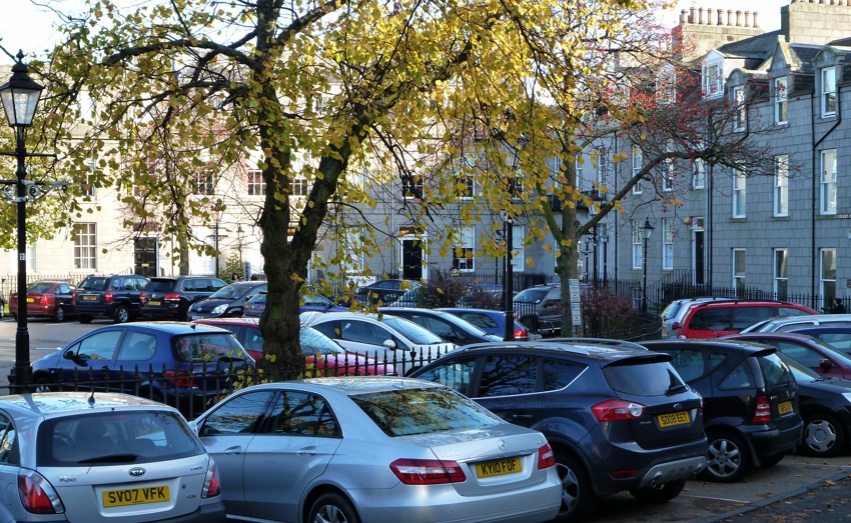
Yes (in common with what is proposed for Union Terrace by the boosters of the City Square Project) Golden Square was once characterised by a central garden area which is now given over exclusively to motor cars. And it's called a square.


We had a great laugh when we read a risible article on this pro-motorcar lobbying blog (beware popups, ugh!) which suggested that a Trevipark robot-controlled automatic underground parking system had been proposed for Golden Square. I couldn't help but remember a Thunderbirds episode from my childhood when a system like that was used by the characters - with disastrous consequences! Call International Rescue!

Thunderbirds

Trevipark

Aberdeen author John Aberdein touched on the cognitive dissonance provoked by the present configuration of Golden Square in his splendid satire on civic Aberdeen - Strip the Willow... Two characters are discussing the fact that Aberdeen fails when compared to its continental competitors for lack of a civic square. They then, of course immediately realise their mistake, and identify Golden Square as just such a continental-style human-scale civic square. They then bemoan the fact that it's given over to car-parking. They decide that the urban environment would be greatly improved by the installation of seats in the square - and then they point out that there are, indeed, usually dozens of seats in Golden Square - it's just that they're always exclusively locked away in metal boxes.

Plenty comfy seats. But locked in private metal boxes.
There was a moment, just a moment, when it seemed that Aberdeen City Council might return the centre of the square to human-scale (rather than motorcar-scale) use, but, unfortunately, it seems that financial mismanagement and the resultant ensuing austerity has lead to a kind of money-grabbing pragmatism. You can read more detail about it on rxpell's Moved To Comment blog. Thanks also to rxpell for this photo:


The statue of the Duke of Gordon (who he?) was placed in Golden Square in the 1950's. The statue is notable not for the person it depicts but for the fact that it was sculpted by a Thomas Campbell in 1841-2 of Dancing Cairns granite and so was one of the first statues to be cut in granite since the Ptolomies of ancient Egypt.

With a continentally-renowned concert hall, cafe-bars, restaurants, offices, cathederal, theatre, flats, and townhouses surrounding - in our opinion motor cars should of course be discouraged from entering Golden Square and North and South Silver Street. Golden Square could then be something really special; with Silver Street on either side, Golden Square could once again be described as the proverbial "apple of Gold in a Basket of Silver". The same goes for Bon Accord Square to the south of Union Street. Both those areas would then (if this vision were realised) make fine, human-scale, slightly bohemian (definitely Grecian) mixed-use urban-village type-things.

Isn't that what we all want?