Showing posts with label blight. Show all posts

Friday, 5 August 2011

Entropic Modern


--oo0oo--

With a nod of thanks to the correspondent who recommended the art of Gair Dunlop, and gratitude to Gair himself for the quality of that work, which we enjoy again and again in the variety of projects of his which are online. We're sure Gair won't mind us borrowing the name of his blog - Entropic Modern - for this post.

------§§§§§§§------


>>>>>
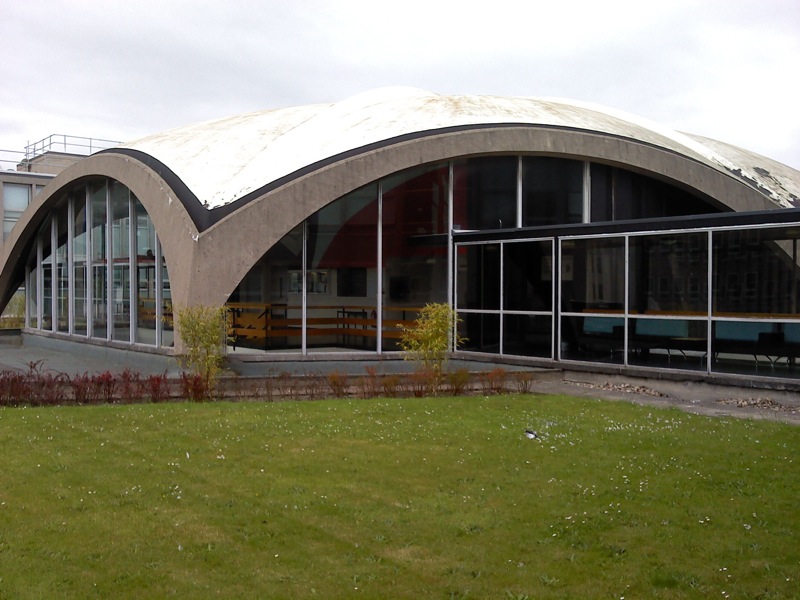
As we explore the urban environment of our isolated northern energy-boom town, we encounter modernist buildings and places, spaces and atmospheres designed or otherwise which put us in mind of the observations invoked by Gair Dunlop's art. The sense of a future that never quite got here, the sense of an unfulfilled promise. A feeling that something civilisational peaked at some point towards the end of the 20th century, and - its reach exceeding its grasp - that something, whatever that something was, is now ebbing away...

We remember the 1960 film of HG Wells' 1895 novel The Time Machine in which a time traveller projects himself from fin de siècle into the far future where he finds a society of enervated, illiterate vegitarians - the Eloi - living amid the splendrous ruins of an impressively advanced modernist civilisation. In the film, the Eloi are viciously preyed upon by a degenerate species of de-evolved humans - the Morlocks. But the cold-war exigecies of the day meant that the 1960 film made some significant elisions to the original Wells text and its societal and political implications.


------§§§§§§§------


<<<<<<<<<<<
http://en.wikipedia.org/wiki/The_Time_Machine#Plot_summary

[...]
Time Traveller tests his device with a journey that takes him to the year 802,701 A.D., where he meets the Eloi, a society of small, elegant, childlike adults. They live in small communities within large and futuristic yet slowly deteriorating buildings, doing no work and having a frugivorous diet. His efforts to communicate with them are hampered by their lack of curiosity or discipline, and he speculates that they are a peaceful communist society, the result of humanity conquering nature with technology, and subsequently evolving to adapt to an environment in which strength and intellect are no longer advantageous to survival.
Returning to the site where he arrived, the Time Traveller finds his time machine missing, and eventually works out that it has been dragged by some unknown party into a nearby structure with heavy doors, locked from the inside, which resembles a Sphinx. Later in the dark, he is approached menacingly by the Morlocks, ape-like troglodytes who live in darkness underground and surface only at night. Within their dwellings he discovers the machinery and industry that makes the above-ground paradise possible. He alters his theory, speculating that the human race has evolved into two species: the leisured classes have become the ineffectual Eloi, and the downtrodden working classes have become the brutish light-fearing Morlocks. Deducing that the Morlocks have taken his time machine, he explores the Morlock tunnels, learning that they feed on the Eloi. His revised analysis is that their relationship is not one of lords and servants but of livestock and ranchers, and with no real challenges facing either species.
[...]
>>>>>>>>


http://www.cryptonomicon.com/beginning.html
Neal Stephenson
In the Beginning was the Command Line

<<<<<<<<<<<
Contemporary culture is a two-tiered system, like the Morlocks and the Eloi in H.G. Wells's The Time Machine, except that it's been turned upside down. In The Time Machine the Eloi were an effete upper class, supported by lots of subterranean Morlocks who kept the technological wheels turning. But in our world it's the other way round. The Morlocks are in the minority, and they are running the show, because they understand how everything works.
The much more numerous Eloi learn everything they know from being steeped from birth in electronic media directed and controlled by book-reading Morlocks. So many ignorant people could be dangerous if they got pointed in the wrong direction, and so we've evolved a popular culture that is (a) almost unbelievably infectious and (b)neuters every person who gets infected by it, by rendering them unwilling to make judgments and incapable of taking stands.

<<<<<<<<<<<


------§§§§§§§------

The below-ground life of the Morlocks in The Time Machine makes us think of the recently-published musings of those who would influence the future of the built environment in our town. In their recently published and hubristically titled "Genius Loci" document (beware - direct download PDF), we can read about their obsession with covering streets over, with putting shops and public spaces underground and under domes. We cannot understand this obsession. We cannot understand why these people are afraid of the sky. Maybe, because our town's predominant hydrocarbon industry is responsible for putting the "fear" in the atmosphere, our business community would prefer that we not look at the sky, out of shame for what they are doing to it.

These business interests would plan for us an underground life, just like depicted in  another other sci-fi film of the latter part of the 20th Century - 1976's Logan's Run  in which the population are shown inhabiting a futuristic underground setting (actually filmed in the then relatively new and thrilling underground shopping malls of Dallas and Forth Worth) where they enjoy an orgiastic lifestyle of unrestrained consumption in a consequence-free environment. But then, as we watch, we learn that the consequence they must face is a mandated limited lifespan with compulsory euthanasia administered during the spectacle of a quasi-religious ceremony at age 30. Those who try to flee from the society (the freedom-seekers know as "Runners") are ruthlessly hunted down by paramilitary death-squads known as "Sandmen".

------§§§§§§§------


So now, as we range over the decaying of the modernist dream on the streets of our town - a dream from an era when optimistic people with altruistic visions believed in good faith that they could improve society as a whole from the top down - we detect an interesting parallel decay in the discourse of our time. Whereas once it was believed that the the economy and society could be planned and structured to work for the benefit of all its members with equality and justice, now such beliefs are regarded with more contempt even than fringe cult faiths and are thought to be illiberal and totalitarian in intent. Whereas once it was thought that rationality and the scientific method could iterate a design for life and improve lives, now our faith is in market-based solutions and minimum government intervention - indeed, a minimal state - to allow Hayek's "spontaneous order" to emerge from below.

The message we see in the decay of urban modernism is a message of freedom, written in the dust for those who know how to read it: No-one is going to design our lives for us. Society (if it exists) does not care and will not care. It is up to us as free individuals to choose what we will be.

Eloi or Morlock? Sandman or Runner?


Friday, 24 June 2011

IF IT AINT BROKE, BREAK IT.

-----------######-----------

"Eff you Gideon. I am withdrawing demand from the economy because of your inflexible high VAT policy. I'm going into town for lunch. But I'VE MADE MY OWN SANDWICHES!
"And I've got a flask."

-----------######-----------


<<<<<<<<<<<<<<<<

http://thecitygardenproject.com/background.asp

The City Garden Project proposes to radically transform a strategic central location by raising the inaccessible, under-used Union Terrace Gardens 


http://thecitygardenproject.com/background.asp

The City Garden Project has been spear-headed by ACSEF following the announcement by Sir Ian Wood in November 2008 that he would pledge £50 million towards a transformational scheme to redevelop Union Terrace Gardens and the Denburn Valley. Similar transformational schemes have been considered by the city before but have failed due to a lack of private sector funding.

>>>>>>>>>>>>>>>>>>


<<<<<<<<<<<<<<<<<<<<<<<<<

http://thecitygardenproject.com/funding.asp

The City Garden Project will cost around £140 million.
It is anticipated that half the money will come from the private sector and half from an innovative funding mechanism known as Tax Incremental Finance (TIF).

>>>>>>>>>>>>>>>>>


<<<<<<<<<<<<<<<<<<<


TIF was devised in the US, where it has been hugely popular with cities as a tool that has enabled them to tackle urban blight. The key benefit of the scheme is that it enables local authorities to raise finance to fund the critical infrastructure needed to get major regeneration schemes of the ground.

>>>>>>>>>>>>>>>>


<<<<<<<<<<<<<<<<<<


The letter sent by Mayor Menino identified these issues clearly and in a colorful way. Mayor Menino speaks for all urban residents when he writes, “Let’s be clear about what blight means. It’s not just about aesthetics, though it certainly scars an urban environment. Blight kills jobs by destroying an area’s appeal to businesses and customers. It destroys a neighborhood’s residential appeal. It drives property values down, and it promotes crime. The notion that you would purposefully cause this to occur–not due to financing difficulties or other problems beyond your control, but as an intentional cynical ploy to extract concessions from the public sector–is inexcusable.”


=======§§§§§§§=======

Wednesday, 23 March 2011

Twenty-eight Percent.

Last night, we were along to Peacock Visual Arts to attend the premier screening of Fraser Denholm's timely and apposite documentary film: "Run Down Aberdeen."
(Own-trumpet-blowing warning: Other Aberdeen's Alan was one of Fraser's interviewees in the doc.)

The film was followed by an open-floor and panel discussion, with the film-maker Fraser flanked by local politicos Deputy City Council Leader Cllr Kevin Stewart, Cllr Martin Greig and Lewis Macdonald MSP.

Here's the film to watch online - pass it on:


Run Down Aberdeen from Fraser Denholm on Vimeo.

We'll write a bit more about the film and the issues it covers later today, but for now we want to explore one particular statistic - mentioned in just one sentence during the floor discussion - from our Deputy Council Leader, Cllr Kevin Stewart.

A question from the floor relating to Aberdeen's role in the Oil and Gas industry was being handled by the panel. Labour and SNP agreed wholeheartedly that Aberdeen was an "economic powerhouse". And that's not just for the North East, but for the whole of Scotland and the UK, according to Lewis Macdonald MSP. Deputy Council Leader, Cllr Kevin Stewart, said that Aberdeen contributed 28% of UK tax revenues to the UK Exchequer.

This is not true. And the fact that both Stewart and Lewis believe that it is tells us more about these politicians than they mean it to. Just have a think about it... that statement suggests that of all the revenue collected by the UK government, more than a quarter comes from the economic activity of less than half-a-percent of the population. What an assertion to make! Really, if this were the case the whole world would beating a path to our small corner to learn the secrets of our special sauce.

But we've seen this error trotted out before by local press and local business-sector bloggers. (We trust that it is a genuine misunderstanding - and not a willfully disingenuous manipulation - politicians wouldn't do that, would they?) So, let's see where the source of the error comes from:

Firstly, like all misunderstandings of this type, it contains a kernel of truth. The 28% figure is within this document (big PDF) from special-interest business lobby group Oil & Gas UK.
[Edit: The figure has actually been revised recently, and now stands at 30% - even more than Cllr Stewart asserts!]

But, that 28% figure relates to Corporation Tax revenue - not all revenue, and it relates to the entirety of the oil and gas sector, not just the 'upstream' (finding and getting) activity which dominates business in Aberdeen.

So, for the avoidance of doubt, Oil & Gas UK rightly assert that the oil and gas industry generated 28% of UK corporation tax receipts during the tax year 2008/09.  But ask yourself: "What else happened during that period?" It's then quite easy to see why the oil and gas industry banked more than the "Square Mile in London" (as has been said elsewhere) at that time: As the oil-price spiked to that $147/barrel record, the energy companies enjoyed windfall taxable profits against the dark background of the financial sector falling into more-or-less ubiquitous loss. It is also relevant to point out that many UK Oil & Gas sector companies operate in a variety of overseas locations, but are stock exchange listed in the UK.

It is also telling that our local representatives to attempt to attribute the entirety of that oil and gas activity exclusively to this town. This is risible. Upstream (finding and getting) oil and gas is a cost centre for the energy companies. Profits are generated in transport, refining, trading, electricity generation & transmission and value-added retail. None of which impinge much on this region. We are exasperated that this boosterism based upon fallacy continues to characterise the discourse in this town and is continually repeated by our local press and politicians. We find it a bit nauseating.

Our local politicians appear to have fallen into the trap of believing Aberdeen's hubristic self-styling as Oil Energy Capital of Europe. It is not. London, Rotterdam, Paris and Moscow vie for that title. No-one outside Aberdeen who works in this huge industry which spans many regions and activities calls Aberdeen "Energy Capital of Europe". When these people in the industry outside Aberdeen hear the term they snigger, as a rule. In the words of novelist Cristopher Brookmyre:
"Europe's Oil Capital. Honestly. The first time he heard the expression, he'd assumed it was a bit of self deprecatory humour. That was before he learned that there was no such thing as self-deprecatory humour in Aberdeen, particularly when it came to the town's utterly unfounded conceit of itself."
Now, please don't misinterpret what we're saying. There's definitely much to be proud of in the business world in Aberdeen "City and Shire" (ugh). But there's no need to "enhance" these good things with disingenuous or demonstrably false hubristic misrepresentations which make us look vaingloriously stupid. To do so devalues that which is genuinely good and praiseworthy about our town. To do so undermines our standing amongst our competitor regions. And to do so undermines calls for greater support from central government and other non-governmental actors - help which Fraser Denholm's pertinent and well-timed new documentary aptly demonstrates that we need.

The future will contain many challenges. We need to face them with open eyes and realism. As we've said before, oil and gas reserves are finite. The day will come when we will all dearly wish that we had started down the difficult road of re-balancing our energy supply earlier than we have. In Aberdeen we will, additionally, wish that we had started down the road of re-balancing our local economy a little earlier too.


At Other Aberdeen we greatly fear that the currently high oil prices, the hubris they inspire and the offensive (and, as we have seen, ill-founded) triumphalism they provoke militates against the redirection of capital towards the development of a sustainable economy in Aberdeen, be that in the shape of the switch to renewable energy technology, the burgeoning development of the Scottish life sciences sector or other more traditional business sectors. We, unsurprisingly, would be happiest to see the creative and arts sector help lead in the regeneration of Aberdeen's built townscape and business landscape through grassroots bottom-up inclusive creative initiatives. We were gratified to hear during the panel discussion that Lewis Macdonald MSP supports this hope.

But then, there we were, at Cineclub hosted by Peacock Visual Arts. Should we have been surprised to see a politician (who is seeking re-election) wearing his metaphorical "I support the Arts" badge? Not for the first time this week, we realise that to ask the question is to answer it.

Tuesday, 8 February 2011

The Ongoing Yellowing of Aberdeen

We've already mentioned once or twice over the months the yellowing of some buildings in Aberdeen, and the possible mechanism which is causing it as contractors botch attempts at cleaning the old stone.

This one, on Ferryhill's Crown St. is the worst we've seen yet:


Thursday, 20 January 2011

Building Societies to Pawnbrokers. Doughnuts to Donuts.

Timely and perceptive article in today's Financial Times (registration required):
The changing face of Britain’s high streets
Today’s high street is very different to a snapshot of the average one in October 2008, a month after the Lehman collapse.
Building societies, recruitment agencies, estate agents and pubs have vanished from neighbourhood shopping streets, according to data compiled by the Ordnance Survey, the national mapping agency.
However, not everybody is shutting up shop. High street bookmakers were the only category to see significant growth, with their numbers up 5 per cent over the two-year period.
Demand from pound shops, pawnbrokers and bakers is also in evidence, demonstrating the increasing social stratification of the high street as wealthier shoppers drive to out-of-town retail parks and malls.
And saucy FT comment here:
Lombard: Bookies inherit the high street
The meek will inherit the earth, but the bookies are inheriting the high street.
Building societies, temples of prudence staffed by priestesses in polycotton, are closing branches by the thousand. Betting shops are springing up instead, luring the populace with the cash-gulping idols that are fixed-odds gambling machines.
We've certainly noticed this happening in Aberdeen. Pawnbrokers, pay-day-advance moneylenders, pound shops and plush-looking bookies (bookasinos) all join the dots with vacancy, dilapidation and blight to plot a psychogeographical picture of our transvolving town.

The British doughnut, a lump of indifferent carbohydrate with jam in the middle, describes rich inner-city development surrounded by acres of gloom.
Easy credit money flows into city-centre apartment and commercial development in the 1990's and early 2000's. The near-centre residential and light-industrial zone which surrounds the centre is abandoned. That was then, but now...
The “doughnut effect" ... confusingly describes the opposite phenomenon to the “donut effect” that American planners talk of. The American donut, a sugary ring with an empty centre, is a fine metaphor for the rich suburbs around a collapsed inner city.
...the British  "Doughnut Effect" of the 1990's and 2000's turns out to be a chimera, a bubble blown by easy finance and collapses into the American "Donut Effect" after all. Confusing.


However, in Aberdeen we are optimistic that not all is lost. We have noticed some multiple grocery retailers (Tesco, Sainsbury, Co-op) beginning to re-occupy medium-sized and small town centre and local node sites. These car-park-less small scale need-responsive shops are designed not for customers to buy a month's worth of food, but rather just to pop in for something which is needed today. The large multiples are going back to the future and re-inventing the corner shop. Indeed, the Co-op's TV advertising campaign seeks to make capital of the fact that that, as a customer on foot - buying food fresh whenyou need it - you reject car culture and contribute to the pleasant livability of the town and your own well being and quality of life. But then, the Co-op are just a bunch of communists

As opposing forces both seek to hollow out and re-occupy the town simultaneously, we are thrilled by the dynamic of this unfolding urban narrative. We are particularly interested in the fact that Tesco, for one, seem to be playing on both sides.

We truly have no idea where to place our bets on how it will land.

Tuesday, 18 January 2011

Granite Crisis!

Over the years that we've lived in Aberdeen, we've noticed a tendency amongst the population: an odd attachment to "The Granite" and a willingness to fetishise it beyond reason. We find it odd, because there's nothing unusual in a town to being so homologous in its predominant construction material - most are.

Let's be sure not to be misunderstood. The architecture of late 19th and early 20th Century Aberdeen is unquestionably magnificent and praiseworthy. But this is now the early 21st Century. Architectural alternatives to the still-prevailing Victorian paradigm do actually exist and we should not be afraid of them. Indeed it's true that the dove-grey and shimmering stone from Kemnay and Rubislaw and other quarries is a very high quality building material, but - in the final analysis - a building material is all it is. And now there's none left that can be economically extracted. Alternatives do exist; we should, similarly, not be afraid of them either. Indeed, our irrational attachment to "The Granite" might now have more psychogeographical drawbacks for us than it has benefits.

We are nonplussed that every so often there's talk of a "Granite Museum" (!). We are perplexed that Big Oil manages to manufacture consent amongst the population by paying documentary-film lipservice to our town's granite heritage. And we are downright confused that "matching" granite for new development is sourced from far-flung quarries on the other side of the world. Why is it necessary that new buildings ape the old in every possible respect? If there's one good thing to be said about Stewart Milne's risibly Disneyesque Dalhebity House, it's that he chose to transcend the granite paradigm, build it from sandstone and so perhaps set a precedent which will allow our town to move on.

Next, we are faintly embarassed that Aberdonians continue to boast of Marischal College: "The Second Largest Granite Building in the World." Honestly, "second largest". It's like that Community Chest card you get in Monopoly: "Congratulations, you have won second prize in a beauty contest". It's an insult. We insult ourselves with this bathetic and vainglorious hubris.

We also feel that -  just as the Georgian/Victorian fakery of kilt and highland games and gathering of the clans to this day helps keep Scotland down: in its place, in the past - likewise this fetishisation beyond reason of our granite heritage has the potential to act as a brake upon the realisation of a progressive Aberdeen of the future.

But finally, and most importantly, (and it is important that we admit this), The Granite is now, after a hundred years in situ, mostly just a disgusting mess.

Truly horrid

Disgusting

Embarrassing (click the pic to see the full-size HORROR!)

Foul
We have already discussed on more than one occasion the difficulties and pit-falls which are experienced when building owners attempt to clean their facades. Aberdeen is turning yellow with the failures.


And then, if a building is successfully cleaned, it merely serves to highlight the grimy dilapidation of its neighbours.
Dirty to the left, as if new to the right.
Given all this, we think it's now time to think the unthinkable, time to slaughter a few sacred cows. Now is the time to break this restrictive tabu.

We are prepared to offer a radical solution:


Paint these troublesome buildings

A precident already exists in Aberdeen. Rather than clean modernist concrete buildings, many have recently had their fascias painted. Johnstone House in Rose St. is the first which comes to mind, and we think that Shell's Aztec Ziggurat at Altens Farm Road recently got the treatment too.

Baby blue Johnstone House
Indeed, Aberdeen has some modernist tower blocks which combine concrete elements with granite rubble decorative insets. These have been painted. Nobody moaned.

before


after

Looks great. As if brand new.
The benefits of painted facades for Aberdeen's troublesome granite buildings are manifold: The building's facade becomes flexible and easily and cheaply refreshable - changeable to suit fashion or function, whim or caprice; we could at last move away from our dour "Granite City" image and become something altogether more attractive and approachable - the "Ice Cream Pastel City by the Sea"; in the fulness of time, this could become a distinct new aspect to our heritage - unique in the UK - perhaps at long last we would gain the spot on the tourist map which we deserve.

Here are some examples from Do You Know:

Of course, not all of these will be to everyone's taste, but that's part of the beauty of the idea - it's diverse, thought provoking, de-familiarising and playful. And, once you've made the leap to decide to paint a building, you have literally rendered it's appearance infinitely changeable.


[Puts on flame-proof boiler-suit]