Showing posts with label development. Show all posts

Thursday, 17 November 2011

An Energetic Approach to Lingo Bingo and Greenwash

Last year, we wrote an indignant piece about local development quango ACSEF (Aberdeen City and Shire Economic Future) and their flagship cargo-cult real-estate project, "Energetica", which had then just benefitted from a relaunch.

The Energetica "leaflet" distributed at the time was, we said: "[a] self-satirising work of pompous cut-and-paste managementspeak buzzword grandiloquence [which] is both a plea by vested interests for development land to be released to construction companies and a sales brochure which sickeningly flatters potential buyers."
A Newburgh
Energetica Tenement

But we've been reading the peerless Auchterness blog, where we learned a much-needed thing or two about planning, so now we take it all back, all that nasty stuff we said about Energetica. For it seems that last year's relaunch of Energetica went so well that they've decided to have another relaunch this year, with a refresh of the offering and rebranding with new brochures to download from a smashing new website with a dot-uk-dot-com domain and everything.

And so we congratulate ACSEF on this re-launch, not least because it shows a praiseworthy evolutionary approach to the use of language in support of the promotion of real-estate ventures. Whereas the previous iteration of Energetica transparently telegraphed the oil-industry legacy of the ACSEF board members (last year we were instructed that the project would "stimulate synergies" and were invited to consider the "private sector vision" of "dynamic organisations"), today, things have moved on, oh yes, and an altogether more modern and forward looking and thrillingly emotional offering is published, ready for you to download in modern, exciting, PDF form here.

For on the Energetica website and in the lovely new brochure we were very thrilled to see a use of words which is designed to push the reader's psychological buttons - evocative words, expressive phrases laden with an abstracted emotional freight - words which connote a softer kind of power than that of the oil-service companies who are largely responsible for promoting this real-estate scheme. Here's the sort of stuff they're saying now:
"Here, now, and on the horizon" - "Inspired through a deeper understanding" - "If it can be imagined, it can be realised" - "Passion and opportunity should be shared" - "We should take responsibility for our world"
Yes, it's clear that - through their stewardship of the International Design Competition for the destruction of Union Terrace Gardens - ACSEF have learned a thing or to about peppering their publications with the very latest kind of Starchitect-style boilerplate. See - the Union Terrace Gardens debacle wasn't for nothing after all!

But above all, one of the most admirable aspects of the Energetica project is its greenwashing credentials - the use of the word "sustainable", for instance is a big favourite of our local oil company tycoons here in Aberdeen, and is highly evident on the Energetica website and brochure. There are, on the exciting, innovative, forward-looking Energetica interactive maps, little glyphs which denote the locations where a handful of wind-turbines might go in-between Aberdeen and Fraserburgh one day. Sustainability, see? And we all know that golf is a "green" activity (geddit?!), so it's heartening to see a preponderance golf courses decorating the map of Energetica - many indeed are the the chances afforded by these exclusive mostly-male bastions for high-ranking executives to discuss important matters in a low-pressure unminuted environment, away from the attentions of the busybody stickybeaks who just wouldn't understand the finer points of high-end real-estate dealings anyway. And as saviour of the future Mr Dr Donald Trump himself has said
...if I added the deals I make on my course to my portfolio then it would be a much bigger part of my business. If I didn't play golf at my course in Westchester County (N.Y.) then I wouldn't have four major buildings there. Owning a great golf course gives you great power.
We offer a word of caution, however, to ACSEF. We know how difficult it is for them to shrug off their existing high-carbon motorcentric and frequent-flyer world-view, but if they are to truly achieve world-class breakthrough greenwash, they should leave out (or at least de-emphasise) all their talk of the Aberdeen Airport Expansion project, which is mentioned in the brochure and on web-pages here and here and here. Moreover, they might consider leaving out (or at least not trumpeting quite so loudly) all their needy-pleading promotion of Aberdeen's mooted orbital motorway project (the AWPR - Aberdeen Western Peripheral Route) and the accompanying intended increase of capacity on the A90 trunk road to Ellon which are mentioned on the Energetica brochure and on the web pages here and here and here and here and here and here.

And a final word of advice. In attempting to issue a greenwashing press-release, when ACSEF speak on behalf of oil service companies who have leased a shed at the Energetica industrial estate, if they are to have us believe that these companies are truly the sort of enterprises which are committed to plotting an entrepreneurial course for Aberdeen "City and Shire" into a future beyond the exploitation of oil and gas reserves, its probably best if they stop referring to sustainable and renewable sources of energy as being "alternative energy". When executives with a background in oil and gas use language like that, it just gives the game away, see?

But, to sum it up, we congratulate ACSEF once again on their re-launch of Energetica. We think it's gone so well that they should have another re-launch, really soon.

More about Golf Greens than Green Energy


Saturday, 19 February 2011

Hardgate Well, and Another Hardgate Well

All the little and big stories, all the little and big artifacts, all the places and all the people. Woven together where the past meets the present and gathers its forces to generate the future. That's "Other Aberdeen"; that's what the psychogoegraphical toolbox we're building is intended to disclose. We are all part of the process, tools in the box, part of the story of the town.

That's why we're really pleased that 'Other Aberdeen' has inspired a reader to share his story of a place, an artifact and of people. It brings it all together - that's what Other Aberdeen's for. Today, many people seem to think that a town is merely the sum of all the business activity within it. Part of Other Aberdeen's mission is to demonstrate that this is wrong. Reader Bill Watt has joined in by clicking the e-mail link to the left of the page and sending a message to otheraberdeen@gmail.com with this story and photos:


When I first became aware of the intended destruction of a local landmark ‘The Hardgate Well’ I shot off the following series of photographs for posterity. 
Readers may find it interesting to know that the Hardgate Well had a brother/sister well just across the road which I very nearly fell into back in the early 1980’s.
 How I almost fell into the well; My Father (Bill Watt Senior) was employed by the owner of a house just across the road from the ‘Hardgate Well’ to renovate his basement. Part of the renovation involved lifting all the granite flagstone flooring in the basement rooms and hallway.
The need to remove the flagstones was caused by rats or voles, not sure which, tunnelling everywhere just under the flagstones causing the flagstones to sink and tilt in all the rooms and hallway, the intended solution was to remove all the flagstones, level the ground and pour in 4-6 inches of concrete to replace the flagstones thus preventing the rats/voles from returning, question being how were the wee devils getting under the flagstones in the first place.
 As my father was getting on and didn’t want to carry out the heavy work of lifting and removing all the large granite basement floor flagstones he approached me (Bill Watt Jnr) to assist him.
We estimated the removal would take a couple of days as the flagstones covered a couple of rooms and a hallway, each flagstone was about 2’ x 3’.
My job was to lift each flagstone and walk it out the back door and onto the Hardgate there the flagstone would be stacked until someone collected them to be re-used, probably in someone’s garden..
Removing the flagstones took two full days. To complete the job ready for the concrete delivery I worked into the evening of the second day, no electricity, no one to help me, I was all alone and the basement was getting dark, finally I had just one last flagstone to remove at the end of the hall.
The procedure was the same for removing all the flagstones, it was, dig my pickaxe just under the edge of the slab, prise it up just enough to get my fingers under the stone then with all my strength lift the slab and take a step forward to get my body behind the slab for the last shove to get it upright against the wall, as I had done with all the other slabs, except this time as I lifted and was ready to take my step forward I heard a small plop, like a small stone dropping into water! This noise saved my life, if I had taken the step forward I would have dropped down into a well with the slab slamming shut on top of me, crushing me and or knocking me out, once in the well I doubt if I could lift the slab again as the well was 4’ to 5’ deep with slippery walls and three quarters full of crystal clear water.
Could this be where the rats or voles were coming from? We never did find out. Next day I showed my father and the owner of the house the well, I managed to get a photograph before I was instructed to fill the well with rubble before the cement arrived. You may think from the picture that the hole is an old drain, which is possible, however this does not explain why the hole is so deep and why the water so clear, in addition no one knew it was there as it had been covered by granite flagstones for a number of years, probably since the house was built which was at least 200 years ago.


With our grateful thanks to Bill Watt for the story and photos. He retains all rights.

The well(s) of this slope featured in the notorious Battle of Justice Mills (pdf) during the Civil Wars, the battle being a curtain-raiser on a dark period of occupation for and atrocities against the then people of Aberdeen.

The original Ordnance Survey of 1867 shows many wells along the spring line at Justice Mill Lane and Bon Accord Terrace on the southern facing slope of the Glen of the Holburn (or Ferryhill Burn, or Howburn or Justice Mill Burn), today's Union Glen. It makes a fascinating connection to the past that Bill and his father discovered one of these wells while making a property fit to face the future. It's all the more gratifying because today we can spread the story in this most modern of ways.


We've heard that locally-headquartered multinational oil service company Wood Group has leased space in the new office block development which now occupies the site of the derelict buildings shown in the first of Bill's photos above.

We're pleased that commerce/industry has returned at last to this historic part of Aberdeen. Now, it has a future.

Tuesday, 30 November 2010

Another Twenty-Seventh City

With Aberdeen City Council taking the steps necessary to establish a special delivery vehicle (wassat?) to manage and develop publicly-owned assets in Aberdeen worth hundreds of millions of pounds, it is unsurprising that the town's thriving ecosystem of independent journalists, bloggers and activists are restive.

Earlier in the month, Aberdeen City Council published this report (PDF) which you might want to read. Though it's pretty tough going, full of pencilneck lingo bingo type rubbish like this:
Within this backdrop, the City Development Company would seek to remediate pockets of ‘market failure’ within the City region, and to not only contribute to the sustainable ‘macro’ economic future of the area, but to facilitate with partners the capturing of value for targeted beneficiaries within a charitable / regeneration role.
Articles and opinion expressing reservations about and opposition to the setting up of what will be Scotland's first city development company have been published in citizen journalist organ "Aberdeen Voice" and political blog Lenathehyena.Facebook groups such as Friends of Union Terrace Gardens and ACSEF Must Go are, as ever, alive with dissent. Opposition politicians murmur their dark misgivings into the twittersphere. Not wanting to be left out, we thought that Other Aberdeen had better chip in. So here goes...

This new development company (to be called "One Aberdeen") is to be a public-private partnership, with the aims of attracting investment, increasing the value of taxpayer-owned land and creating jobs.

Right. Firstly, the whole philosophy of transferring real-estate assets out of council control raises existential questions about the legal entity status of this development company. We are told that the organisation is to be a not-for-profit charitable foundation. We are nonplussed by this - we would have thought that the sole justification for transferring assets out of council control would have been to set loose the unfettered zeal of the entrepreneurial profit-motive. Thus freed from the dead hand of the state local authority, liberated capital in the hands of unrestrained capitalists is operated in an uninhibited fashion to generate profit for the capitalist and in the process provide value for the consumer. So, if all profits are to remain within the development company for re-investment, where is the incentive for the capitalist to operate the assets to the peak of their potential? How will the capitalist add to his capital under this charitable arrangement?

The "One Aberdeen" charitable trust will be set up as a holding company for a "Property Company" which will be its wholly owned subsidiary. A majority (3 from 5) of the members of the Property Company's executive board will be drawn from the private sector, and it would be reasonable to assume that these individuals will be professionals from within the real-estate sector in the local area - anyone else would not be competent to hold the post from lack of contextual experience and expertise.

Since time immemorial, real estate deals have been characterised by now-you-see-it-now-you-don't misdirection and sleight of hand. Bad things are made to look good and good things are made to look bad. We at Other Aberdeen pretend to no expertise in these matters, but in order for capitalists to become interested in operating within the One Aberdeen framework, one can be sure that there will be arrangements which we cannot at first see which will enable the capitalist to add to his capital or add to the value of his capital. For instance, one way to increase the sale price of an item is to reduce the supply of that item which is available to reach the market. In the context of publicly-owned real estate operated by a board member with links to a private-sector real-estate company (which operates its own private land-bank) it would be in the interest of that private-sector company to frustrate any attempts to bring the publicly-owned land to market. As it is likely that those drawn from the private sector to operate the "Property Company" subsidiary of One Aberdeen will be professionals who currently operate within the private real estate sector in the area, it is, therefore, easy to see how conflicts of interest will arise. Should those board members not be drawn from the private real estate sector in the area, then they will be incompetent holders of their posts. This is, of course, Catch 22. If board members are competent, then they will be subject to conflict of interest. If they are not subject to conflict of interest, then they are incompetent.

Perhaps this move to shuffle non-performing assets off to another body is simply an admission of inefficiency and incompetence on behalf of our council's current Enterprise Planning and Infrastructure (EP&I) committee; they are unable to generate value from certain assets, so they're just letting someone else have a go. Fair enough, perhaps we should admire the straightforward self-critical candour implicit in the creation of One Aberdeen as an executive replacement for the major part of the business of the EP&I committee. If we look at the move from this angle, it is merely a management change, and one which will change not much. If the council are guilty of anything, they are guilty of management by vogue. A fairly outmoded vogue at that; by their own admission, this move has been under consideration by the EP&I committee for at least a decade, and this type of public private partnership has been attempted before elsewhere, with varying results. For instance: the private-sector's attempted putsch on the civic sphere in Leeds failed spectacularly in 2009; Wolverhampton Development Company was culled in the summer; Hull's development company, Hull Forward, failed at the end of September; and Plymouth City Development Company closed its doors at round about the same time.

Others have rightly drawn a portentous comparison between John Aberdein's splendid satire on civic Aberdeen "Strip the Willow" in which private enterprise has its rapacious untrammeled way with an initially supine yet increasingly insurgent polity and populace in Aberdeen. The novel seems astonishingly prescient and is a damn fine read, so we recommend it. Along similar lines, though less obviously satirical is Jonathen Franzen's "The Twenty-Seventh City" which is set in St Louis, Missouri during a period of economic decline in the mid 1980's. The novel is a fictionalised account of a real-estate speculation led attempt to revitalise the city.

St Louis had, at one time, been the fourth-largest and richest city in the USA. Highly wealthy, it sat in the centre of the continent at the confluence of the Missouri and Mississippi rivers at a strategic location linking north with south and east with west. Transportation hub and engineering powerhouse, a centre of both high technology and buchaneering risk-taking capitalism, St Louis hosted the 1904 Olympic Games and World's Fair. However, the Atlanticism of the second half of the 20th Century (along with other social and economic factors) didn't serve St Louis well, and by the 1980's, the city had declined from its eminent position to being only the "Twenty-Seventh" city of the title of Franzen's novel.

As the novel unfolds, we learn that the private-sector real-estate speculation-led attempt to revitalise the city is a great success. Through their own city development company - "Municipal Growth", business owners, land-bankers and construction industry interests gain political influence which allows them to sucessfully lobby for (among other measures) the relaxation of zoning (planning) constraints, the abolition of rent controls and the transfer of civic land-banks to private control. All of which has the desired effect: the inner city is gentrified, property values and rent receipts rise, inward investment increases, urban renewal. All spruced up and tickety-boo! Fantastic! Just like that.

However - and this is what should concern us in Aberdeen - this real-estate led renewal threw the baby out with the bathwater. Something had been lost, the ineffable St Louis-ness of St Louis was gone. The marginal, the marginalised the already disenfrancised had no place in the re-developed St Louis. The element of the city which lent the city it's color and vibrance, the creative, bohemian jazzy edgy of musicians and artists, poets and writers are squeezed out of the edges which they had occupied in the city before the arrival of "Municipal Growth". While the city is now sanitised for white-collar white-people to admire each other's choice of consumer goods, this is against a sterile background lacking in cultural context - it is a rat-race money-go-round only. Without meaning, without direction and without hope.

We should worry that here in Aberdeen, the proposed supremacy of private sector real estate interests will create a city suitable only for self-similar white-collar people - a homogenising swarm of cookie-cutter cubicle clones, an army of pre-indebted consumer/producer drones. So we must make sure to work to keep these private sector interests honest, we must be sure to scrutinise what they do and how they do it. There are plenty handbooks out there.

Like the fictional ones above and this real-life one below:

Leeds Plan B

Friday, 19 November 2010

Another Pictish Homage - Mile-End at Beechwood.

Having felt all brave and urban-explorerey looking round Oakbank, we needed to recouperate and sit down and have a nice refreshing and relaxing sip of tea from our flasks. So, looking for a nice place to rest, we found ourselves sitting on the un-dry-stane dyke at the entrance to the new Mile End School off Midstocket Road. The new Mile-End School is on the site of the former Beechwood School, which was for kids with special educational needs. Both schools are integrated now and the former Mile-End School sits empty to the east, about a half mile down Midstocket Road. We'll be keeping an eye on that.

Guarding the entrance to the new school is this homage to the Pictish Symbol Stones which are strewn all over Pict-land from the Forth to Shetland. We've noted the sculptor's work before, at Ruthrieston Pocket Park.


There have been about 350 known Pictish stones discovered to date. Historic Scotland have put together an excellent website which gives lots of information about the Picts and the artifacts and enigmas they left us to wonder over and waste our time blabbering on about. 

There are no doubt many, many more which have been ploughed under fields, biding their time and keeping their council, leaving us to guess and speculate on the nature of the Pictish enigma and their obscure symbol-language. Doubtless many more languish undiscovered, hidden in plain sight having been incorporated into more recent buildings or walls like the Brandsbutt Stone at Inverurie, which has now been restored. 


We don't know what we think about that. Certainly the stone should have been rescued from where it had been unthinkingly secreted -  unseen and unstudied. But some might suggest that the Blue Peter-y concrete patch 'restoration' almost mocks the stone.

Like the Brandsbutt Stone, the new sculpture at Mile-End School shows a "V-Rod" symbol in combination with a crescent.


Beneath the V-Rod and crescent we see a "Z-Rod" in combination with a "Double Sun". As mentioned above, the meaning of the symbols is obscure, but some analysts suggest that the V-Rod is a symbol of death, and that the Z-Rod in comination with the double-disk (or double-sun) represents the solar cycle and by association the cycle of life, death and rebirth into an afterlife. So maybe the sculpture represents the re-birth of the school in its new location.

Beneath the pictograms, we see an inscription in the Ogham alphabet which we can transliterate thus:


BUNIGDIFMNIEDERIT
OBARDHEATHIUN

Though perhaps we've gone wrong somewhere.

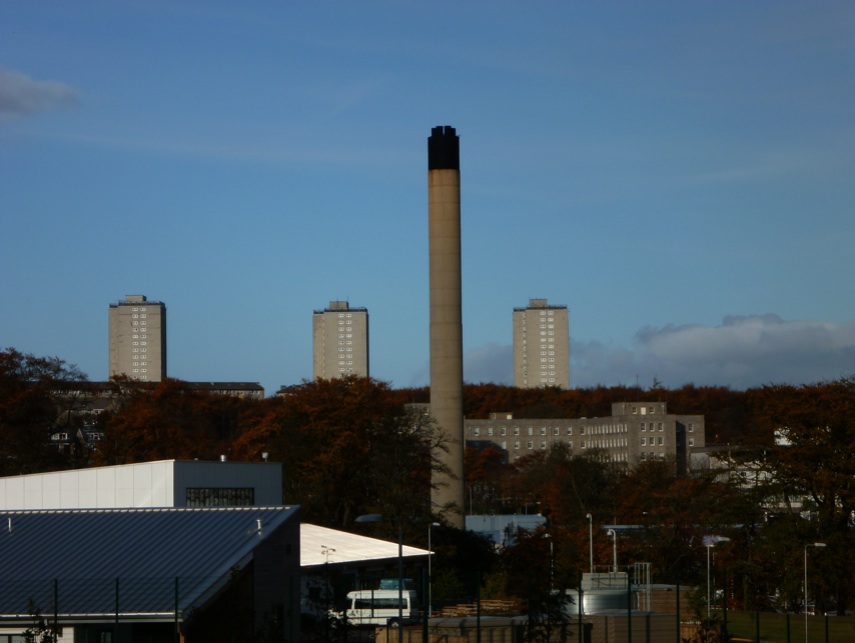
The new school with Foresterhill behind, looking to the skyscrapers of Cairncry

Autumn suits Midstocket Road


Oakbank School

Oakbank was, to people of a certain age in Aberdeen, the great threat. Used by our parents to guarantee our good behaviour, the threat of 'Approved School' (let's call a spade a spade: 'borstal') was weilded, Damoclean above our heads, as the place we'd end up if we didn't "learn to behave".

Oakbank main building.
I can just, if I strain, remember visiting Oakbank on an fundraiser open day in the 1970's (most probably the centenary celebration). A family outing to a borstal. Nice. All I can really remember was the celebrity guest of honour performing his tombola obligations. That guest of honour was local superstar continuity announcer Jimmy 'Spunky' Spankie, steadfast and redoubtable stalwart of Grampian Television's 'just like your living room' in-vision continuity suite. A man who's fame was compounded by his trademark plaid trousers, which he always wore. Those were the days.

Jimmy - wearing slippers and looking a bit 'tired'.
Oakbank was founded in 1878 and sited high in the Stocket Forest off Midstocket Road. When it was new it was then what was known as an 'Industrial School'; the class of institution which became know as 'Reformatories', then 'Approved Schools', then 'List D Schools'.  All just euphamisms for children's prison - though these institutions did have an open regime, which set them aside from the pure 'borstal', which is a tougher and more enclosed kind of youth prison.

Midstocket Road at entrance to Oakbank.

Latterly, Oakbank was classed as a 'List G School'; an establishment which catered for the needs of young people with emotional and behavioural disorders and specific mental health issues. We're gratified that over the decades the emphasis and aim of this institution changed from that of disciplined reform of the character to recognising that many of the troubled inmates were in need of intensive support - not punishment. Fees ranged from £93,600 to £179,400 per pupil per year.

The Governor's Lodge - a listed building.
However, nothing good will last forever, and we wonder about the fate of the institution's final pupils who were receiving that support In 2008 when it closed it's doors, the charitable trust which ran it collapsing amidst reports of mismanagement leading to "serious concerns about many aspects relating to the school". 100 jobs were lost. We hope that the skills which were embodied in that staff have not been dissipated and are still being used to help young people who need the support of our society, in order that - in turn and in time, they might become productive, active and supportive members of that society themselves.

Since the closure of the school, there has been all the usual now-you-see-it-now-you-don't bad things made to look good and good things made to look bad real estate dealing bullschist going on about getting the school rennovated to maintain its function (no chance!) or redeveloping it as 'aspirational, exclusive' housing (ker-ching!) or as a business park (the 'park' bit meaning 'carpark', of course). The local press report concerns of anti-social behaviour and vandalism at the abandoned site. There are also reports that dangerous chemicals and personal files are stored on the site. There has, it is said, been fire-raising. Local residents, it is reported, live in fear.

Document box-files plainly visible in office.
All very nasty, we're sure, and local councillor Bill Comrie has lead calls to have the school demolished, saying that the "huge amount of fear" suffered by his residents justifies the indescriminate destruction of the buildings by new site owner "Carlton Rock Ltd" (they don't appear to have a website). Thus conveniently clearing the site and clearing the way for planning consent in the spring (housing, we reckon being favourite). Yes. It's an ill wind that blows nobody any good.

But at present, the site is lying vacant and derelict.


Pull up a seat...


And admire the views...


Wednesday, 3 November 2010

Top Deck Trials

A little while ago, wandering around the centre of town, we crossed the top deck of the St Nicholas Centre. We think it's fair to say that this is now a strange place. There used to be a bustling Post Office, a Job Centre, a baker, a cafe, a cosmetic shop, the stationary outlet for WH Smiths and something else which we can't remember. Now, though, it has failed commercially; the shop units are boarded up and vacant.


It seems counter-intuitive that there should be this void, this vacuum at the very centre of the town, and of course, we have to ask: "why?"

We've already mentioned the unpleasant attitude displayed by those who enforce the already unpleasant surveillance system which blankets the deck with it's foul intrusion. But consumers are used to that sort of invasive prying, so that's probably not it.

No, we think that the big problem for the top deck of the St Nicholas Centre is two-fold. These are problems which the late-seventies master-planners and mid-eighties architects could not have foreseen. These are problems which cannot be overcome at this site, for they are problems which reside within the consumers themselves, not with the design of the shopping centre.

Firstly, the top-deck of the St Nicholas Centre is outside. This obliges hapless unsuspecting consumers to expose themselves to the wind and other meteorological phenomena for which they might not be psychologically, physically or sartorially prepared. It now being technologically possible (and therefore de-facto desirable) to upgrade to a life lived completely behind closed doors. Like a sort-of saturation-diving system but for producer/consumers.

Whereas the industrial diver goes from living-chamber to diving-bell to seabed worksite, all the while never exposed to the ambient environment; likewise the producer/consumer can go from apartment underground carpark into car to underground (or multistory) carpark at the workplace (or shopping centre), all the while never exposed to the ambient environment. It is revealing that the top decks of Aberdeen's multi-story carparks are invariably deserted - it is as if the producer/consumers are afraid to see the sky.

Secondly, the top-deck of the St Nicholas Centre is upstairs. This obliges the consumer to climb some stairs, thus unavoidably taking some exercise. Don't be silly! If you must exercise, the place to do that is in the controlled and mediated environment of the gym, where it's paid-for and therefore safe. And indoors.

Now the stationary outlet alone operates on the top of the St Nicholas Centre - solitary amid the foot-fall depleted devastation. Look upon my post-it pads and dispair! Nothing beside remains.

We like stationary well enough, but self-sealing envelopes and rollerball pens seem, well, somehow just not enough to justify the existence of this prime piece of real estate right in the heart of the city centre. And so, nature abhorring a vacuum, a sort of social market in urban space takes over. Re-development, re-use or re-invention inevitably follows (sooner or later) when a piece of real-estate becomes blighted.

Some people, when they see an area becoming run down with vacancy and blight, get all hand-wringingly "something should be done - it's a disgrace - etc". We don't - we find it thrilling to watch the urban environment weaving it's cocoon of vacancy - who knows the shape of the metamorphosed creature which will emerge! We think that such areas can become "edges" - and so we welcome blight, we embrace the run-down and we seek out the vacant.

Zimmer-rock guitarist "The Edge" (out of pension-pop outfit U2) once embarrassingly told an interviewer that he'd chosen his nom-de-plectrum because "the edge is the difference between something and nothing". Cringeworthy though this self-regarding aphorism might be, we think that there's something to it, especially when we look at the urban realm. Edges are where things are juxtaposed. And when diverse items (artifacts, attitudes, activities, architecture, people, whatever) are put together, opportunities exist for new developments (and not just real estate!) to take shape through a process of serendipitous accident or coincidence - this is the fountainhead of creativity.

So we were delighted to notice a few "edges" forming on the top deck of the St Nicholas Centre...

We watched some guys doing reeeeaaaaallly impressive trials-bike stuff there, much to the delight of a group of young asian girls who were hanging about eating pakoras in their eyecatchingly beautiful multicolour printed headscarves. Much preening and giggling and flirting and stunt-riding and otherwise showing off. We felt that there was quite a good community feel on the go. (Is this the Big Society?) The stunt riding was really entertaining; the riders were proud to show off their abilites to old farts like us.

A grumpy fat woman opened a window from the offices above and shouted her disapproval with threats. We shouted back at her to leave the kids alone. Was she never young herself? Perhaps she envied their fitness and good looks.

We've been in touch with the best of the trials bikers we saw that day. He's a young guy (damnhim) called Greg Wright who you can watch displaying his impressive skill on this video:


Like the best public art, activities like Greg's add colour, excitement, entertainment and diversity to our town. People like Greg and his parcourt and skateboarding colleagues are assets to this town and so it really bothers us when people do them down and try to marginalise them, as if they were street-drinkers or aggressive beggars or somesuch. They are not; they are athletes and artists on the cutting edge of something new. They are role-models and exemplars of skill development, fitness and an active life.

Greg is the only trials biker at his elite level who lives in Aberdeen. He's recently enjoyed the success of being placed 2nd in the elite section of a competition held in Edinburgh. The trials biking community is growing rapidly in Scotland, and there is the possibility of a Scottish tour competition developing with around six different locations around the country. Fort William is already a world centre of extreme cycling sports, and locations around Glasgow, Edinburgh and Aberdeen would be included on the itinerary.

Keep your eye out for Greg - he's well worth watching, and he's one to watch. His progression in the sport is something we should support. Our non-commercial dogma at Other Aberdeen prevents us from sponsoring him directly, but if any of our readers are interested in helping Greg out with a bit of cash for bike parts, travel expenses and the like, we can put you in touch. E-mail us using the link at the top left of the page.

We find it deliciously ironic that he should practise and hone his outdoor active skill on the top deck of the St Nicholas Centre - a place which failed in it's primary function as a shopping centre because it required a small level of outdoor activity on the part of its users.

Thursday, 21 October 2010

Victorian Vandals

There's always been much talk amongst the chattering classes in Aberdeen about the Victorian "vision" of the city. About how "The Victorians got it right". About how the expansion of the town through Rubislaw, Rosemount and Ferryhill and the creation of the most iconic buildings and scenographic vistas of the city centre somehow represents a perfect moment in our civic history; an ideal Aberdeen.

Well, here at Other Aberdeen, we're always suspicious of idealism, we always feel we have to look around the back, as it were.

Those who believe that "The Victorians" could do no wrong blindly overlook some of the most egregious acts of vandalism which they perpetrated in our city. The development which the city underwent in the second half of the 19th century was done in a hurry. Some evidence remains...


Fountainhall. Depicted in the 1867 Ordnance Survey - deep in the countryside - a working estate.
Fountainhall - being devoured by the Victorian terrace of Blenheim Place which is orientated on a different line and butts rudely into the NW corner of the house, the majority of which has been demolished.


Rosebank House - above the Ferryhill Mill, just off the Hardgate.
Depicted in the 1867 Ordnance Survey with stately drive and formal gardens
.

Rosebank House today.
Split into flats and incorporated into a row of tenements

Granton Lodge - Off Cuparston Place (today's Great Western Road)
Depicted in the 1867 Ordnance Survey with large forecourt and extensive grounds.
Granton Lodge today.
Brutally hemmed in by tenements on Great Western Place, side-on and off-line to street.
Frontage completely obscured.
 

Wednesday, 20 October 2010

The A to Z of Aberdeen - G


G is for Golf

We don't get golf.

Perhaps it's because just as our mothers were 'golfing widows', so we were 'golfing orphans'. Our fathers got dressed up in weird clothes and then went missing on Friday evenings and Saturday afternoons and Sunday mornings during our childhoods, and then came back talking rubbish.

Perhaps it's because, as a great philosopher once wrote, it is "a good walk spoiled". The root of psychogeography is, of course, a good walk. Why would we want to spoil that? Well... we wouldn't.

Perhaps it's because of the draining of wetlands and the creation of monocultures. We greatly prefer biodiversity.

Perhaps it's the trousers. Sorry, "slacks".

Perhaps because its adherents call it a sport, whereas it's actually just a game.

Perhaps its because they don't even bother carrying their own clubs these days - they get an electric robot to do it. We despise laziness.

Perhaps it's because they take themselves so seriously. Pomposity will not be tolerated.

Perhaps it's because they bang on and on and on in great detail and at length about the round they just completed, as if it's the most interesting thing in the world. It isn't - it's just a list of numbers.

Perhaps it's because of its aporcryphal acronymical exclusivity. G.O.L.F. = Gentlemen Only Ladies Forbidden. We despise exclusivity.

Ah, exclusivity, that's probably got something to do with our bad attitude to our so-called "national sport". There are  thirteen sites given over exclusively to golf in the greater Aberdeen area. A total of fifteen courses (twelve eighteen-hole and three nine-hole) covering a total area of 8.25 km2. We'll write that out longhand so there's no mistake; yes, eight-and-a-quarter square kilometers of Aberdeen's land is given over to a bizarre, exclusive, minority pursuit.

That's an area a bit bigger than that bounded by Anderson Drive, Westburn Rd/Hutcheon Street, the Inner city Ring Road to Victoria Bridge and the River Dee back to South Anderson Drive at the Bridge of Dee. Um, that'd be the entirety of the city centre and inner city. Just for golf. Imagine: Midstocket, Mile End, Rosemount, Gilcomston, Gallowgate, City Centre, Ferryhill, Pitmuxton, Ruthrieston and Rubislaw - all given over to golf.

A thought experiment...

The population of Aberdeen (according to the General Register of Scotland) is 202370 on an area of 186 km2 (1089 / km2)


So, if we subtract the amount of land given over exclusively to golf, we get 202370 people on a land area of 178 km2 (1137 / km2)

And, if we then allow that space to be developed by laissez faire policy, thus resulting in a mix of uses like that elsewhere in the city, we would provide housing within the city for nearly 9500 people as well as employment and services in support of that enhanced housing capacity.

So, if we abolish golf, we get better housing, more jobs and economic growth - who doesn't want that? The dog-in-a-manger golfers are holding the city back! We have just proven that golf stifles economic growth and is detrimental to our housing stock and job availability.

It's time these people got out of our city's way. It's not even as if it's a particularly patriotic pursuit, what with our "national sport"  being invented in China over a thousand years ago and everything.


Tuesday, 19 October 2010

Justice Mill Lane

We've mentioned the redevelopment of Justice Mill Lane a few times over the last months. Something we've tried not to do is prejudice our own opinion of the new buildings before they have settled into their use and made their presence felt in the wider urban environment through modified transport usage, work patterns, economic ripple effects and so forth.

Left to right: 
Travelodge (looming over Bon-Accord Baths), IQ office (Glass ziggurat), Radisson Park Inn Hotel.

Of the three major developments which have been progressing towards completion through 2010, two - the Radisson Park Inn Hotel and the IQ office development - are now complete and the third - a Travelodge budget hotel - appears to be on final fix. The Radisson is the only one of the three which is operational at the time of writing. And it looks quite nice inside. If you like that sort of thing. We'll go along for an omelette or club sandwich in the cafe-bar soon and report back. This is not a restaurant review blog, but in that instance we'll make an exception. Maybe. A neighbour of ours had a lovely big fluffy grey cat called Radisson, so that might prejudice our review because we loved him.

Pointy

The gigantic IQ office ziggurat also appears to be complete. We like the idea; we would greatly prefer to see office occupancy in the city centre - in the traditional Central Business District - than see continuation of the current trend which has speculative office 'campus' developments proliferating on out-of-town greenfield sites. 

Justice Mill Lane frontage Radisson Park Inn Hotel and IQ offices.


Out-of-town offices oblige the salaryman cubicle-jockey to clock up carbon-intensive commuting miles; reverse-commuting out of the city every day. We worry that this is one of the factors which helps condemn the traditional city centre to rot and vacancy, blight and decay, for lack of passing trade; lack of effective demand at pavement level. Moreover, more journeys by car erode the livability of our city which (some have forgotten) is actually charmingly compact and pleasantly walkable. It rains very little in Aberdeen, but, know what? Even when it does, umbrellas are available. So are overcoats and jumpers for when it's cold. Overcoat manufacture used to be a big part of the industry of this town, as it happens. But that's in the past, and we really don't want to turn back the clock. In today's global economy, it's better for everyone that overcoats are made elsewhere - we're all information-economy knowledge-workers in Britain these days. Mostly.

We reckon that today's knowledge worker (for such is what all office workers surely are, no?) should either be teleworking via broadband and skype and crackberry etc or, if actual - rather than virtual - 'facetime' (ugh) is really required, what better place could there be for office accommodation than the city centre? Knowledge workers in the city centre generate and distribute wealth firstly through the value added by their work pushing pixels around in the electronic sweatshop and secondly via their consumption of ancillary products and services which are also located in the city centre, close to the office electronic sweatshop. From the sandwich shop to the pub, from the bookshop to the boutique, all benefit from the passing trade of customers who are in the city centre for a different primary reason. 

On the flip side, the office workers benefit from the proximity of these services to their place of work - how convenient! And the city benefits from the mixed-use built environment created by a vibrant culture of pavement-level human-scale enterprises. Through this mix, the opportunity exists for new business and personal relationships to develop through a process of serendipitous accident or coincidence - the fountainhead of creativity.

By contrast, the out-of-town 'campus' concept de-humanises its workers by making them access the workplace by car, by spatially dislocating them from their place of residence and by divorcing them from human-scale interaction with other enterprises and their surrounding environment. The cubicle becomes a cookie cutter of conformity; the knowledge worker is forced into a monoculture and so creativity is stifled. Perhaps this is what the developers of out-of-town offices are wrongheadedly trying to engineer into the workforces which will occupy these campuses; compliance, acquiescence, surrender. Salaryman robot people.

Aberdeen Gateway - out of town, between Cove and Findon

Axcess Aberdeen - out of town, west of Portlethen

Westhill Business Park - out of town, south of Westhill

The completed IQ building looks not bad. But it is for the moment unoccupied and mothballed. Let's hope it gets tenants soon; a huge chunk of capital like that squatting at the west end of the city centre has the potential to regenerate the whole of the area.

IQ southern elevation

Reception mothballed

Now that the Justice Mill Lane builds are largely complete - formwork struck and scaffolding dismantled, roads re-opened and services commissioned - we can begin to think about the visual impact of the buildings on this important city centre site.

The view of Justice Mill Lane from the glen of the Holburn is radically altered, and not for the worse. The new terraces are visible from many points south, creating a dramatically and intriguingly scenographic vista drawing the eye to the west of the city centre. We do, of course, feel sad for the Bon Accord (Uptown) Baths, which are overwhelmed by the new development. Next to the dramatically contrasting upright slabs of the Travelodge, the glazed ziggurat terraces of the IQ, and the chequerboard and dental cladding of the Radission, the baths now look rather hangar-like and drab; a dated industrial shed, it has not aged well. It pains us greatly to write these things, but the truth is the truth. It is difficult to see how the baths can survive. Nothing good will last forever.

Bon-Accord Baths dwarfed by Traveloge and IQ


All our lives the Justice Mill Lane and Langstane Place corridor - historic though it may be - has been an unpleasant, dirty, drab and shabby canyon. It was as if the city centre was showing its semi-industrial arse to the pedestrian or road-user. Now, with the completion of these major buildings, along with other more modest developments further east, we begin to see the emergence of a different, brighter and more vibrant streetscape; significantly altered with new generous pavements contrasting markedly with their cramped predecessors. The more we look, the more we see a modern, clean aesthetic beginning to win over the former dirty, industrial, run-down, blighted and vacant area. 


Ironically, immidately across the road from the Radisson and IQ, the rear aspect of the now defunct Jumpin' Jacks nightclub, formerly the Capitol Cinema, is now one the most egregiously run-down examples of vacant blight in Aberdeen city centre. We can only hope that some group of developers and bankers can wrangle together regeneration capital for the Capitol soon. Ahem.

Not so good


However... these are only early impressions. We reserve the right to change our minds as all three buildings come on-stream and their full impact becomes clear over the months and years ahead. 

We have one significant gripe...

This is the pre-development artist's impression:


This is as-built.


The actual building is far more prominent and muscularly present from the Langstane Place viewpoint than early submissions suggested it would be. Bit naughty.