Showing posts with label urban environment. Show all posts

Tuesday, 21 February 2012

The Charm Agenda, Charm Offensive, Offensive Charm


A whole month after our "Final Thought" about the planning debacle surrounding Aberdeen's only town-centre green space - Union Terrace Gardens - events conspire to make liars of us, and we're obliged to offer yet more "final thoughts".

CHARM

I was leafing through the most recent edition of Tyler Brûlé's Monocle "cultural briefing" magazine the other day. (Yeah, yeah, I know.) But we very much like Tyler's takes on urbanism, on transport and on modernism (in architecture and design). Since he turned the 'lifestyle' magazine market inside out when he launched Wallpaper in 1996, his editorial push has been characterised by a purity of vision and a earnest championing of good taste and human scale urban design - quality, authenticity and integrity in urbanism. Looking at his magazines, you might think that postmodernism never happened.

The most recent edition of Monocle points out that, as we're getting accustomed to having tough economic forecasts thrust in front of us, and as politicians and mass-media pundits struggle to begin to think about how they might approach - as they eventually must - the necessity of starting to condition the general public to the fact that a return to economic growth may not actually be possible - certain brands, businesses, regions and people seem not to be merely surviving, but rather thriving despite the economic crisis. The magazine devotes an editorial and an entire globetrotting section with travelogues (dérives) and essays (polemics) all turned to the examination of that special quality which allows some to float easily to the top to enjoy the oxygen of prosperity while others sink in the stifling mire of economic depression. Tyler's travel writers, photographers, philosophers, and graphic artists are flung to the four corners of the earth and return to identify this fundamental ingredient of resilient success. They conclude that this vital essence is charm.
>>>>>>
It's a set of attributes got by doing things based on human feelings and not because a focus group says it sounds good or the numbers seem to add up when you pile them on to an Excel sheet. The reason we think this word [charm] is key in 2012 is because it adds the DNA for longevity into brands, business and neighbourhoods
[…]
Honesty, integrity, simplicity … are other words that help all manner of firms thrive, but oddly, they never seem to make it past the door of a business school. That's because these things can't be taught; you have to genuinely possess these qualities.
[…]
Charm is unquantifiable, which is why management consultants and MBA graduates overlook it. Decisions about the future of a town, building or business that are made in the boardroom don't consider the importance or charm. … And yet charm is arguably the most important factor for securing repeat business, which in today's financial climate is invaluable.
Charm is fragile too - it's not something you can buy (think Dubai), it takes time to nurture and requires safeguarding because, once lost, it's near impossible to reinstate.
<<<<<<<<
So you can see that this resonates with today's urban planning tumult in Aberdeen. Since the intervention of oil-tycoon Sir Ian Wood in 2008 caused the collapse of the project to build the Northern Light (a contemporary art centre) in favour of his own vanity-stroking City Square Project (as was), the discourse in Aberdeen has been characterised by a singular lack of charm. Accusation and counter-accusation have flown in an increasingly polarised debate as the polity is subjected to the spectacle of a process which has been distressingly divisive. Misdirection, misinformation, sock-puppetry, DPR, website hacking, vexatious allegations, character assassinations and other dirty tricks have all been rumoured to have been used by one side or the other or both. Allegedly. We have been disappointed but unsurprised to see a lack of balance in the local press, who have continued to act as editorial mouthpieces for the boosters of CO2-supremo Sir Ian Wood's project, their pro-development articles hitting their own front pages with predictably metronomic regularity. But then, we've long since aired our disappointment about how our Aberdeen newspapers are operated.

In our opinion, the distasteful aspects of this process which will in effect privatise commonly-held land, were inevitable. When carbon-bigwig Sir Ian Wood first announced his intention to outbid the creative and performing arts community in Aberdeen he set our teeth on edge by going on record and saying:
Eighty percent of the people who spend time in [my] square will have no interest in the arts.
So breathtaking an expression and expectation of philistinism, both patronising and dismissive, used by the emission-king Sir Ian Wood as a justification for why his scheme would be preferred by the people of Aberdeen over the Northern Light scheme, was inevitably seen by the creative arts community - both producers and consumers with curator-types in between - as an opening pre-emptive strike in a dirty war for the soul (both metaphysical and urban-physical) of our town. Thus was the wind sown, and now we reap the whirlwind as the time has arrived and the people of Aberdeen are now making a decision on whether or not the park gets bulldozed. A postal referendum is in progress at this time. What emission-monger Sir Ian Wood first called "The City Square Project" has been re-branded "The City Garden Project". You can see what they did there.

THE SUPERFICIAL CHARM OF BOILERPLATE

One of the many aspects which has characterised the moneymen's push to foist their debt-creating real-estate land-grab and building project on the people of Aberdeen is the use of pubic relations (PR) consultancies who are involved in projecting a presence (we think that's the kind of thing these sorts of people tend to say) for the City Square Garden Project. Posters, flyers, web, social media, radio, tv and print. It's all been very slick and impressive. If you think that a corporate branding and impression management (as they say) exercise can ever be impressive, that is. Many people do in these hyperreal times, more's the pity.

A couple of weeks ago, I asked one of the social media manifestation aspects of the City Square Garden Project a straightforward enough genuine question. Here's what I asked:
>>>>>>>
One of the things which is a perennial spectacle in Aberdeen, in the city centre, is the sunset gathering of starlings - vectoring in from all directions and amorphously flocking in the sky above Union Street. The spectacular flock (numbering tens of thousands of birds) swoops around the city centre, gathering strength of numbers as subsidiary flocks join, before groups break off and dive beneath Union Bridge to roost.
  
The RSPB and the BTO (British Trust for Ornithology) state that: "starling numbers have fallen by 66 per cent in Britain since the mid-1970s. Because of this decline in numbers, the starling is red listed as a bird of high conservation concern." 
And the RSPB also note that the Countryside Act (1981) makes it illegal to intentionally kill, injure or take a starling, or to take, damage or destroy an active nest or its contents. They say that preventing the birds from gaining access to their nests may also be viewed as illegal by the courts. And indeed, the provisions of the Scottish Nature Conservation Act (which supersedes and modifies the Countryside Act) are more stringent yet when it comes to bird habitat protection, making it an explicit offence to: "obstruct or prevent any wild bird from using its nest". How can this be avoided by the plans as proposed? 
How will the project circumvent the provisions of the Countryside Act and the Scottish Nature Conservation Act? How will the promotors of the project deal with this issue? Has the City Garden Project been in touch with the RSPB and the BTO?  If they have not already contacted the RSPB/BTO, why not?
<<<<<<<<<<
The response from the City Square Garden Project's social media manifestation:
>>>>>> 
We love the birds too and want to see them remain in the city centre. What is exciting about the new gardens is the fact that new eco-systems and habitats will be created by the larger gardens with a greater diversity of plants and wildlife. 
<<<<<

Ugh. Firstly, when I read that, I had the feeling that I'd been mugged. It's that superficial charm of the PR "handling" thing that they do by the numbers; that thing that's straight out of the first year media studies playbook where they 1. gushingly agree ("yes we love birds too, see - we're just like you!") - then 2. deflect by issuing handwaving boilerplate ("the new thing will be EVEN BETTER"); all without addressing the serious and genuine specific concerns I'd expressed. At the time of writing, I've seen no genuine response to my questions from the City Square Gardens Project PR people. 

The thing about charm is, it cannot be faked. We can all tell when a corporate entity has a "workshopped vision" rather than a genuine opinion. We are used to the cant of the scripted interactions we must suffer with call centres and checkout till operators. We can even now detect when the script has been drafted in order to appear unscripted. It's wearing, it's tiring, it's disheartening. We live now in an age of flesh-robots consulting decision-tree boilerplate scripts. Where are the real people? What are their genuine opinions? It's doubly disheartening to realise that the real people promoting this real-estate venture (in this case, emission-king Sir Ian Wood and a group of 50 anonymous(ish) - certainly faceless - businesspeople who are bankrolling the PR initiative) reckon themselves to be so lacking in genuine charm that they must retain a PR consultancy to generate a continual outgushing of superficial charm boilerplate in order to deflect public attention away from them, and away from key questions and problems with the project. I suppose, at least, we should congratulate the group of fifty anonymous(ish) businesspeople for their self-knowledge. 

A HAPPY IMPRESSION OF BLACKMAIL

A correspondent pointed us towards the blog of local(ish) PR practitioner Ken McEwan, in which the PR-man contends that  - unless the people of Aberdeen consent to carbon-mogul Sir Ian Wood's real-estate development scheme which would destroy Aberdeen's only town centre green space - there will be no further investment of any kind in Aberdeen. When he asserts: "This is an all or nothing package" he's kind-of saying "Vote Yes to the comprehensive redevelopment of Union Terrace Gardens or the rest of the city gets it!" 

Of course, the PR-man avoids any use of the words "loan" or "debt", choosing to use the words "investment" and "funding" instead. But leaving that aside, and also leaving aside the arguable thrust of the "all or nothing" assertion, what we find most enlightening is the posture that this PR-man is happy to be seen to be taking. To us, it seems that he appears to be revelling in creating the impression of a kind of civic-development blackmail. Aren't these PR-types charming?

CO-OPTED

When we last wrote about this subject, we got a bit of criticism for our use of language like "emission-king" and "pollution-mogul" when describing carbon-baron Sir Ian Wood. Some people thought we ran the risk of undermining the work of the various voluntary groups who are working to retain Union Terrace Gardens. We responded by saying that we would happily consent to the destruction of Union Terrace Gardens were the pre-eminent CO2-magnate Sir Ian Wood to renounce his role in the extraction of oil and gas and denounce the oil industry for the atmosphere-threatening activity which it demonstrably is. We said that we were not interested in coalitions, particularly when membership of a coalition might compromise our principles. It's a matter of perspective - for what use will a small city centre park be should the thermohaline circulation system collapse? How will Union Terrace Gardens in their current form help the hundreds of millions of people who will be displaced from low-lying coastal regions as sea levels rise? When ever will the many hundreds of thousands who will be killed in resource-wars to come be able to enjoy the peace and tranquility of a sunken garden in a provincial northern town? 

So we were saddened when the major grouping of volunteers which is working to retain Union Terrace Gardens announced that they have received the beneficent backing of oil-tycoon Jimmy Reid (yes, another one, another tycoon). We wrote about the intransigence of these pollution-millionaires before, in the context of the financial collapse of the potentially atmosphere-saving carbon capture and storage pilot plant at Longannet power station. 

In a press release, carbon-grandee Jimmy Reid, publicity-friendly MD and Chairman of Balmoral Group said:
>>>>>>
I and many of my business contemporaries, are committed to establishing a fund which will help bring the gardens back to their former glory. Without destroying our heritage, and without putting Aberdeen City further into debt, it would not be difficult to breathe fresh life into the park. Improved access, new planting, cleaning and restoration, park wardens and live events could all be relatively easily and cost effectively achieved.
<<<<<<<

We were sickened by the sycophancy which Jimmy Milne's announcement provoked from some members of the groups who want to retain Union Terrace Gardens. And we were troubled by this talk of a fund set up by faceless businesspeople to run a public park. But, again, these are side issues. More important to us is that we certainly don't want our activism (such as it is) to be co-opted weight-of-numbers-wise (as it runs the risk of being) in support of the consent-manufacturing activities of the pollution-magnates and their climate-jeopardising activities, whatever their views on the direction of urbanism, new or old. Such are the dangers of coalition membership. Which oil-tycoon do you prefer? We prefer neither.

Spot the difference


SOUR GRAPES

The whole spectacle of this fight for the future of a small park has split opinion in this town. It has marginalised the creative sector, it has damaged the arts and it has polarised discourse. It has served as a window-dressing diversion away from the necessity to build a truly sustainable industrial future for Aberdeen based upon the exploitation of renewable energy sources. The atmosphere of hostility and distrust is poisonous to the enjoyment of this town for its own sake, something which is one of the avowed aims of the whole OtherAberdeen blog. And now the polity of the whole town has been manoeuvred into the false dilemma of being forced to endorse either the vision of one oil-tycoon or the other. We feel a need to distance ourselves from this spectacle, for sometimes the grapes really are sour.

Tuesday, 14 June 2011

GOT A WEE POSTCARD FROM THE CENTRE OF THE 20th CENTURY


<<<<<<<<<<<<<<<<<
http://otheraberdeen.blogspot.com/2011/05/20th-century-boundary-stones-acb.html
2011.05.30

...suppose we should really get ourselves along to the local studies department at the Central Library and see if we can look at a mid-20th century map for clues to where we might find others of these 20th century boundary stones, but hey - this isn't a job! (Nevertheless - if anyone's got a copy of such a map that they can let us have we'd be really grateful.)

<<<<<<<<<<<<<<<<<<<<<<<<<<<<<<<<


20th century boundary X Inbox Reply


from xxxx@yyyyy.com
to otheraberdeen@gmail.com
date Fri, Jun 10, 2011 at 9:44 PM
subject 20th century boundary
att 1 Attachment 421kb


Hi, saw your request for a map with indication of Aberdeen's boundary before 1975 and thought that this might help. (SEE ATTACHED)


Regards
xxxxxANONxxxxx
<<<<<<


1 Attachment 421kb proposals.jpg

#######################################

As so often happens in life, when we go looking for one thing, we find something else; something more distracting, perhaps. Something enlightening, something fascinating.

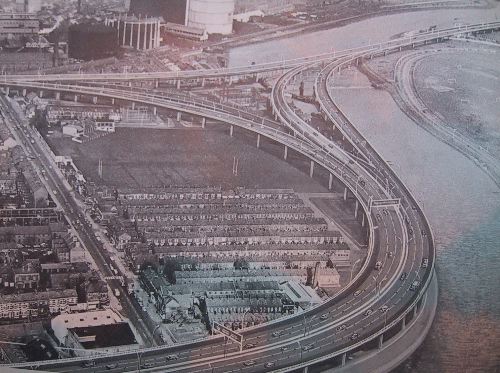
In this case the map document "THE-CITY-AND-ROYAL-BURGH-OF-ABERDEEN, Survey and Plan ~ 1949, ROAD COMMUNICATIONS. PROPOSALS" opens up a door into the minds of the post-war town planners and their fever-dream visions of the future; it is a wee postcard from the centre of the car-crazy 20th century. It isn't really a map (maybe it's a "mind map") rather it's a disingenuous presentation of a schematic diagram made to look like a true map. It takes quite serious topological liberties with topographical realities. Having thrown topographical reality to one side, our post-war planners dared to dream big.

Three ring-roads; a gyratory system at Holburn Junction/Rose St/Thistle St; much of Ferryhill demolished for an inner city motorway (in all but name); a high-speed radial expressway cutting Cragiebuckler in two to link Countesswells Road at Hillhead with Queens Road at Hill of Rubislaw (the undeveloped green corridor for this pupative expressway exists to this day). Three ring roads. 

Even in their wildest car-crazy dreams the post-war planners in London only ever envisaged a maximum of four concentric ring-roads for the capital.

pic from Wikimedia Commons
Predict and Provide
Predict (traffic levels) and provide (capacity beyond that) was the tenet of these mid-century promethean would-be road-builders: iconoclasts, they would destroy the city to create it anew. A new order beckoned and all round the world the social, economic and political decks were being shuffled. The externalities of unchecked motor vehicle growth had not yet impinged upon the considerations of these utopians, instead they saw a future painted in the broad bold strokes and interplanetary proportions of what we today recognise as being nothing but science-fiction. So (concurrent with Dr Beeching's noticing that railways were old fashioned and best done away with) in his 1963 report "Traffic in Towns" Professor Sir Colin Buchanan mused:


In the future: the British Empire's
borders extend all the way to Venus


The possibility most usually canvassed is that within a measurable time some kind of individual jet-propulsion unit will be developed, of which a rudimentary form has already been tried out in the U.S.A. for military use.  
But sensible Sir Colin went on to question the individual jet-pack's viability as a means of daily transport for commuters, and concluded, therefore, that the only possible future was one of comprehensive grand-plan redevelopment to make more and more room for cars - Jellicoe's "Motopia".


The way it turned out for us at the
Denburn Road "improvement".

But Prof. Buchanan did reach ahead of his time and recognise that increases in road capacity can actually exacerbate congestion problems:
The problems of traffic are crowding in upon us with desperate urgency. Unless steps are taken, the motor vehicle will defeat its own utility and bring about a disastrous degradation of the surroundings for living... Either the utility of vehicles in town will decline rapidly, or the pleasantness and safety of surroundings will deteriorate catastrophically – in all probability both will happen.
At the time these words were written, they were not, but the mechanisms of network-induced demand are now well known, are within the body of established empirical science and are regarded as The Fundamental Law of Road Congestion. Indeed, in the United States, where much highway (motorway and dual-carriageway) infrastructure is now approaching obsolescence, planners are discovering that removal of these artifacts from the centre of the car-crazy 20th century has major economic and social benefits for cities.


>>>>>>>>

Professors Gilles Duranton and Matthew Turner analyzed travel data from hundreds of metro areas in the U.S., resulting in what they call the most comprehensive dataset  ever assembled on the traffic impacts of road construction. They write:
For interstate highways in metropolitan areas we find that VKT [vehicle kilometers traveled] increases one for one with interstate highways, confirming the “fundamental law of highway congestion” suggested by Anthony Downs (1962; 1992). We also uncover suggestive evidence that this law may extend beyond interstate highways to a broad class of major urban roads, a “fundamental law of road congestion”. These results suggest that increased provision of interstate highways and major urban roads is unlikely to relieve congestion of these Roads.
>>>>>>>>>>>>>>>>

Milwaukee spent $25 million to demolish the 1-mile-long Park East freeway, while it would have cost $100 million to rebuild that 30-year-old freeway.  Removing the freeway opened 26 acres of land for new development, including the freeway right of way and surface parking lots around it, which have already attracted over $300 investment in new development, in addition to stimulating development in surrounding areas.

San Francisco increased nearby property values by 300 percent by tearing down the Embarcadero Freeway and opening up the waterfront, stimulating the development of entire new neighborhoods.

Niagara Falls is removing the Robert Moses Parkway in order to slow people down and encourage them not to drive as far.  Just as building this parkway encouraged tourists to take longer trips and drive right through to Niagara Falls, Canada, removing this parkway is meant to encourage tourists to take shorter trips and stop in Niagara Falls, New York.

~~~~~~~~~~~~~~~~~~~

But such counter-intuitive cognitive-dissonance-inducing facts do not go down well here, where we plan the Aberdeen Western Peripheral Route "special category" bypass road (a motorway in all but name) and the Berryden Corridor "Improvements" (an urban dual-carriageway radial expressway scheme).

Notable amongst the justifications and rationalisations for work on both the new ring-road and the new urban dual carriageway are promises of "improved journey times". This flies in the face of the UK Department for Transport which, as long ago as 1996 adopted guidance documents stating that cost-benefit studies on new road building schemes must assume that elasticity of demand may be as high as 1.0 with respect to speed. Which is to say that the average trip length increases as much as speed increases: building roads which reduce journey times merely serves to lengthen the average trip taken; with the same amount of time being spent behind the wheel, the number of driver-miles increases. The very essence of induced demand.

>>>>>>>>>>>>>>>>

Reducing journey times in and around and to and from the North East not only improves quality of life for individuals but helps retain and attract businesses who need reliable connections to their markets in order to survive.

<<<<<<<<<<<<<<<<<<<
Aberdeen City Council
Frequently Asked Questions


How does losing a part of school playground improve health?


The alignment of the carriageway alongside the school was chosen in order to meet the design requirements for roads and to avoid the demolition of property on the other side of the road. The design of roads in an urban environment can be restrictive and at times compromises have to be reached.


<<<<<<<<<<<<<<<<<<<
Aberdeen City Council
Frequently Asked Questions


Why are you creating a motorway through the city?


The dual carriageway route proposed for the Berryden Corridor permits a number of transport modes and can be successfully integrated into an urban environment. It will have a speed limit of 30mph like the majority of the urban roads in Aberdeen. The Berryden Corridor Improvement Project makes up part of an integrated transport system for Aberdeen City, which includes projects such as;


  • The Aberdeen Western Peripheral Route (AWPR), the construction of which will reduce unnecessary traffic travelling through Aberdeen, freeing up capacity in the city centre 
  • Union Street pedestrianisation and its associated traffic management.  
  • A number of studies to investigate how to better manage and improve the transport system around the city [...] 
  • Feasibility studies to investigate cycle routes on the Anderson Drive, Inverurie Road and King Street/ Ellon Road corridors. 
  • A Bus Action Plan 
  • A freight action plan 
  • A Car Parking Strategy, which aims to increase charges in the city centre and extend the controlled parking zone.
[...]

 All of this assists the Council in meeting its policy and environmental commitments.


###########


Poised like an arrow pointing at the heart of the city centre, the new urban dual carriageway will deliver high volumes of high speed traffic into the centre of our town, and through the agencies of their action plans, studies and strategies our planners expect us to believe that this will "assist" schemes like the 30-year-promised pedestrianisation of Union Street. Pedestrianisation and modal switch to cycling, walking and public transport is achieved by discouraging motor traffic, by re-allocating aspects of the urban environment away from cars, not by ushering in more.


>>>>>>>>>>>>>>>>>>>


Comments


Alex Mitchell said...


We only have to observe the bleakness & utter desolation of the entire length of East/West North Street, from Mounthooly to the Castlehill roundabout, to realise the destructive futility of this outdated slash-and-burn approach to town planning, with its demented prioritisation of an accelerated flow of vehicular traffic above every other consideration. How many streets, houses and communities were destroyed to accommodate the East/West North Street urban motorway? And there is a cluster of nice little residential streets such as Caroline Place near the former Rosemount Church, really a kind of urban village, standing in the way of the proposed Berryden Junction!


<<<<<<<<<<<<<<<<<<<<<

The number of cars, buses and lorries using the key roads in and out of [Aberdeen] has fallen to its lowest level for years.
Surprising new figures suggest traffic levels on Aberdeen’s congested major roads may be dropping after reaching saturation point. Experts linked the findings to the growing use of trains and bikes in an age of increasing environmental awareness and economic austerity, as well as commuters sharing cars or finding quieter routes in to work.
Transport chiefs warned against complacency and said the city’s bypass must be delivered, as well as a third bridge over the Don and a solution at the notorious Haudagain roundabout.
Councillors in Aberdeenshire were certain commu-ters had not witnessed a reduction in rush-hour congestion, even if vehicle totals on the roads had fallen.
Data from Transport Scotland, under freedom of information legislation, reveals the five-day weekly average number of vehicles using Aberdeen’s trunk roads for every month in the last 20 years.
After huge growth during the 1990s, the traffic volumes appeared to stabilise over the last decade and have even started to fall.


>>>>>>>>>>>>>>>>>////////////


After Aberdeen's traffic density had reached a maximum a few years ago, it then subsided back and our town planners and their business sponsors decided that attracting more traffic to the town centre should actually become the desireable outcome. And so they dusted off those ill-conceived plans from the centre of the car-crazy 20th century and today they push on ahead with a re-hash of the 1949 plans for orbital motorways and urban dual carriageways. They seek to induce demand, to pander to the car-dependent addiction of the polity. Is this the most car-sick town in Europe?

The solipsism of the roadbuilders' logic is circular tail-chasing devastation.

1960's
Is there going to be too much traffic? Better build urban dual carriageways and motorway ring-roads.


2010's
Is there not going to be enough traffic? Better build urban dual carriageways and motorway ring-roads.


<<<<<<<<<<<<<<<<<<<<<<<<<
http://en.wikipedia.org/wiki/Automobile_dependency


Automobile dependency implies that cities where automobiles are the predominant transport deny their residents not only freedom of choice about the way they live and move around the city but also that the culture of automobile use has produced a kind of addiction to them. The analogy is made with addictions to harmful substances and activities because of the well-known law of diminishing returns in relation to increasing use or participation: the more that is used, the less of the desired effect is gained until a point is reached where the substance or activity has to be maintained to remain 'normal', a state of dependency.
When it comes to automobile use, there is a spiralling effect where traffic congestion produces the 'demand' for more and bigger roads and removal of 'impediments' to traffic flow, such as pedestrians, signalised crossings, traffic lights, cyclists, and various forms of street-based public transit such as streetcars (trams).
These measures make automobile use more pleasurable and advantageous at the expense of other modes of transport, so greater traffic volumes are induced. Additionally, the urban design of cities adjusts to the needs of automobiles in terms of movement and space. Buildings are replaced by parking lots. Open air shopping streets are replaced by enclosed shopping mall. Walk-in banks and fast-food stores are replaced by drive-in versions of themselves that are inconveniently located for pedestrians. Town centres with a mixture of commercial, retail and entertainment functions are replaced by single-function business parks, 'category-killer' retail boxes and 'multiplex' entertainment complexes, each surrounded by large tracts of parking.
These kinds of environments require automobiles to access them, thus inducing even more traffic onto the increased roadspace. This results in congestion, and the cycle above continues. Roads get ever bigger, consuming ever greater tracts of land previously used for housing, manufacturing and other socially useful purposes. Public transit becomes less and less viable and socially stigmatised, eventually becoming a minority form of transportation. People's choices and freedoms to live functional lives without the use of the car are greatly reduced. Such cities are automobile dependent.


~~~~~~~~~~~##################~~~~~~~~~~~~~


An tiny little old lady tries to cross the road at the t-junction, peering round the wing of the big silver-grey SUV to try to check it’s OK to cross, and to try to make herself seen to the motor traffic using the junction. She waits, and waits, and waits.

Inside the house, a rivulet of running sweat tickles as it begins to trickle down his spine between his shoulderblades as he flollops into the sofa and reaches grunting over his belly swapping the clunky chunk of the black plastic carkey electronic transponder for the skybox remote control. Flips to EPG; pagedown pagedown pagedown. Pagedown. Huh! Nothing - saturday lunchtime. He puts the sweat-finger smeared remote down on the sofa arm and, getting his breath back after walking from the car, puffs hard, blowing his cheeks out. His eyes swivel first, then his head, then his body to look out the window. There it is. He got it two years ago, he knows the exact date, it’s the exact same age as his youngest daughter; his wife was in the maternity unit. She was there while he got his baby. Got the cherished plate transferred over from the older model (this one’s a serious upgrade) LYN 684, that’s in honour of his wife - she likes that.

Saturday and sunday its OK to park it there - no traffic wardens about at the weekend. He loves his end-terrace house (now after about five years he’s got it just the way he likes it), but it has its problems. To his chagrin, traffic regulations mean that, because his house is on the t-junction, he can’t pave over the front garden and turn it into a parking bay, the way his neighbours have done. That’s harsh, particularly as those same traffic regulations have double-yellows immediately outside the house - so he can’t park there; can’t park where he can see the car from the sofa - one eye on the adverts, the other on the Audi. Sometimes he even has to park round the corner up to a hundred metres away. That can be quite a walk, particularly for his eldest daughter - she’s six now, and not used to such distances. But, come the weekend, the wardens retreat and he parks his own car outside his own house, just as he should. To hell with the double yellows: Ford’s in his flivver; all’s well with the world. He can look at it as much as he wants. If he could, he’d park it in the living room.

What’s that? In the corner of his field of view, somebody’s near his car! It’s just as well he parked it there so he can see who’s interfering with his property! He levers himself up and, pulling the airtex front of his too-small poloshirt back down over his paunch, waddles to the bay window. It’s an old lady, just standing. Standing right beside his car, her right hand out by her side, as if she might touch the bonnet at any moment. He hammers his fist on the windowpane - nothing. Face reddening, slack-jawed, wide-eyed he thumps again, bangbangbangbangnbang! Still nothing. Is she ignoring him? He squeezes slather-footed between sofa and TV and hurries out the door, down the hall, out the front door. He looks at the car but he can’t see the woman. Where is she?


References:


http://www.marchandmeffre.com/detroit/index.html
http://www.wesleyjohnston.com/roads/belfasturbanmotorway.html
http://www.hiddenglasgow.com/forums/viewtopic.php?t=642
http://en.wikipedia.org/wiki/Traffic_in_Towns
http://hc110-2.blogspot.com/
http://dc.streetsblog.org/2011/05/31/study-building-roads-to-cure-congestion-is-an-exercise-in-futility/
http://www.nottingham.ac.uk/transportissues/uktp_history.shtml
http://www.preservenet.com/freeways/FreewaysInducedReduced.html
http://waronthemotorist.wordpress.com/2011/01/15/crap-cycling-and-walking-in-car-sick-glasgow/#more-768

Tuesday, 29 March 2011

So, just what will the future look like?

We've seen the future. We can afford it. Yes we can.

A gem from the home of dynamic capitalism:

The Future of Manufacturing is Local.
Think manufacturing, and most likely your brain defaults to abandoned factories, outsourcing and economically devastated regions like the Rust Belt ...
But there are many parts of this country [USA] where manufacturing is very much alive, albeit in a different form. The monolithic industry model — steel, oil, lumber, cars — has evolved into something more nimble and diversified. As this country continues to figure out how to crawl out of its economic despair, we could benefit from focusing on the shift.
The article quoted above comes from a design and architecture commentator on The NY Times' opinion pages. In that context our thoughts turn to the future for our own town as we read that oil and gas giant Statoil is re-considering the future of some of its North Sea activities.


Yes, they do make things
in San Francisco
We've said before that, at some point, we'll wish that we in Aberdeen had started the process of rebalancing our economy sooner than we have (indeed, have we started at all?) The article in the NY Times which examines the re-balancing of parts of the US economic activity towards a nimble and diversified model of re-thought manufacturing might provide us with some inspiration. The article focuses on the work of SFMade, a grass-roots bottom-up charitable organisation, which is demonstrating great success in providing real help in regenerating the shattered economy of California. The SFMade community (for that is what it now is) stands in contrast to top-down hierarchichal organisations such as local enterprise companies and chambers of commerce.

Key phrases stand out from the NY Times article:
Times have changed. So has business, and it's time to rethink, and indeed rebrand, American manufacturing. 
From one member of the SFMade community:
“For decades we have developed a culture of disposability — from consumer goods to medical instruments and machine tools. To fuel economic growth, marketers replaced longevity with planned obsolescence — and our mastery of technology has given birth to ever-accelerating unplanned obsolescence. I think there is increasing awareness that this is no longer sustainable on the scale we have developed.”
From another member:

“Pick your community well. You’re not there solely to make money; you’re there to play a larger role.”

About SFMade's corporate structure:

The decision to be a non-profit was borne out of the belief that trade organizations (like the Chamber of Commerce) often serve more of a business development function rather than address the needs of the local manufacturing community. In contrast to government-initiated programs, SFMade emerged from the community, the culmination of a grassroots movement. The group allows that community to reconnect, share resources, receive education and assistance on everything from zoning to sourcing to taxes.


It is particularly interesting to note that this important bottom-up work on economic rebalancing is being done in San Francisco. That's one of the cities used by Charles Landry as an exemplar of best practise for creative human-scale liveability during the recent presentation he gave in Aberdeen. The presentation was hosted by ACSEF (Aberdeen City and Shire Economic Future) at the event which marked the relaunch of their misconceived and controversial City Gardens Project which, if realised, would cause the destruction of Aberdeen's Union Terrace gardens. 


It is vital that we see alternatives to ACSEF's monolithic proposal emerge in Aberdeen. We believe that their top-down approach to regeneration is out of its time and reflects their inability to grasp the fundamental and disruptive change which the nature of capital is subject to at present. Where once capital was embodied in factories and large chunks or arrays of machinery; monolithic amounts of liquid currency, tracts of land and large workforces - today, rather, capital is increasingly ephemeral; being comprised of ideas and individuals; ones-and-zeroes and the people who've created them - and mercurial, being much more mobile and subject to the whims of fashion and disruptive innovation. Our oil industry heritage with its big lumps of machines and money, tracts of (seabed) land and traditional working practices - largely unchanged in decades - has ill-served our town in preparation for the furious pace of change which now predominates in the new world of creative and social capital. All that is solid melts into air. 

Torry Rocks!
In our own small way in Aberdeen, we have, perhaps the seed model of something resembling the SFMade movement in the Torry Retail Rocks initiative, where young people can get access to subsidised (otherwise vacant) retail and workshop space in Aberdeen's historic Torry area (it's its own town, really). The streetscape and livability is already improving along Torry's Victoria Road thanks to this grass-roots bootstrapping work. We believe that this sort of initiative, which resembles the granular scale of SFMade, has much more to offer Aberdeen by way of a sustainable economic future than anything which traditional capital (and the traditional thinking that implies) can offer.

We feel that ACSEF have only partially grasped this point that capital has now a much greater social and creative aspect than at any time before the rise of capitalism itself. That's why they give the appearance of believing that a huge real-estate deal at Union Terrace is the means by which Aberdeen's economic future can be secured. It is not. The truth is much more granular - fractal, even, and impossible to encompass within one man's "vision"

While we've seen the future, we can't tell you exactly what it'll look like - this vision is panoramic, inclusive and cannot be assimilated in one glance. But we can tell you that we can easily afford to implement this vision. We can also tell you that we can't afford not to.

Monday, 28 March 2011

Woonerf for the Denburn Valley Development.

Word comes from the European Commission that, for the sake of the future, for the sake of sustainability and for the sake of liveability, it is their aspiration that petrol and diesel vehicles be banned from urban centres by 2050.

As radical pedestrians and utility cyclists, naturally, this is exactly the sort of thing we want to hear. This weekend, the taste of exhaust pollution in the centre of Aberdeen was quite disgusting, the noise-stress was unbearable and the vast majority of people (pedestrians) were, as usual, crammed into their tiny pavement allocation by the car drivers who use the space allocated to them on our town centre's roads to the exclusion of all other potential utility that might be gained from that precious urban space.

Future carpark.
In the light of this new anti-motor transport policy development in Europe, it seems all the more perverse that Aberdeen's political and business interests are intent on pushing ahead with urban dual carriageway projects which will deliver large numbers of high-speed drivers into the town centre at a higher rate than ever before. This, of course, will necessitate the creation of more car parking space, which will in turn induce more journeys by car into the city centre. It's like the 1960's version of urban planning. Quite embarrassing, really. One of the places earmarked for a big new car park (sometimes euphamistically termed or "traffic hub") appears to be the city's historic Union Terrace Gardens. This is deplorable.

A radical daydream creeps into our consciousness, a vision of a pleasant city centre which is proud to display both its heritage and its faith in the future. One of the major arguments put forward by those who want to redevelop Union Terrace Gardens is the fact that they are 'poorly utilised'. Well, we're not sure that a city park loses utility when unoccupied by people - it continues to provide ecological services; oxygen generation, urban wildlife habitat, sound baffling and the like - but, what's good for the goose is good for the gander, and it has been pointed out elsewhere that the Denburn urban dual carriageway is, likewise, 'poorly utilised'.

A woefully underused urban asset.
No pavements. WTF?

Another argument for decking over the Denburn valley is to conceal the unsightly urban motorway. But, wait a minute - why conceal something which is barely used? Why not just do away with it? Keeping such a big road seems a bit, em, short sighted when private petrol vehicles are to be banned from town centres in less than 40 years time. We say dig it up and lay turf. We say plough it up and plant trees. A small service road on the woonerf model could be retained for emergency vehicles and utility services, but, most of the time it would be used by pedestrians for pleasant sunlit walks in the serene and valley. Maybe the Denburn itself could run in the open once more.

Aberdeen Woonerf!
A "woonerf" is a shared space urban landscape - it's a policy pioneered in the Netherlands in the 1970's. "Woonerf" is a term increasingly used in the English-speaking world to mean an area where motorists have priority equal to or lesser than other road-users, thus increasing the livability of the city at the human scale, even as residential density increases. Based upon principals of filtered permeability and shared space for transport corridors and thoroughfares these woonerf areas were pioneered in Groningen and other towns in the Netherlands, Flanders and Germany to encourage walking and cycling by giving them a more attractive environment free from traffic and a time and convenience advantage over car driving. Why can't we have that?

A further argument put forward for decking over the Denburn valley is that the current gardens are often shaded - and this is true in the evenings. With our new plan to turn the existing dual carrageway into a new contemporary garden, the Denburn Valley Gardens (if you will) would encompass both east and west slopes of the valley, so some part of the gardens would always be in direct sunlight. The existing Victorian gardens would be fully retained at practically no cost, and when the sunlight moves off them, garden users can cross over to new, modern gardens on the east bank, terracing down from Belmont Street, accessed by footbridges over the railway line which itself would be retained lending scenographic drama to our showpiece city centre and displaying the latest tilting train TGV technology.

One of the intentions of the European Commission's policy is to move half of journeys under 200 miles onto rail. Retaining sight of the railway (and, perhaps, new platforms for passenger embarkation) would display the fact that rail travel is at the heart of our city's vision of the future - not the dead-end car-dependent motorcentric vision which today predominates to the detriment of our environment.

And so our radical daydream turns into achievable vision. We're not joking. This is now our stated vision for Union Terrace Gardens and the Denburn Valley, including Upper Denburn (you'll be hearing a lot more about Upper Denburn over the next few years - you heard it here first!).

It would look a little bit like this original human-scale vision for the valley, with greensward and gardens on both sides, a tiny Denburn Road woonerf full of dawdling pedestrians and the latest high-tech railway on display:


We'll be examining this radical new proposal in a bit more detail over the coming weeks with site-visits and the like. We'll do this in comparison with similar projects which have been delivered elsewhere, such as Cheonggyecheon Park in Seoul:

This is more-or-less exactly what we have in mind.

The "High Line" regenerated a disused railway viaduct.
At Denburn, we will turn a disused dual carriageway into a park.

We will also look at our new woonerf proposal in the context of the City Gardens Project "Turning Vision Into Reality" presentation material (particularly that provided by Charles Landry), which we believe supports our vision for high-liveability, human scale, mixed use, walkable places of refuge and tranquility, where creativity can flourish.

Here are some of Charles Landry's slides, as presented to ACSEF and as available to download from the City Gardens Project website:

High-liveability - Mixed use - Places of refuge

Human scale - Walkability

Comforting to read this.