Showing posts with label art. Show all posts

Thursday, 19 May 2011

The A to Z of Aberdeen - I is for Insecurity

is for Insecurity.

As we first set out in our page-top banner all those months ago: "Something is wrong with Aberdeen." We're not sure what the full extent or true nature of the pathology afflicting our town is, but we believe that life here is worth fighting for, so we try to find out and in doing so perhaps find out whether anything can be done to palliate the symptoms or - who knows? - maybe we'll find a cure!

Multi Million Pound!
We use the tools of psychogeography as both diagnostic method and potential antidote for this as yet unidentified Aberdonian syndrome. And so, by putting our feet on the ground and moving through the land- and city- and mind-scape quietly but determinedly minded to the task, we fathom truths in depths which might not otherwise be plumbed. Conter-intuitive facts build up behind and cascade over the now-crumbling dam of received-wisdom conditioning as we choose not to ignore the man behind the curtain. Thus we've defamiliarised ourselves with the town which we’ve lived in for so many years and, coming through a critical examination of our urban landscape from this defamiliarised high angle of attack - with the new eyes we have chosen to look through, we see things that we’ve simply dismissed or ignored before. We begin to see things as they really are, and we gain the key to decrypt the events and messages encoded within the fabric of the town itself and within its people themselves. And then we write up our findings. These essays sometimes in turn generate comment responses which we then re-use as psychogeographical feedback feedstock, hurling them back into the hopper for further explorations of both the physical landscape of our town and its psychological mindscape. By the geometry of this iterative strange-loop strange-attractor exploration praxis we shine our revealing fractal spotlight into the urbanism of Aberdeen.

Recently, when we complained about all the existing and forthcoming martial statuary in Aberdeen, we called for suggestions for alternatives; for more, em, conducive subjects for commemorative statuary. We were delighted by the responses we received. One contributer (coincidental with one of our private correspondents) suggested that we look at the life and work of Alfred Adler: a groundbreaker amongst the early 20th century Austrian psychological trailblazers; contemporary of (and rival to) Freud; and pioneer of 'individual psychology' which includes certain important psychological concepts which remain coin current (though sometimes subverted, as we shall see... ) to this day.

Adler toured extensively in the UK during the 1930's and was particularly well-recieved in Aberdeen during a lecture course he gave in 1937. (He died tragically of a heart attack on Aberdeen's Union Street the morning after the climax of his lecture course.) Tragedy aside, so well received was he in our town and such was his influence that it led directly to an appropriate Aberdonian legacy: the founding of a Chair of Psychiatry at Aberdeen University and the establishment of an endowment for the psychiatric treatment of disturbed children. But Adler's legacy is much wider than that, as primary amongst his theoretical achievements was the development of his most famous concept: the 'inferiority complex'. Broadly (forgive the short summary of complex concepts) Adler contended that children, because they are smaller than adults and wholly dependent upon them for their survival, experience a sense of inferiority which in turn can lead to harmful attempts to strive for superiority through a damaging and over-compensating desire to dominate.

Well - we thought as we read and learned about this - that's dynamite in an Aberdonian context. We thought of the essays we'd written about the hubristic PR-driven business-friendly churnalism and the self-serving boosterism which is very often evident in local discourse. We thought about the credulous gullibility evident in the cupidity of some of our local politicians and we considered the grandiose and overblown approach which now characterises property development schemes in our modestly-sized city. Aberdeen as Citizen Kane.

Adler also developed the concept of the 'style of life' - 'lifestyle'. This concept has since been subverted by the marketing/advertising/PR industry in support of consumerist aims, but Adler originally intended the term to describe the dynamics of a personality in a social context - an individual's uniquely adopted approach to the challenges of life: love, hope, work, disappointment, mortality etc. Adler identified several pathological 'styles' including what he called the ruling type: aggressive, dominating, not much social interest or cultural perception; the getting type: dependent, taking rather than giving; and the avoiding type: characterised by escapism, screened from reality, not much socially constructive activity. Again, all of this resonated in an Aberdonian context. Aberdeen as Citizen Kane.

A few weeks ago, we wrote in our ongoing "A to Z of Aberdeen" series, that we had identified a condition of hyperreality in the built environment and polity of Aberdeen, and we pondered "... what is the 'real' reality which this Aberdonian hyperreality is screening us from? Why is it that we seek the comfort of a surface simulation of past glories...?" Now we think that the answer to this question is that Aberdeen and the Aberdonian condition is characterised by an deep seated insecurity - an inferiority complex - and it is from this feeling of insecurity we flee to nibble on the simulacrum crumbs of hyperreal comfort - in the hyperreal avoiding type 'style of life' - 'lifestyle'. This is the Aberdonian inferiority complex. This is indicative of our insecurity.

How secure do you want it to be?
Moreover we've recently documented a gnawing insecure paranoia amongst security people - both among self-empowered private security CCTV jockeys and among actual real police who are empowered by the state with investigatory powers and the power of arrest. We've had increasingly frequent encounters with these security (or rather in-security) people, each time for the innocuous and innocent reason that we were taking photographs of buildings. Risible rationalisations for the self-importantly self-empowered and querulous (sometimes insultingly presumptuous) questioning we've been subjected to have been proffered. All of them to do with the 'terrorist threat'. What nonsense! For even in the nation's capital we can wander about taking photos of the Secret Security Service building, the ruling political party offices and the military headquarters with impunity. But in Aberdeen, it requires a police follow up if one is espied by CCTV taking photos which happen to include a building which is (for example) partially occupied by some accountants who are sub-contracted on a temporary basis to some here-today-gone-tomorrow multinational oil company. We can now understand that the 'terrorist threat' excuse is but a fig-leaf for a deep-seated insecurity. Rather like those A-list celebs who ban their underlings from eye-contact, the proprietors of these buildings do not want us to look at them; for shame of themselves they dislike people examining them - for fear of criticism they dislike a record being made of their very existence. That they hide this motivation even from themselves and rationalise their insecure paranoia as being a self-important response to an incredible 'terrorist threat' is the self-deception which is symptomatic of their insecure need not to reveal this devastating self-knowledge.

Additionally, we can see a cliff's edge insecurity in the economy of Aberdeen "City and Shire". In this part of the world the extractive industry of oil and gas production is predominant, and the usual epiphytic ecosystem of accountants, lawyers, bankers and real-estate agents has grown up to service the capital which that industry has brought. Some time ago, we wrote of the 'Dutch Disease' and 'Resource Curse' which afflict the business sphere here. This pathology of an over-reliance on one business sector is, again, something which is characterised by self-deception. We recently attended a film screening where, in part of a live debate which followed the screening, Q&A panel member Lewis Macdonald MSP asserted that 'high oil prices are good for Aberdeen'. Yes, we can see why people might think that; our stock in trade is oil and gas; high prices must therefore ipso facto bring more money into the local economy. But money is not value, and affluence is not wealth -  an understanding of the distinctions is subtle but those distinctions are, nonetheless, fundamental.

One of the effects high oil prices will have is to hasten the day when there is no oil and gas left to extract, for in the short term producers maximise production to exploit the high price available for the commodity. In the meantime, capital is largely concentrated on this one extractive sector and is diverted away from other sectors which may be more sustainable in the medium and longer terms. An overbalancing in the economy results, with the attendant distortions of excessively high pay rates for certain skills, real-estate bubbles, social dislocation, conspicuous displays of affluence and a self deluding belief that these riches have been brought here by the skill of the people who are reaping the harvest, not by the blind hand of ante-deluvian providence which laid the hydrocarbon-bearing rock strata beneath the seabed those many millions of years ago. Again we see the willing self-deception which is symptomatic of the insecure need not to reveal this devastating self-knowledge.

The rush to exploit the jamboree business environment brought into being by high oil prices will, to be sure, continue to flood our little city with an abundance of money in the hands of but a proportionally tiny few. But very little of long-term value will be created by that money as long as capital is directed towards oil and gas to the exclusion of other sectors.

However, the business community in Aberdeen is not wholly future-blind. Key figures and corporations and industry bodies know well that oil and gas is not forever, but their visions for the future of the business sector in Aberdeen are at times characterised by over-blown schemes completely out of scale with what is affordable, achievable or desirable. It can seem that the business community (and some parts of the civic sphere) in Aberdeen is insecurely concerned only with how the city is perceived outwith its borders and outwith the country. And so we see projects and schemes which are designed not for the people who are already here, but for people who might come to live and work here, or people who just might visit for a conference or something, maybe ... if we build something 'iconic'. This is not only a cargo cult, but is also a clear display of over-compensation. There is much in the local economy which is good, praiseworthy and could form the basis of a sustainable economic future for our area - for instance, there is a great deal of technological crossover between oil and gas extraction and the burgeoning marine energy exploitation sector. But, when we read the minutes (MS Word direct download link) of the business association body which has taken responsibility for shepherding this burgeoning sector, we are reminded of that bit in Monty Python's Life of Brian when the People's Front of Judea are planning their rebellion:


Other coastal centres around the UK (Plymouth, Cardiff, Orkney, Dundee, Belfast, Hull, Yarmouth, Bristol) are already investing and creating capital in establishing and servicing this sector which actually now exists. It is not something to plan for it is already something which is "actually happening" - it is very much now something to be getting on with. Yet our high-tech industry in Aberdeen, swimming in highly liquid capital, drags its insecure feet in fear of risking a little bit of that capital on a pretty good medium to long term punt. Oh no, capital in Aberdeen much prefers the short-term near-certainty of the high rate of return afforded by the high oil price. Hiding behind the oh-so-certain sounding soundbite: "high oil prices are good for Aberdeen", we hide this insecurity from even ourselves. And we get paid for it too! Or so we think! The author of "Oil!" (recently filmed as "There Will Be Blood"), American novelist, investigative journalist, philosopher, trickster, politician and self publicist Upton Sinclair famously said:
It is difficult to get a man to understand something, when his salary depends upon his not understanding it.
[Coincidence scoops us. Speaking at the All-Energy conference yesterday, a look of: 'O My God is that the actual time!' in his panicked eye, local oil tycoon and rich-list denizen Sir Ian Wood echoed our sentiments on the STV local news just last night.]

Yet, as we consider historical dimensions and perspectives, we see that this willful and potentially self-defeating conservatism is nothing new for Aberdeen. Regular readers will be aware of our series of articles tracing Aberdeens ancient boundary stones - the 'March Stones'.  The obsolescence yet survival of these items fascinates us. There is no functional reason for the March Stones to have survived, yet this ancient method of denoting land boundaries survived functionally in our town well into the Victorian Era, by which time the system of land surveys and title deeds lodged with central authorities had rendered all such physical markers redundant. Yet they survived, and were replaced if necessary because of damage, flood, landslide or whatever. We cannot help but wonder if there's something very Aberdonian about this. Sure, other towns have boundary stones, but as far as we can find out not even Washington DC (a far newer and completely planned city) has managed to retain all boundary markers in situ. It is as if the new-fangled survey technology of theodolite and trigonometry was distrusted by the city fathers and land-owners of Victorian Aberdeen, it is as if deeds lodged with a notary or in a city hall meant nothing - all that mattered was the good earth, marked out by stone pillars that you could go and see. There was probably some merit in this attitude - it's certainly resilient. However, just because conservative attitudes may have served us well in the past it does not follow that the similar attitudes will help in the future. For instance: while some areas of Aberdeenshire languish with only dial-up internet; and while Aberdeen itself failed miserably when the opportunity came to have a next-generation fibre-optic communication system sutable for the 21st century installed, still we see local authority and public calls for pointless and bizarrely out-of-scale urban dual carriageway and motorway ring-road systems which were cooked up in the middle of the car-crazy 20th century.

While insecurity is a common state of mind, state of business and state of civic finance in these chewy economic times, we cannot help but fear that the specific circumstances of our town amplify these insecurities, and militate against us finding our way to the sunlit uplands of truly justified self-confidence; for finally, we discern a disquiet in the heart of the arts community in Aberdeen. Perhaps this disquiet reflects the pathologies we've identified above. But perhaps we also discern something a little more disturbing. As we've seen, large parts of the business sector in Aberdeen are at present superabundant in liquid capital, but they're insecure in that affluence. By contrast the creative arts - by definition a self-confident source of challenging discourse, a context creating discipline, is nearly always and nearly everywhere characterised by an ongoing need for funding. At a surface level, this might seem like an ideal marriage, but unfortunately the reality of the outcome is that in this town the creative arts are under constant threat of co-option by the demands of capital.

Describing an exhibition of new art by Aberdeen students,  Gray's School of Art's Gordon Burnett said recently:
The aim of this project is for the students to engage with the range of professional issues involved in responding to a client-lead brief.
(Our emphaisis) Which is fine. But to place the yolk of business and the concomitant profit motive on art at this early state in an art-student's experience might, we fear prove counter-productive to that artist's long-term development. Elsewhere, we see other attempts at the co-option of the arts by business interests, for instance in the forthcoming "Aberdeen Arts Award" at the "Arts and Business Scotland Awards" to be held in Aberdeen later this year.
The Arts and Business Scotland Awards celebrate successful arts and business partnerships and bring together many influential people in the business and cultural worlds from the high level judges to those who attend the awards ceremony itself.
This shotgun marriage of buisness and art troubles us. From the earliest rock art and clay fetishes, through the anatomically super-perfect and beautiful statuary of Ancient Greece, we discern, understand and participate in our world in the way we do because of the filters and guidelines which the artists of those artifacts have created for our cognition to follow. The arts is the branch of human striving which provides the context for our society and civilisation to then fill with content. That we think the way we do; that we say the things we say; that we behave the way we behave is all the product of the artists who have provided us with the collective cognitive tools to interpret and interact with the world around us since the beginning of human civilisation.

But now we see attempts by business bodies to define what art is, and to put it in a box which they control. It appears that the "ruling type" and "getting type" of "styles of life" identified by Adler as part of the inferiority complex are intent on subsuming the activities of arts and delivering the subverted content thus created into the ravening maw of capital for exploitation for profit. As business seeks to control the context, it denudes artistic content of meaning, gelding the message, and anodynising the very fabric of societal progress. It robs art of art itself.

We now voice our own insecurity when we say: 
"Beware the coming of the years without art."


reference:


Pam Hirsch
Apostle of freedom: Alfred Adler and his British disciples.

Saturday, 14 May 2011

Barriers to the Increase of our Aberdonian Photon Collection

Earlier this week, we were at Aberdeen Art Gallery, looking at the Aberdeen Artists' Society 2011 show. Which we recommend.

But that's not what we want to discuss today. During our visit, I took a handful of photos - some interesting photogenic aspects of the building's structure caught my eye. Here's some:


No sooner had the shutter closed on that last photo than an attendant started hassling us, saying that photography was forbidden. He indignantly told us that it was forbidden in some parts of the gallery, but not others. In those areas where photography was not forbidden, we'd have to fill in "a form" with "all your details" and then wait to see whether permission to take photos would be forthcoming. We were told that this system had been instituted "in the last few months". 

This is bizarre and disturbing. Taking photographs in art galleries is not something weird, unusual or sinister or dangerous. It's not subversive and it's not harmful; I've been doing it all my adult life in art galleries all over the world. Let us be clear: we can understand a restriction on photographing new work - the new work in the Aberdeen Artists' Society exhibition, for instance. It is perfectly reasonable that the artists would prefer that that new work not be photographed. (Yet the paradox exists that photographic copies of lots of the exhibited work are available in the exhibition catalogue for three quid, and the Aberdeen Artists Society Facebook page has lots more.)

But that day I wasn't even photographing any of the artworks in the gallery - and I told the attendant so. "Oh aye, they all say that" he retorted pugnaciously, but he did not ask to review the shots I'd taken. He appeared elbows-out chin-juttingly personally resentful of the very fact of our existence, and the fact that I laughingly questioned his unquestioning enforcement of a nonsensical rule nettled him greatly. He nearly had steam coming out of his ears. 

This is the fourth time that I have been approached and dealt a rebuke for simply taking photographs - collecting photons - in Aberdeen. First time was a couple of years ago on the top deck of the St Nicholas Centre, the second time was the now (in)famous incident on the top of the car-park of the Union Square shopping mall. Thirdly, the police traced and interviewed me after I'd photographed an office building in the west end of Aberdeen, and now I am told of severe restrictions on photography at Aberdeen Art Gallery. The frequency of these ridiculous rebukes is increasing. What's going on?

A contrasting experience perhaps helps illuminate the situation in Aberdeen. We were in London earlier in the spring, and found the time to visit the world-famous Tate Britain gallery. Stuffed full as it is of artworks of permanent global importance, we took loads and loads of photos there. At Tate Britain (just as at all other public galleries, except in Aberdeen) the attendants appear to actively accommodate visitors who want to take photos. Sometimes restrictions are put on flash photography for understandable conservation reasons; but otherwise, photography is regarded as desirable and normal; expected and even necessary for the living artistic health of a gallery, its patrons and its attendees. Why is it different in Aberdeen?

William Blake
'Thus did Job...'
One of many photos we took in Tate Britain
After enjoying Tate Britain, we crossed Vauxhall Bridge and took loads and loads of photos of the most security sensitive building in the UK. We hung about on the waterfront terrace in view of  CCTV clusters and MI6 spooks on balcony ciggie-breaks, who could see perfectly well that we were openly photographing interesting aspects of the building. We were not approached; we were not prevented from doing what we wanted to do. Earlier in the day, we'd passed outside the Ministry of Defence and we took a few photos. Again, unchallenged. And we'd lingered outside the fabulous modernist slab-and-plinth edifice of Millbank Tower, home of the ruling Tory Party, and again we took some photos. Again, unchallenged. Why is it different in Aberdeen? 
Spook Central
 

General Central
Tory Central
How is it that we can take as many photographs as we like in a world famous art gallery in London, but we're effectively prevented from doing so in the minor provincial gallery in Aberdeen? How is it that we can take as many photographs as we like of extremely sensitive sites involved in national security, defence and government in London, but the police only take an interest when we photograph a shopping mall and office building in Aberdeen? What the devil is wrong with this town?

A room in the Aberdeen Art Gallery complex where we were told that photography is strictly forbidden is the fantastically neoclassical Memorial Court. We were told by the attendant that it is "disrespectful" to photograph war memorials. What? Why then does the Aberdeen Art Gallery website host its own photos of this room? Is this photo somehow less "disrespectful" than any I might take?


Again, to contrast this attitude with what we experienced during our recent visit to London; when we walked along Victoria Embankment we were entranced to see the new-ish Battle of Britain Memorial; a high-relief frieze by Paul Day. So emotional, engaging and moving is this memorial, so popular is the site, that kids even pose for photos interacting with the memorial; they act taking part in the fighter-pilot scramble, they touch it, understanding history. Photos help reinforce these impressions, they buttress our memories - helping us remember; a personal memento for a public memorial. What's disrespectful about that?


Why is it different in Aberdeen?

Thursday, 28 April 2011

A Turning of the Tide

A little while ago, we pointed out that the banner pic at the top of the Other Aberdeen blog has a significance beyond what might be apparent. We might change it one day, so here it is on this post:


There it is: Aberdeen's North Pier, Breakwater, Guiding Light and Harbourmaster's Tower photographed at the exact moment of the turning of a very high tide at the mouth of the Dee.

We've just returned from a few days on business in London, and were amazed to find out that while we were away a metaphorical tide had appeared to have turned in Aberdeen:

  • The Bon Accord Baths, it has been reported by Aberdeen City Council, are set to gain a tenant. The preferred bidder for the lease is to transform what we believe to be this truly iconic building into a stylish new arts centre. Not only are we are delighted that this internationally important building has a future but we are also very pleased that its new use will be as:
a new home for theatre, art and dance studios, a music recording studio and practice rooms for up-and-coming artists. The building could also host half-term holiday clubs for children and workshops for people of all generations, disabilities or backgrounds.
  • The future of The Belmont Picturehouse has been secured. A town-centre cinema valued for providing an alternative programme to the unchallenging anemic diet of Hollywood blockbusters available elsewhere, this arthouse cinema had been under threat of closure after the collapse of lease negotiations between the council (owners of the building) and potential new operators. A petition signed by more than 4500 cinemagoers was instrumental in making the council aware of the affection in which the Belmont Picturehouse's patrons held the cinema.
  • We learned of plans for a commercially-operated convenient car-share "car club" scheme in Aberdeen's town centre. Currently operating successfully in 46 other towns and cities across the UK, car clubs like these allow residents all the flexibility and envirnomental benefit of on-demand motor-vehicle use without the unnecessary environmental, economic and urban-detrimental overhead of actually owning a car - like a taxi you drive yourself. Take a smart BMW to a relative's wedding, take a Transit van to the tip. Brilliant.
Broadly speaking, a car club is an organisation that owns or leases, and maintains, a fleet of cars from which its members can book a vehicle whenever they need it. The club pays for tax, insurance, servicing, cleaning and fuel, whereas members pay a joining fee and a subsequent fee for each journey made ... Studies by Carplus, a national charity supporting responsible car use, have shown that 10% of car club members will give up owning a car or sell a second family car or defer owning a car in the first place. Typically, this results in ten vehicles slipping off the radar for each car club vehicle. The environmental benefits are evident, and individuals are encouraged to consider more closely whether they really need a car, or (more likely) whether they really need a second one.
All small things, yes, but taken together they represent incremental victories for those of us who hope to see Aberdeen build a broad base of creative capital within a new, livable, progressive, human-scale implementation of urbanism. This in turn will provide the foundation for a creative-arts-based regeneration of our city and a virtuous cycle of further iterative progress for the urban livability agenda - both of which being main interests and aims of this blog.

So often at Other Aberdeen we feel we are swimming against the tide. It has been nice to return from a few days away and find that we are, for the moment at least, going with the flow.

Thursday, 14 April 2011

Thin Places Delineated at the Broad and Gallows Hills

A couple of months ago, we were on Aberdeen's Broad Hill to visit the innovative and subversive art installation: "By Order of Me".

Some of the artworks invite the viewer to consider the psychogeographical aspects of our situation ("You make the world the world"), as well as the psycho-historical aspects of the location ("Just think - there used to be bears here"). Go along with an open mind and time on your hands, observe the signs and you'll see what we mean. The installation is to remain in place until the end of the year.

It was a most raw February day when we were there, with a high tide battering hard against the esplanade which forms the sea-wall protecting the links from the North Sea. We walked under the esplanade and between the beach and the Broad Hill, then traversed the Trinity Cemetery up to the summit of Gallows Hill. Our interpretation of and interaction with the landscape inspired by the artifacts and the topography of the area.

Under the esplanade
Esplanade surveillance cluster.
For your safety and comfort.
From the top of Broad Hill, we see some remarkable views over the town lying to the west and, it being a prominent landmark, we're not surprised to find both an OS Trig Point pillar and a granite boundary stone at the hill's summit.


South face "R"
Both photos are of the same stone, we think it marks the boundary of fishing rights, the incised groove runs west to east pointing seaward. The inscribed letters will be the initials of the proprietors of the fishing rights. We're not certain of this, so if you know better, let us know...

North face "ND"
Traces of the foundations of recent structures can be seen in the low-lying flat links land - now a cricket pitch - beneath the hill. The area was heavily militarised during the Second World War, reflecting one of its historic uses as a convenient open and flat place to hold wappenshaws - "weapon-showings" - mustering of men under arms to satisfy clan or feudal lords that a suitably large, fit, well-equipped and bellicose corps of men could be gathered to execute their war-like bidding. We can't say whether the marks we see are the outlines of military camp structures and emplacements, or whether they are to do with the more conducive sporting and leisure uses of this land, which have included horse-racing, livestock shows, football, golf, galas and markets.

Impressions of previous land-use.
The shifting patterns of land use in this marginal zone between the town and the sea reflect the dynamic nature of this littoral zone itself. It is said that from time to time in pre-history the mouth of the River Don would become silted up and its waters would flow southwards, innundating the area now occupied by a links golf course and exiting to the North Sea somewhere around the latitude of the Broad Hill. Recent geographers doubt this assertion, the impervious clay bed of the links being at too high a level to allow the river to flow all the way south to the Broad Hill before finding an outlet or re-breaching its established one. However, the past undoubtedly saw the area characterised by a dynamic and shifting landscape with boggy quicksands, tidal lagoons, freshwater and brackish lochs (the Canny Sweet Pots - a bastardisation of Gaelic roughly translating as "the head of the settlement by the deep pools of water) fed by the Powis Burn and Banstickle Burns, which now run in underground culverts beneath the links. At their confluence, those burns became known as the Tile Burn which had a tidal flow allowing sea-going vessels to navigate some half-a-mile inland to the 18th century tile and brick works which gave the burn its name.

On the day when we visited, when a very high tide and a storm blowing in from the sea caused the waves to bluster and batter against the sea wall with more violence than we'd ever seen before, it was very easy to imagine a similar day in a time before modern sea defenses, the water inundating the land and reconfiguring the shifting sands, lagoons and watercourses.


This feeling of impermanence; of the diaphanous edge between something and nothing - the delicate balance between certainty and inconstancy which we felt and experienced as we stood braced against the onshore gale surveying the foreshore - put us in mind of the concept of the "Thin Place" in Celtic spirituality and the early Christian church. I've heard there's a Celtic saying that heaven and earth are only three feet apart, and that in the "thin places" that distance is even smaller. The early Christian church in Ireland, in Wales and in Scotland sought out these "thin places" for pilgrimage and in some cases to co-opt the sites and plant their missions on the foundations of pre-existing spirituality.

We feel that others have felt the same about this site throughout the history of our town and perhaps before. On the western slope of the Broad Hill, descending into a hollow and then ascending up to Gallows Hill is the Trinity Cemetery, which hosts a unique monument to people who've willed their remains to medical science for research.
The increase of knowledge and the advance of medicine
An ancient scabby dog-shit strewn right-of-way leads up the side of the graveyard to the summit Gallows Hill. As if to emphasise the theme of changeability and inconstancy, as we mounted the summit, the weather changed dramatically, the skies cleared and the sun shone strong and low in the late winter sky.

A young couple on the summit of Gallows Hill

Looking back down the right-of-way from Gallows Hill
 to Broad Hill in the backgound, North Sea beyond.
Some old maps show a powder magazine sited on Gallows Hill, and a rifle range extending down the right-of-way between Broad Hill and Gallows Hill, chiming with some of the martial aspects of this part of Aberdeen. An ancient site of execution, where the gibbet remained in place until at least 1776, the choice of this site for the storage of volatile military materiel was apt. No doubt folk would avoid the area if they could, because of its associations with crime and punishment, death and bodily corruption. The Victorian Trinity Cemetery tempers the negative psychogeographical aspects of Gallows Hill somewhat with the usual mawkish Victorian aspirations towards spiritual redemption and resurrection in an idealised afterlive of child-cherubs and young-women-as-angels. These Victorian signs and symbols strike a saccharine note with us in the 21st century, and so merely add a further freight of peculiar queerness to the undeniably singular atmosphere which is embodied in the topography, artifacts and history of this area, despite it being very close to the town centre today.

Clinging to the old rugged cross
Gravediggers baronial-gothic cottage
The hill is marked with a couple of 19th century (probably) boundary stones and a much older stone, marked with a cross. The retired grave-digger (no, really) who lives in the splendid Gothic-Victorian pavilion guarding the gates of the graveyard told us that this was a "Doupin Stone" like the one out west at Wynford, but we can't corroborate that. Aberdeen City Council's archaeology pages don't appear to have a record for it and the RCAHMS record it as a boundary stone.

Groove-incised boundary stone.

Boundary stone inscribed "TH"

Cross-marked stone
The hill overlooks Aberdeen Football Club's stadium at Pittodrie. We understand that the hill was at one time known as the Miser's Hilly, because hard-up or parsimonious football fans could watch the match free from the prominence. We suggest you read Alex Mitchell's pieces on the Ancient Burgh's of Aberdeen in the Aberdeen Voice for more background.


Remains of a bonfire on the summit
There used to be a manure works nearby to the north at Linksfield, involved in the production of fertiliser and chemicals for the leather tanning industry and bleachings. The feedstock for for the works was provided by a police stables, it's dung-heap occupying the site of the present-day football stadium, the name of which - Pittodrie - is from the Gaelic "pitt" - place of and "todhair" - manure; bleaching


The Manichean paradox embodied in the fact that the filth of manure is transmuted into an agent of purity: the bleach for the tanneries and bleachings, similarly chimes with the transformative and dynamically charged psychogeography inherent in the shifting topography of the area and how that in turn has affected our use of it. A place of comings and goings; of shifting surfaces; of things which are not as they seem; of deaths, planned and natural; of aggression and recreation; and of crime and redemption all in a "thin place", a place on the edge between the land and the sea, the edgelands between here and there; the border between the past and the future. The difference between something and nothing.


Wednesday, 23 March 2011

"Nothing to See Here" in "Run Down Aberdeen"

Other Aberdeen is not, of course, a review column. But, over the last week, we've attended a couple of events (for want of a better word) which chime with our desire to to see the creative and arts sector help lead in the regeneration of Aberdeen's built townscape, business landscape and political mindscape through grassroots bottom-up inclusive creative initiatives. Whatever that means!

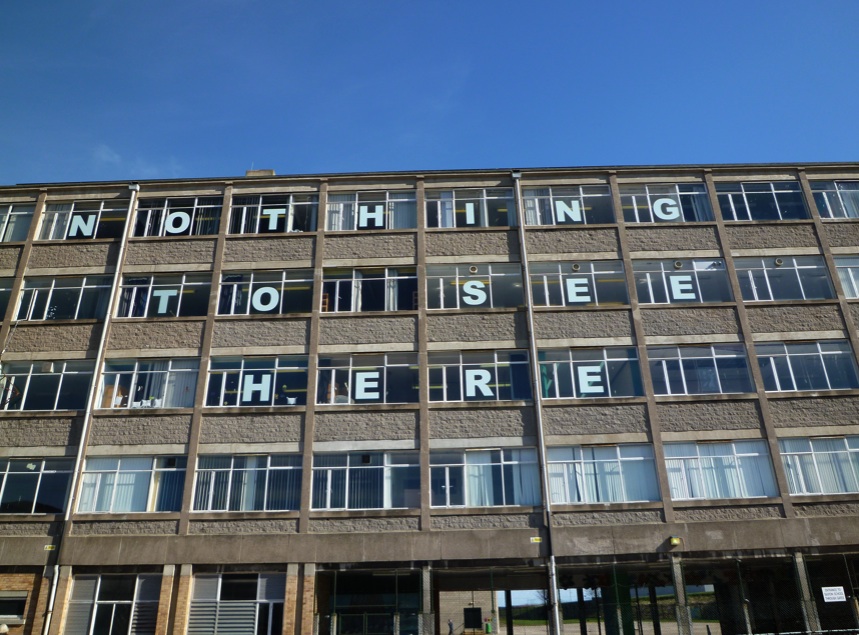
Well, impressions of what that might mean began to flit across our minds at last night's premier screening of "Run Down Aberdeen", a new documentary film by Aberdeen video-artist Fraser Denholm (we've linked to his blog once or twice before), and at the performance of "Nothing to See Here", a unique piece of site-specific interactive promenade theatre by Extreme Aberdeen - a collaboration between Aberdeen City Council and the National Theatre of Scotland in partnership with extreme-sports social-enterprise "Transition Extreme". (We saw "Nothing to See Here" at the weekend, but have embargoed our review, because it would be full of spoilers for anyone who has not yet seen the 'performance'. The run is now finished.)

RUN DOWN ABERDEEN

Fraser Denholm's documentary film "Run Down Aberdeen" was commissioned by the creator of the Facebook community group which shares the documentary's name. The film rolls our sleeves up for us and does the necessary job of setting the terms of reference by which we might, with eyes open and the spirit of steely realism (which will be vital), begin to grasp the future in our medium-sized northern town, out on the edge of Britain. The documentary does an exemplary unflinching job of investigating the reactions, impacts and causes of our current condition. For a backdrop to interviews with politicians, writers and citizens [picks up own trumpet - the author of this blog being one - puts own trumpet down] Fraser uses contradictorily heartbreakingly beautiful photography featuring our egregiously dilapidated built environment. Fraser asks the right questions of his interviewees, the backing music woozily plink-plonking an atmosphere of unease to accompany the soft-spoken understated voiceover.

Last night's screening was followed by an open-floor panel-session, the film-maker flanked by local politicians. We were unsurprised that - having just watched the film - Deputy Leader of our local council, Cllr Kevin Stewart, said that he "didn't like the title". We feel that this is typical of the reality distortion field which sometimes characterises discourse in this town, and was at sharp variance with the realism from which the documentary does not flinch. Timely and relevant to the state of our town, Fraser has demonstrated - by examining the political, economic, commercial and creative background (psychogeographical) context - that our town is, indeed, run down. And he has done so in a technically excellent, flawlessly paced and balanced way that reflects the "grey strangeness" (per Betjeman) of our town; the edge on the edge.

Mentioned both in Fraser's film and in the floor discussion afterwards was the hope that a grass-roots creative sector movement might have a pivotal role to play in the regeneration of Aberdeen. Clearly, there is no amount of capital which can be mobilised to comprehensively recondition the built environment (the townscape, if you will) any time soon, but in the engagement of the audience and in the unflinching eye of the documentary maker we perhaps begin to discern the mobilisation of creative capital which might bring about the right conditions to recondition the mindscape of our town - something which we think is a pre-condition of future social (as well as commercial) sustainability for Aberdeen.

NOTHING TO SEE HERE

Another creative initiative operating to modify the mindscape of Aberdeen is the Extreme Aberdeen initiative; a grass-roots project involving more than 250 young people, the project has sought to inhabit the edges of our town to create an "adrenaline fuelled mix of worlds". We mentioned their "By Order of Me" project last month. In the finalé event "Nothing to See Here" we are audience and player in an interactive site-specific theatre performance art event.

This promenade-theatre production is a phantasmagorical journey through the soon-to-be-demolished Linksfield Academy and Community Centre building. The audience is split into groups of two or three and propelled physically and mentally through the building. Themes of loss, trust, betral, confusion, lack of control, injustice, wrongful imprisonment, surveillance, inspiration, celebrity culture and triumphant redemption are explored via a series of dream-like tableaux; now visiting a man on his hospital death-bed, then being hooded and kidnapped out of a van by baseball-bat-wielding balaclava'd thugs, next participating in a rigged game-show, finally redeemed as a rock-star singing solid-gold soft-rock High-School-Musicalesque to a crowd of ecstatic and adoring fans. (No, really.)

The production uses a mix of professional actors, student actors, schoolkids, young musicians and extreme sports like parcourt and BMX to create the immersive scenarios which don't so much require suspension of disbelieve on behalf of the audience/participants as de-condition us from normal reality in favour of the non-linear dreamscape which becomes our lives for an hour or so. And, all the while in the production we find echos of the way we live today and of our own lives. The specifics of certain of the episodic elements continue to swim unbidden into our minds for days afterwords. We suspect that this may continue for some time to come. This production is truly transformational - not just for the lives of the young participants who will retain this experience and gain strength and inspiration from it forever, but also for us. We will never forget it.

"Nothing to See Here" perhaps goes part of the way to answering the implicit question of "Run Down Aberdeen"; that question being what happens next? The obsolescence and decrepitude of the site is one of the themes of the production, and the building itself is one of the 'stars'. The site-specificity of "Nothing to See Here" relies on the fact that a derlict and condemned building gave the producers the once-only chance to create something huge and something unique - something unrepeatable and special for the community which shared in the production on all sides - in front of and behind the curtain and also behind the scenes, the edges between all three aspects of performance being is intentionally blurred, indeed - demolished.

In projects like these, both the documentary film and the site-specific theatre production, we begin to see that grass roots creativity - the kind which involves people and improves lives - does not require a "big name arts and culture brand" as some believe they should attempt to attract to Aberdeen rather than support home-grown arts organisations. Likewise, the kind of creativity which is inclusive and innovative does not require any new-build "iconic" building in which it would be stultified and suffocated behind figurative and literal glass screens. Creativity is always and everywhere something for everyone. Creativity has no boundaries, no walls. The whole of Aberdeen is our playground, it's one big edge...

You've just got to get out there and be in it, live in it.

[edit: We just learned the spendid news that Cllr Stewart has requested that a special screening of "Run Down Aberdeen" be arranged for Aberdeen's Councillors.]


Here's Fraser's film, pass it on:


Run Down Aberdeen from Fraser Denholm on Vimeo.


And here's cast and crew (and maybe you) on an "All Time High" at "Nothing To See Here":

Twenty-eight Percent.

Last night, we were along to Peacock Visual Arts to attend the premier screening of Fraser Denholm's timely and apposite documentary film: "Run Down Aberdeen."
(Own-trumpet-blowing warning: Other Aberdeen's Alan was one of Fraser's interviewees in the doc.)

The film was followed by an open-floor and panel discussion, with the film-maker Fraser flanked by local politicos Deputy City Council Leader Cllr Kevin Stewart, Cllr Martin Greig and Lewis Macdonald MSP.

Here's the film to watch online - pass it on:


Run Down Aberdeen from Fraser Denholm on Vimeo.

We'll write a bit more about the film and the issues it covers later today, but for now we want to explore one particular statistic - mentioned in just one sentence during the floor discussion - from our Deputy Council Leader, Cllr Kevin Stewart.

A question from the floor relating to Aberdeen's role in the Oil and Gas industry was being handled by the panel. Labour and SNP agreed wholeheartedly that Aberdeen was an "economic powerhouse". And that's not just for the North East, but for the whole of Scotland and the UK, according to Lewis Macdonald MSP. Deputy Council Leader, Cllr Kevin Stewart, said that Aberdeen contributed 28% of UK tax revenues to the UK Exchequer.

This is not true. And the fact that both Stewart and Lewis believe that it is tells us more about these politicians than they mean it to. Just have a think about it... that statement suggests that of all the revenue collected by the UK government, more than a quarter comes from the economic activity of less than half-a-percent of the population. What an assertion to make! Really, if this were the case the whole world would beating a path to our small corner to learn the secrets of our special sauce.

But we've seen this error trotted out before by local press and local business-sector bloggers. (We trust that it is a genuine misunderstanding - and not a willfully disingenuous manipulation - politicians wouldn't do that, would they?) So, let's see where the source of the error comes from:

Firstly, like all misunderstandings of this type, it contains a kernel of truth. The 28% figure is within this document (big PDF) from special-interest business lobby group Oil & Gas UK.
[Edit: The figure has actually been revised recently, and now stands at 30% - even more than Cllr Stewart asserts!]

But, that 28% figure relates to Corporation Tax revenue - not all revenue, and it relates to the entirety of the oil and gas sector, not just the 'upstream' (finding and getting) activity which dominates business in Aberdeen.

So, for the avoidance of doubt, Oil & Gas UK rightly assert that the oil and gas industry generated 28% of UK corporation tax receipts during the tax year 2008/09.  But ask yourself: "What else happened during that period?" It's then quite easy to see why the oil and gas industry banked more than the "Square Mile in London" (as has been said elsewhere) at that time: As the oil-price spiked to that $147/barrel record, the energy companies enjoyed windfall taxable profits against the dark background of the financial sector falling into more-or-less ubiquitous loss. It is also relevant to point out that many UK Oil & Gas sector companies operate in a variety of overseas locations, but are stock exchange listed in the UK.

It is also telling that our local representatives to attempt to attribute the entirety of that oil and gas activity exclusively to this town. This is risible. Upstream (finding and getting) oil and gas is a cost centre for the energy companies. Profits are generated in transport, refining, trading, electricity generation & transmission and value-added retail. None of which impinge much on this region. We are exasperated that this boosterism based upon fallacy continues to characterise the discourse in this town and is continually repeated by our local press and politicians. We find it a bit nauseating.

Our local politicians appear to have fallen into the trap of believing Aberdeen's hubristic self-styling as Oil Energy Capital of Europe. It is not. London, Rotterdam, Paris and Moscow vie for that title. No-one outside Aberdeen who works in this huge industry which spans many regions and activities calls Aberdeen "Energy Capital of Europe". When these people in the industry outside Aberdeen hear the term they snigger, as a rule. In the words of novelist Cristopher Brookmyre:
"Europe's Oil Capital. Honestly. The first time he heard the expression, he'd assumed it was a bit of self deprecatory humour. That was before he learned that there was no such thing as self-deprecatory humour in Aberdeen, particularly when it came to the town's utterly unfounded conceit of itself."
Now, please don't misinterpret what we're saying. There's definitely much to be proud of in the business world in Aberdeen "City and Shire" (ugh). But there's no need to "enhance" these good things with disingenuous or demonstrably false hubristic misrepresentations which make us look vaingloriously stupid. To do so devalues that which is genuinely good and praiseworthy about our town. To do so undermines our standing amongst our competitor regions. And to do so undermines calls for greater support from central government and other non-governmental actors - help which Fraser Denholm's pertinent and well-timed new documentary aptly demonstrates that we need.

The future will contain many challenges. We need to face them with open eyes and realism. As we've said before, oil and gas reserves are finite. The day will come when we will all dearly wish that we had started down the difficult road of re-balancing our energy supply earlier than we have. In Aberdeen we will, additionally, wish that we had started down the road of re-balancing our local economy a little earlier too.


At Other Aberdeen we greatly fear that the currently high oil prices, the hubris they inspire and the offensive (and, as we have seen, ill-founded) triumphalism they provoke militates against the redirection of capital towards the development of a sustainable economy in Aberdeen, be that in the shape of the switch to renewable energy technology, the burgeoning development of the Scottish life sciences sector or other more traditional business sectors. We, unsurprisingly, would be happiest to see the creative and arts sector help lead in the regeneration of Aberdeen's built townscape and business landscape through grassroots bottom-up inclusive creative initiatives. We were gratified to hear during the panel discussion that Lewis Macdonald MSP supports this hope.

But then, there we were, at Cineclub hosted by Peacock Visual Arts. Should we have been surprised to see a politician (who is seeking re-election) wearing his metaphorical "I support the Arts" badge? Not for the first time this week, we realise that to ask the question is to answer it.