PART 1
One of the things which first got us into this psychogeography lark was the writings of Alex Mitchell in his "Round and About" articles for Aberdeen Civic Society. In documenting one of his
psychogeographcal walks, Alex tells us of the panoramic views which are available from the top-deck of Union Square's multi-storey carpark.
More recently, noted local psychogeographer and guerilla artist
Lewis Dryburgh appeared on the Fred MacAuley radio show via high-tech live link-up from the top-deck of an Aberdeen multi-storey car-park, enjoying his packed lunch and promoting his forthcoming attendance at a
conference in London where he'll be talking about just this very subject.
There's clearly something in this...
So, armed only with open minds and a digital camera off we went to revel in the delights of the splendidly modernist brutalist pay-and-display municipal carparking facility which squats on the corner of Huntly Street and Chapel Street.
 |
| Béton brut |
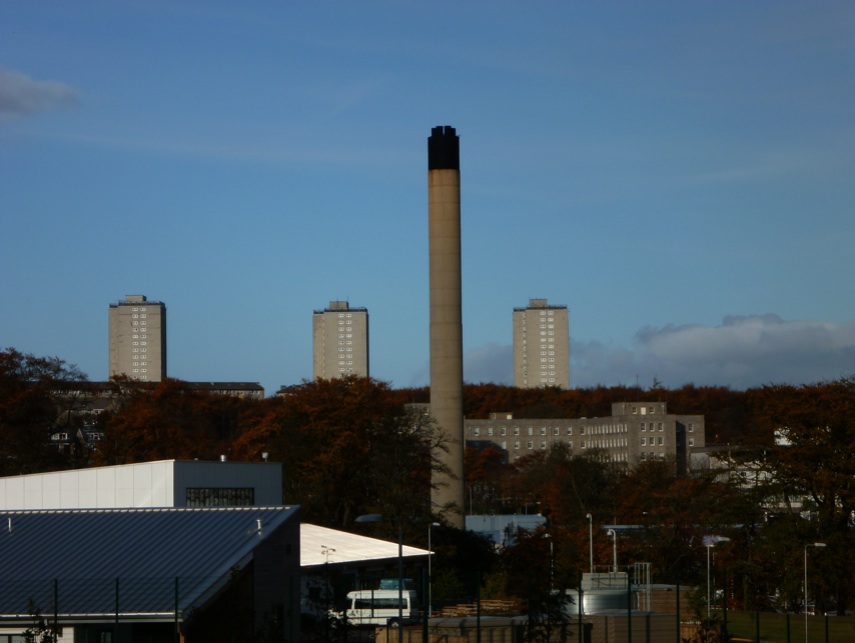
From the top-deck, we're treated to amazing views.
No motorist uses the top deck for parking.
 |
| Deserted |
Someone's been enjoying a lovely snack ... Lewis?
 |
| Pizza, spesh & tabs. |
As was mentioned on the Fred MacAuley radio show, because the motorists who park there prefer to use the lower levels (lest they inadvertently catch a glimpse of the sky or are exposed to the wind) the top-decks of these carparks are invariably-deserted splendid urban refuges and viewing platforms for pedestrians where the skyline of the town can be ogled in peace and tranquility, away from the street-level hurly-burly noise and pollution.
 |
| Serene |
We're not even joking when we say that this aspect of the top-decks should be promoted. A handful of picnic benches could be installed and the area landscaped with a bit of container-planting. We appreciate that readers will draw a parallel between what we're suggesting and what's been proposed for Union Terrace Gardens, but we're not trying to be too-clever-by-half cynical here. The top-decks are a fantastic and extensive pre-existing resource within the heart of the city. We should make use of that resource as if it were urban green space. Even if it isn't.
PART 2
However... as with all things... not all is rosy in our putative urban garden on the top-deck. There are plenty artifacts around the place which signify the security regime to which this carpark is subject.
 |
| To intrude, deter and intimidate. |
 |
| If not; lacerate, injure and eviscerate. |
As we went to leave, descending the north-frontage starwell, we heard a voice shouting at us:
"Jist hud on you two, ahm wantin a word with yiz!"
This carpark has an Aberdeen City Council caretaker. Oh no! He's a jobsworth: his jobsworthy credentials confirmed by the fact that he only chose to challenge us as we were on the way out. Squatting in his bothy, pouring over the CCTV footage, he observed us. He watched what we were doing. He didn't like it. He told us that we were
"bein checked up on" because
"Ahv bin telt te keep an eye on things".
So, you saw us on your monitor and
just assumed we were up to no good...
"Aye"
Hmmmm... in which case, why challenge us only when we were leaving - when it was perfectly clear that we'd done no damage, stolen nothing, touched nothing, interfered with nothing. Indeed (and as always) we'd behaved with a high degree of upright decorum. Surely it would have been much better to challenge us when he first saw us. Then we could have had a nice chat rather than him make insulting assumptions about us. Of course, we thought that if you've done nothing wrong - then you've nothing to worry about. Isn't that how the surveillance state was sold to us all? But by this unpleasant encounter we certainly felt we'd been punished for something.
Apparently he's been
"telt te clamp doon" because he gets
"a lot of Big Councillors" using his carpark.
Clamp down on what? Perfectly legal activity? What are they afraid of? Are they afraid that my act of photo-logging will scratch their car? Or is it like the First Nation people of North America who believed that to be photographed was to surrender a part of the soul? Does my act of photography devalue the car?
One of the reasons why we 'do' psychogeography is to uncover the events and relationships which are encoded within the environment of the town and the behaviours, events and relationships which in turn are moulded and promoted by that environment. Our jobsworth caretaker unwittingly reveals a number of these relationships, events and behaviours.
Do the
"Big Councillors" (does that mean fat? he didn't specify) pay for their parking? Or is it a perquisite of their position; is this jobsworth merely a form of subsidised valet parking for the
"Big Councillors"?
We can't imagine why so many
"Big Councillors" are attracted to the area anyway.
According to the jobsworth, cars have been stolen from that car park. And so, having been
"telt te keep an eye on things" the jobsworth believes that all non-conforming behaviour is challengable. The car-thiefs, it seems, can be detected by their enthusiasm for photo-location-logging.
Odd. We'd heard that over-indebted motoristis had been abandoning their heavily-financed hire-purchase cars in this facility. Quite the opposite of car theft.
 |
| Can't pay? Then just walk away. |
And, as so often, as we make our way through life in the surveillance state and the empowered jobsworths it begets, we find ourselves thinking of he words of Bryan Finoki from his
'Field Guide to Military Urbanism' blog. The blog mostly refers to urban situations in war zones, siege areas, divided communities and the like - but these words are pertinent to us, now, here:
[The] contemporary city is defined by a kind of de facto psychopathology that is embodied in the very spaces and architectural rationales that order urbanization today, from gated communities to urban surveillance landscapes, to the last dying refuges of public space that have been [will be?] overwhelmed by privatization and a complete hyper securitization of the built environment at all scales.
One might ask... what is the current diagnosis and mental health state of western democracy? Or, how can the city be viewed as an architectural weapon to enforce behavior, to mandate neo-liberalism in a way, to turn a population into an obedient supporter of rampant commerce? What are the inherent narratives of power that run through spatial constructs like maximum-security prisons, shopping malls, refugee camps, suburban sprawl, and the hardened borderzones between nation-states? Is there a psychopathological connection between them? Is there a new urban archetype here to be deconstructed?
Yes. There is.