Thursday, 18 November 2010

The Crypto-Communist Roof of John Lewis

Coincidentally continuing the theme of multi-storey car-park top-decks, today I found myself on the top of the building which is occupied by the John Lewis department store. The top of the building forms an adjunct to the Loch Street car-park of the Bon-Accord centre. The building was formerly called "Norco House" and was occupied by the department store of the Northern Co-operative Society.

The Communist Party and the Second and Third Socialist Internationals paid great attention to the Co-operative societies, seeing them both as a form of communism-in-action but also potentially as a counter-revolutionary lightning-rod sop to the working class; earthing the charge of revolutionary tension through their rosy ideologies; thus preserving the status quo.

As far as the Northern Co-operative Society goes (and, skating all too quickly over the surface of this frozen yet deep pond) its own history of soaring idealism betrayed by mis-management, pilfering, inefficiency, spanish practices, featherbedding, jobsworthy empire-bulding and eventual over-reach and collapse in 1993 (followed by subsequent carpet-bagging and asset-stripping) parallels the history of Soviet Communism itself. In a very approximate way. Sort of.

John Lewis is an employee-owned partnership business, which is managed through a system which resembles that of worker's councils, so it's entirely apt that they should occupy this building in Aberdeen.

The roof of the building is accessed by car via this thrilling sky-bridge from the main section of the Loch St carpark. The sky-bridge straddles Loch Street below. Pedestrians can reach the roof via the stairs inside the John Lewis store itself.

You can drive your car on top of that. Really, you can.
As usual, this open-to-the sky portion of the car-park was largely deserted.

Nobody here but us psychogeographers.
And the views are, of course, spectacular.

George St

Rubislaw

Gallowgate

Wednesday, 17 November 2010

Chapel Street Multi-Storey Car Park

PART 1

One of the things which first got us into this psychogeography lark was the writings of Alex Mitchell in his "Round and About" articles for Aberdeen Civic Society. In documenting one of his psychogeographcal walks, Alex tells us of the panoramic views which are available from the top-deck of Union Square's multi-storey carpark.

More recently,  noted local psychogeographer and guerilla artist Lewis Dryburgh appeared on the Fred MacAuley radio show via high-tech live link-up from the top-deck of an Aberdeen multi-storey car-park, enjoying his packed lunch and promoting his forthcoming attendance at a conference in London where he'll be talking about just this very subject.

There's clearly something in this...

So, armed only with open minds and a digital camera off we went to revel in the delights of the splendidly modernist brutalist pay-and-display municipal carparking facility which squats on the corner of Huntly Street and Chapel Street.

Béton brut

From the top-deck, we're treated to amazing views.


No motorist uses the top deck for parking.

Deserted
Someone's been enjoying a lovely snack ... Lewis?

Pizza, spesh & tabs.

As was mentioned on the Fred MacAuley radio show, because the motorists who park there prefer to use the lower levels (lest they inadvertently catch a glimpse of the sky or are exposed to the wind) the top-decks of these carparks are invariably-deserted splendid urban refuges and viewing platforms for pedestrians where the skyline of the town can be ogled in peace and tranquility, away from the street-level hurly-burly noise and pollution.

Serene

We're not even joking when we say that this aspect of the top-decks should be promoted. A handful of picnic benches could be installed and the area landscaped with a bit of container-planting. We appreciate that readers will draw a parallel between what we're suggesting and what's been proposed for Union Terrace Gardens, but we're not trying to be too-clever-by-half cynical here. The top-decks are a fantastic and extensive pre-existing resource within the heart of the city. We should make use of that resource as if it were urban green space. Even if it isn't.


PART 2

However... as with all things... not all is rosy in our putative urban garden on the top-deck. There are plenty artifacts around the place which signify the security regime to which this carpark is subject.

To intrude, deter and intimidate.

If not; lacerate, injure and eviscerate.
As we went to leave, descending the north-frontage starwell, we heard a voice shouting at us:
"Jist hud on you two, ahm wantin a word with yiz!"

This carpark has an Aberdeen City Council caretaker. Oh no! He's a jobsworth: his jobsworthy credentials confirmed by the fact that he only chose to challenge us as we were on the way out. Squatting in his bothy, pouring over the CCTV footage, he observed us. He watched what we were doing. He didn't like it. He told us that we were "bein checked up on" because "Ahv bin telt te keep an eye on things".

So, you saw us on your monitor and just assumed we were up to no good...
"Aye"

Hmmmm... in which case, why challenge us only when we were leaving - when it was perfectly clear that we'd done no damage, stolen nothing, touched nothing, interfered with nothing. Indeed (and as always) we'd behaved with a high degree of upright decorum. Surely it would have been much better to challenge us when he first saw us. Then we could have had a nice chat rather than him make insulting assumptions about us. Of course, we thought that if you've done nothing wrong - then you've nothing to worry about. Isn't that how the surveillance state was sold to us all? But by this unpleasant encounter we certainly felt we'd been punished for something.

Apparently he's been "telt te clamp doon" because he gets "a lot of Big Councillors" using his carpark.

Clamp down on what? Perfectly legal activity? What are they afraid of? Are they afraid that my act of photo-logging will scratch their car? Or is it like the First Nation people of North America who believed that to be photographed was to surrender a part of the soul? Does my act of photography devalue the car?

One of the reasons why we 'do' psychogeography is to uncover the events and relationships which are encoded within the environment of the town and the behaviours, events and relationships which in turn are moulded and promoted by that environment. Our jobsworth caretaker unwittingly reveals a number of these relationships, events and behaviours.

Do the "Big Councillors" (does that mean fat? he didn't specify) pay for their parking? Or is it a perquisite of their position; is this jobsworth merely a form of subsidised valet parking for the "Big Councillors"?

We can't imagine why so many "Big Councillors" are attracted to the area anyway.


According to the jobsworth, cars have been stolen from that car park. And so, having been "telt te keep an eye on things" the jobsworth believes that all non-conforming behaviour is challengable. The car-thiefs, it seems, can be detected by their enthusiasm for photo-location-logging.

Odd. We'd heard that over-indebted motoristis had been abandoning their heavily-financed hire-purchase cars in this facility. Quite the opposite of car theft.

Can't pay? Then just walk away.
And, as so often, as we make our way through life in the surveillance state and the empowered jobsworths it begets, we find ourselves thinking of he words of Bryan Finoki from his 'Field Guide to Military Urbanism' blog. The blog mostly refers to urban situations in war zones, siege areas, divided communities and the like - but these words are pertinent to us, now, here:
[The] contemporary city is defined by a kind of de facto psychopathology that is embodied in the very spaces and architectural rationales that order urbanization today, from gated communities to urban surveillance landscapes, to the last dying refuges of public space that have been [will be?] overwhelmed by privatization and a complete hyper securitization of the built environment at all scales.
One might ask... what is the current diagnosis and mental health state of western democracy? Or, how can the city be viewed as an architectural weapon to enforce behavior, to mandate neo-liberalism in a way, to turn a population into an obedient supporter of rampant commerce? What are the inherent narratives of power that run through spatial constructs like maximum-security prisons, shopping malls, refugee camps, suburban sprawl, and the hardened borderzones between nation-states? Is there a psychopathological connection between them? Is there a new urban archetype here to be deconstructed?

Yes. There is.

Thursday, 11 November 2010

Something to See at the Traffic-Free Fernie Lea.

Traffic-free
The fernie-lea. No ferns, though.

Cycling along the pedestrian-and-cyclist-only hyperspace-shortcut-bypass that is Fernielea Road, overlooking the broad shallow valley of the Denburn at Summerhill, our eye was caught by a piece of public art - a mosaic - embedded in the wall of Hazelwood special needs school.

Out of the corner of the eye...

We were first put in mind of the Nasca desert lines and the characters which they depict. We were secondly put in mind of Hindu imagery.

Here's the whole thing - but a photo doesn't really do it justice.
And it put us, thirdly, in mind of an award-winning piece (it turns out, by the same artist) which we saw at the Aberdeen Artists exhibition at Aberdeen Art Gallery a few years back. Investigating closer, we see that the artwork is composed of many smaller ceramic artworks and found objects (or are they things made to seem as if they are found objects?) making up visual puns and cultural references which can be read and interpreted on several levels.

Geddit?


It's entertaining and thought provoking. We were surprised, amused, engaged, challenged and, to an extent, unsettled. The piece is signed (cryptically and pictogramically) and so, just a little Googling delivers us to the artist's - ceramicist Stephen Bird - website.

On his profile page you can read details of the project at Hazelwood and learn that it was one part of a commission which also included work done at Woodlands special needs school. The Woodlands piece was a 'huggable vase' which has been described as a "fascinating blend of childhood pleasures and fantasies".

Pride, achievement, ability - priceless.
The commission which resulted in the creation of the mosaic and vase explored the fundamental issues of disability and inclusion; the pieces having been created by the artist working alongside the pupils to use art as a means of two-way communication. Some children with special educational needs find it difficult to communicate and express themselves, and these artworks use the unique nature of art to communicate and stimulate; to empower and enrich  - thus transcending the linguistic and social difficulties which some of the children suffer, and giving them a great sense of pride, achievement and ability. So these pieces have an inestimable value (which is not the monetary kind!)

The site of the Woodlands special needs school and hospital has now, of course, been comprehensively redeveloped into a prestigious, exclusive, upscale development of aspirational housing for the affluent: "Woodlands at Pitfodels".

PaveParking at Woodlands at Pitfodels
The special needs school has relocated to Regent Walk in the north-east of the town, where we're told (thanks very much to the curators of Aberdeen Art Gallery for this essential information) that the 'huggable vase' can still be seen. We'll get along there at some point and report back.

The results of the commission (which was funded jointly by Aberdeen City Council and the Scottish Arts Council - now "Creative Scotland") received a Scotland Visual Arts Education Award which celebrates creativity and well-being. The awards panel recognised the transformative nature of the project: "Together, the artist's and children's sensitive collaboration produced artworks of deep meaning for the schools, the participants and future audiences." It would be a great pity if - in their quest for savings - national, regional and civic government were to make less funding available for similar commissions and awards in the future. That would be to mistake cost for value; to confuse money with wealth. The two things are, of course, quite different.

An Ugly Sky.

Here at Other Aberdeen, we're naturally in favour of public transport for a town the size of ours. And, in common with a great many, we mourn the passing of the trams. Not that we were around when the trams were running - we're not that old! So it's a sort of vicarious nostalgia that we have for this most electrically-driven form of sustainable zero-emission transport (notwithstanding the remaining filthy sources of grid electricity).

And there we have to check ourselves. Regular readers know that we are suspicious of that sort of "ooh, it's not like the old days" nostalgia that wants to turn back the clock. We most certainly do not want to turn back the clock, and the difficulties which we in Scotland seem to have in delivering big-ticket infrastructure projects shouldn't be dismissed. The Edinburgh trams project has significant problems; we await with interest the final outcome and doubtlessly public enquiry into the cost and time overruns, specification variations and all the rest. It's disappointing.

But what really troubled us was sight of this photo which we came across online:

Look at the web of powerlines above the road and pavement. What a mess!

Our attitude towards trams is, therefore, a work-in-progress, we'll be coming back to this subject again and again.

These ones were gorgeous, though - imagine travelling on the top deck of this modernist beauty with its wraparound and wrapover windows. And look how mannered the area now disastrously blighted by the Bridge of Dee roundabout once was:


Oooh, it's not like the old days!

Thursday, 4 November 2010

An Apple of Gold in a Basket of Silver

Recently, there's been a lot of controversy about the proposed redevelopment of Union Terrace Gardens in the centre of Aberdeen.

As far as we can see, the 'City Square Project' is (was?) a speculative real-estate development proposal which would transform the garden in the city centre into an underground car-park and label its roof a 'civic square'. This reminded us of Aberdeen's Golden Square. Which now has it's own website. Yay!
(Maybe they'll get some content sorted out before the registration lapses next year.)

Golden Square in the 1867 Ordnance Survey 
Golden Square today
Yes (in common with what is proposed for Union Terrace by the boosters of the City Square Project) Golden Square was once characterised by a central garden area which is now given over exclusively to motor cars. And it's called a square.


We had a great laugh when we read a risible article on this pro-motorcar lobbying blog (beware popups, ugh!) which suggested that a Trevipark robot-controlled automatic underground parking system had been proposed for Golden Square. I couldn't help but remember a Thunderbirds episode from my childhood when a system like that was used by the characters - with disastrous consequences! Call International Rescue!

Thunderbirds

Trevipark

Aberdeen author John Aberdein touched on the cognitive dissonance provoked by the present configuration of Golden Square in his splendid satire on civic Aberdeen - Strip the Willow... Two characters are discussing the fact that Aberdeen fails when compared to its continental competitors for lack of a civic square. They then, of course immediately realise their mistake, and identify Golden Square as just such a continental-style human-scale civic square. They then bemoan the fact that it's given over to car-parking. They decide that the urban environment would be greatly improved by the installation of seats in the square - and then they point out that there are, indeed, usually dozens of seats in Golden Square - it's just that they're always exclusively locked away in metal boxes.

Plenty comfy seats. But locked in private metal boxes.
There was a moment, just a moment, when it seemed that Aberdeen City Council might return the centre of the square to human-scale (rather than motorcar-scale) use, but, unfortunately, it seems that financial mismanagement and the resultant ensuing austerity has lead to a kind of money-grabbing pragmatism. You can read more detail about it on rxpell's Moved To Comment blog. Thanks also to rxpell for this photo:


The statue of the Duke of Gordon (who he?) was placed in Golden Square in the 1950's. The statue is notable not for the person it depicts but for the fact that it was sculpted by a Thomas Campbell in 1841-2 of Dancing Cairns granite and so was one of the first statues to be cut in granite since the Ptolomies of ancient Egypt.

With a continentally-renowned concert hall, cafe-bars, restaurants, offices, cathederal, theatre, flats, and townhouses surrounding - in our opinion motor cars should of course be discouraged from entering Golden Square and North and South Silver Street. Golden Square could then be something really special; with Silver Street on either side, Golden Square could once again be described as the proverbial "apple of Gold in a Basket of Silver". The same goes for Bon Accord Square to the south of Union Street. Both those areas would then (if this vision were realised) make fine, human-scale, slightly bohemian (definitely Grecian) mixed-use urban-village type-things.

Isn't that what we all want?

Wednesday, 3 November 2010

Top Deck Trials

A little while ago, wandering around the centre of town, we crossed the top deck of the St Nicholas Centre. We think it's fair to say that this is now a strange place. There used to be a bustling Post Office, a Job Centre, a baker, a cafe, a cosmetic shop, the stationary outlet for WH Smiths and something else which we can't remember. Now, though, it has failed commercially; the shop units are boarded up and vacant.


It seems counter-intuitive that there should be this void, this vacuum at the very centre of the town, and of course, we have to ask: "why?"

We've already mentioned the unpleasant attitude displayed by those who enforce the already unpleasant surveillance system which blankets the deck with it's foul intrusion. But consumers are used to that sort of invasive prying, so that's probably not it.

No, we think that the big problem for the top deck of the St Nicholas Centre is two-fold. These are problems which the late-seventies master-planners and mid-eighties architects could not have foreseen. These are problems which cannot be overcome at this site, for they are problems which reside within the consumers themselves, not with the design of the shopping centre.

Firstly, the top-deck of the St Nicholas Centre is outside. This obliges hapless unsuspecting consumers to expose themselves to the wind and other meteorological phenomena for which they might not be psychologically, physically or sartorially prepared. It now being technologically possible (and therefore de-facto desirable) to upgrade to a life lived completely behind closed doors. Like a sort-of saturation-diving system but for producer/consumers.

Whereas the industrial diver goes from living-chamber to diving-bell to seabed worksite, all the while never exposed to the ambient environment; likewise the producer/consumer can go from apartment underground carpark into car to underground (or multistory) carpark at the workplace (or shopping centre), all the while never exposed to the ambient environment. It is revealing that the top decks of Aberdeen's multi-story carparks are invariably deserted - it is as if the producer/consumers are afraid to see the sky.

Secondly, the top-deck of the St Nicholas Centre is upstairs. This obliges the consumer to climb some stairs, thus unavoidably taking some exercise. Don't be silly! If you must exercise, the place to do that is in the controlled and mediated environment of the gym, where it's paid-for and therefore safe. And indoors.

Now the stationary outlet alone operates on the top of the St Nicholas Centre - solitary amid the foot-fall depleted devastation. Look upon my post-it pads and dispair! Nothing beside remains.

We like stationary well enough, but self-sealing envelopes and rollerball pens seem, well, somehow just not enough to justify the existence of this prime piece of real estate right in the heart of the city centre. And so, nature abhorring a vacuum, a sort of social market in urban space takes over. Re-development, re-use or re-invention inevitably follows (sooner or later) when a piece of real-estate becomes blighted.

Some people, when they see an area becoming run down with vacancy and blight, get all hand-wringingly "something should be done - it's a disgrace - etc". We don't - we find it thrilling to watch the urban environment weaving it's cocoon of vacancy - who knows the shape of the metamorphosed creature which will emerge! We think that such areas can become "edges" - and so we welcome blight, we embrace the run-down and we seek out the vacant.

Zimmer-rock guitarist "The Edge" (out of pension-pop outfit U2) once embarrassingly told an interviewer that he'd chosen his nom-de-plectrum because "the edge is the difference between something and nothing". Cringeworthy though this self-regarding aphorism might be, we think that there's something to it, especially when we look at the urban realm. Edges are where things are juxtaposed. And when diverse items (artifacts, attitudes, activities, architecture, people, whatever) are put together, opportunities exist for new developments (and not just real estate!) to take shape through a process of serendipitous accident or coincidence - this is the fountainhead of creativity.

So we were delighted to notice a few "edges" forming on the top deck of the St Nicholas Centre...

We watched some guys doing reeeeaaaaallly impressive trials-bike stuff there, much to the delight of a group of young asian girls who were hanging about eating pakoras in their eyecatchingly beautiful multicolour printed headscarves. Much preening and giggling and flirting and stunt-riding and otherwise showing off. We felt that there was quite a good community feel on the go. (Is this the Big Society?) The stunt riding was really entertaining; the riders were proud to show off their abilites to old farts like us.

A grumpy fat woman opened a window from the offices above and shouted her disapproval with threats. We shouted back at her to leave the kids alone. Was she never young herself? Perhaps she envied their fitness and good looks.

We've been in touch with the best of the trials bikers we saw that day. He's a young guy (damnhim) called Greg Wright who you can watch displaying his impressive skill on this video:


Like the best public art, activities like Greg's add colour, excitement, entertainment and diversity to our town. People like Greg and his parcourt and skateboarding colleagues are assets to this town and so it really bothers us when people do them down and try to marginalise them, as if they were street-drinkers or aggressive beggars or somesuch. They are not; they are athletes and artists on the cutting edge of something new. They are role-models and exemplars of skill development, fitness and an active life.

Greg is the only trials biker at his elite level who lives in Aberdeen. He's recently enjoyed the success of being placed 2nd in the elite section of a competition held in Edinburgh. The trials biking community is growing rapidly in Scotland, and there is the possibility of a Scottish tour competition developing with around six different locations around the country. Fort William is already a world centre of extreme cycling sports, and locations around Glasgow, Edinburgh and Aberdeen would be included on the itinerary.

Keep your eye out for Greg - he's well worth watching, and he's one to watch. His progression in the sport is something we should support. Our non-commercial dogma at Other Aberdeen prevents us from sponsoring him directly, but if any of our readers are interested in helping Greg out with a bit of cash for bike parts, travel expenses and the like, we can put you in touch. E-mail us using the link at the top left of the page.

We find it deliciously ironic that he should practise and hone his outdoor active skill on the top deck of the St Nicholas Centre - a place which failed in it's primary function as a shopping centre because it required a small level of outdoor activity on the part of its users.

Tuesday, 2 November 2010

Congestion Charge for Aberdeen

It seems that, pushed to the brink by financial mismanagement and the austerity it has caused, Aberdeen City Council (ACC) is proposing the introduction of a London-style town centre congestion charge to help balance the budget.

Firstly, let us point out that those who believe that Aberdeen has a serious problem with traffic congestion are displaying a hopelessly parochial attitude and don't get out too much - they clearly haven't been to other UK cities recently. This video shows Glasgow commuter traffic:


Aberdeen traffic is light by comparison.

Anyhow, if you've read this blog, by now we're quite sure that you'll reckon that we'd be in favour of a congestion charge for Aberdeen. And you'd be right. However, ACC have made a dreadful political mis-step by openly declaring that their intention in introducing the charge would be primarily for revenue generation - such a policy clearly victimises motorists and will provoke a backlash. Because of this poorly handled political aspect, we think that the chance that a congestion charge will be introduced has actually been reduced.

It is all the more surprising that ACC should make such a political mis-step when we have the world-renowned University of Aberdeen Centre for Transport Research based here. Travel Demand Management is one of the specialities of the Centre, which recently completed a study demonstrating that, as in Stockholm, congestion charging can be introduced with the benefit of a fair political wind behind it if the public are allowed to experience a trial period; allowing the benefits to become clear.

The study’s findings show that support increases significantly if people become more convinced of the positive benefits for themselves or for society, as they are more prepared to adapt, on the condition that it is to their advantage.


So, while a congestion charge shouldn't really be looked upon as primarily a revenue-raising measure, we should welcome it and any steps which will limit the extent to which private cars erode the pleasant liveability of Aberdeen. For too long has too much space been donated to the unilateral demands of the motoring lobby - and still they demand more! Will they ever be satisfied? To ask the question is to answer it.

Too often we hear from friends and relatives and correspondants and the local press that there's "no alternative" to the car for getting around Aberdeen. We have to ask ourselves - what's wrong with these people? Can't they walk? Are they really that dependent upon their cars? Are they truly so debilitated by this dependancy that walking even just a mile is out of the question? Aberdeen is no metropolis; it is a charmingly compact and pleasantly walkable medium sized town. Haven't they noticed? Why not leave the car outside the town centre and walk the rest of the way? It costs nothing and it has great personal and civic benefits. Aberdeen would be more pleasant yet were the air quality improved and more road space available in the city centre for pedestrians, cyclists and public transport. And even equestrians - why not? That'd be great!
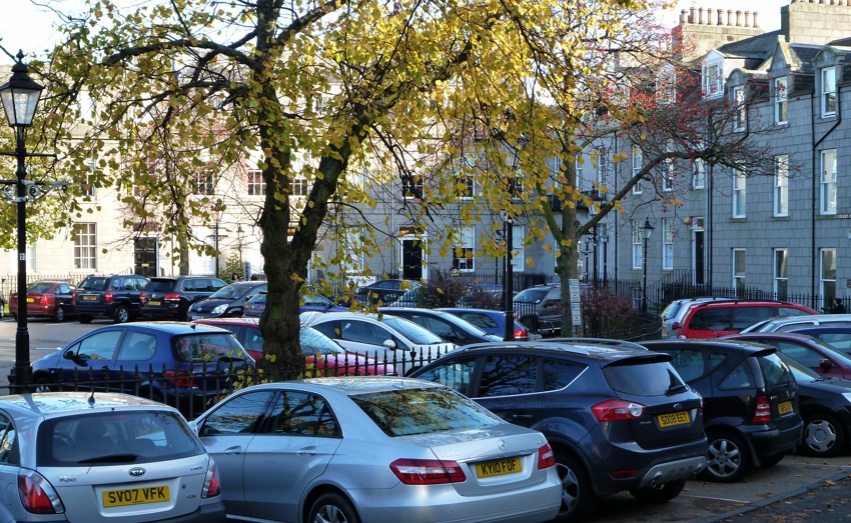
Urban dual-carriageway: congestion, noise, visible and smelly pollution. And some roses.
The roses, unfortunately, cannot mask the smell.
Yes, we do appreciate that this advocacy of actually walking a little bit is a revolutionary and radical idea, and that it will involve a transformative step-change in attitudes - but have you ever been to continental Europe? Aberdeen has a great deal in common with many similar-sized regional-centre towns across central and northern Europe. Culturally, historically, geographically and civically, these places resemble Aberdeen. Transport-wise, however, they are a different world. Forty years ago, while we plonked inner-city dual carriageways and multi-story carparks in the town centre, they (generally) decided to preserve the central urban realm at the human (rather than the motorcar) scale.

The result is that, today - when compared to Aberdeen - many towns in continental Europe have much more pleasant town centres where people live, visit, work, do business and are entertained - all untroubled by the danger, noise, smell and inconvenience of heavy traffic. Sustrans is like a weird voice in the wilderness in the UK in its call for "Quality Streets". On the continent, there is no need for pressure groups to lobby for policies like these - it's just the way things are already.

So we should look at our European competitors (for that is what they are) and realise that we share their heritage. Rather than try to turn Aberdeen into Houston, we should let Aberdeen be what it is - a north European merchant city. For a modern attitude to transport, we need only to look back to the time when cars didn't dominate the centre and try to recapture the feel of that human-scale city. This is not America.

Friday, 29 October 2010

Aberdeen's Freemen. And Freewomen. And Freeship?

While writing yesterday's post about the Doupin' Stone and its association with the Burgesses of Aberdeen, our research touched upon Aberdeen's contemporary "Freedom Ceremony" which is descended from the investiture of Burgesses; a ceremony which has its roots in the 12th century.

Whereas once the freemen burgesses were subject to a ritual humiliation hazing ceremony at their initiation, were then required to pay the monarch for their position and were also obliged to take up arms and give their lives if necessary in defense of the burgh; today, those granted the freedom of the city must merely submit to an agreeable lunch at the Music Hall or Beach Ballroom. At which lunch we doubt very much whether the initiates are required to bare their arses for a doupin'. But - hey, who knows? Maybe they are.

There's a page on the Bugesses of Guild website which gives a list of the freemen of the city invested since the 19th Century. Mostly men - but there are some women, a handful of organisations (mostly military) and one ship(!). There are some fascinating highlights, which provide telling insights into the mindsets of the contemporary city worthies who made up the awarding committees. The bestowing of titles is, of course, subject to the fashions of politics, economics and sociology. So we can, to an extent, plot the direction of these concerns in the minds of the city fathers by having a look at the list of those who have received the honour.

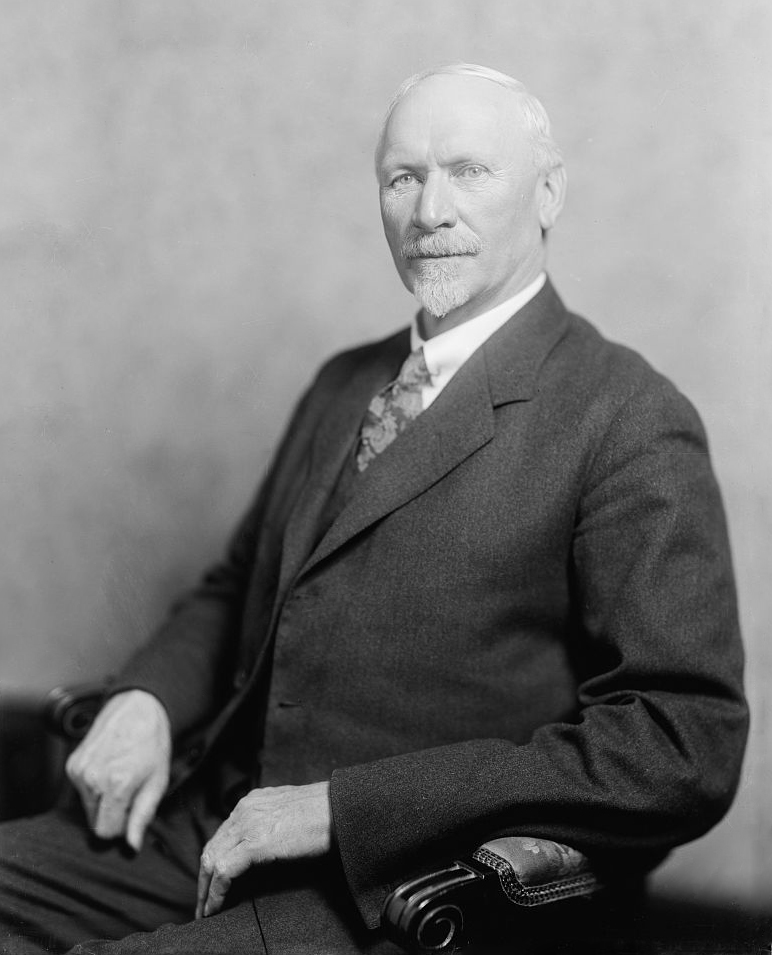
Our eyes were firstly drawn to the racist South African statesmen Jan Smuts; white supremacist and advocate of racial segregation who was invested in 1942. Of black Africans Smuts said: "These children of nature have not the inner toughness and persistence of the European, not those social and moral incentives to progress which have built up European civilization in a comparatively short period."


Smuts


He believed that black Africans were immature or incomplete as human beings, in need of the patronising guidance of white people - like 'special' children or clever pets. This was the white man's burden which he had manfully and heroically volunteered to take upon his shoulders, and for which it appears he was honoured by Aberdeen. Ugh.

In 1984, we attempted to put all that behind us by investing Nelson & Winnie Mandela. Good. Unfortunately, they did not show up for the ceremony. 


The 'Freedom' title in the modern era is, of course, purely honorary and ceremonial; intended to show that the bearer has performed exceptional service to the city and the community. People like Andrew Carnegie, who endowed our Central Library and Thomas Johnston, socialist politician, long-serving chancellor of Aberdeen University and creator of the North of Scotland Hydro Electricity Board - fantastic! Other names to be proud of include John Mallard - who was instrumental in the development of magnetic resonance imaging (MRI) and positron electron tomography (PET) - and Dugald Baird who did much for the health and liberation of women through the advancement of reproductive health, access to family planning services and obstetrics via his position of Regius Professor of Midwifery at the University of Aberdeen. (Though there is a bit of innuendo around Baird with regard to his alleged interest in eugenics.)

But the granting of honours like these can lay bare a cravenness in the awarding body - a forelock-tugging obsequiousness which hopes that a bit of the sheen of the awardee will rub off on the city. An inversion of the concept of bestowing an honor; the process becomes one of seeking the honour of endorsement by a notable figure of the dayFor this reason we see the honour being given to people who have never had anything to do with Aberdeen. People like Nelson Mandela, who we mentioned above, people like Sir Henry Morton Stanley ("Dr Livingstone, I presume") and Mikhail Gorbachev who, as far as we can see, was awarded the freedom of the city simply because he showed up one cold day in 1993. At least he did show up.

In recent years, we've also seen the honour being granted to showbusiness and sporting names; Alex Ferguson, for one. We also note that Buff Hardie, VIP (Very Important Pitmuxtonian) and some friends of his are Freemen of Aberdeen. We very much approve.
Looking Buff
In 1992 HMS Scylla, a Leander-class frigate, was granted the freedom of the city for the services she performed protecting Aberdeen fishery shipping during the Cod Wars with Iceland. Later, Scylla was deliberately sunk to become Europe's first artificial reef.


There she goes.

The awarding of the freedom to this artificial reef shows great foresight on the part of our city fathers, as today's predominant industry will, one day soon, become the world's largest archipelago of artificial reefs. Although this is not UK Oil & Gas' preferred route for the decommissioning of offshore oil and gas infrastructure - it is one which is already well-travelled. The oil-industry buzzword euphemism is 'derogation'.

Derogation in action

Thursday, 28 October 2010

March Stones 28 to 31 ABD - Borrowstone and Wynford - The Doupin' Stone

It's been a while since we visited stones 26 and 27 at Brotherfield, so it's good to get back in the groove tracing the markers of Aberdeen's medieval border.

It's a considerable physical gap between stones 27 ABD and 28 ABD too; two miles distance along the Brodiach Burn - which is a significant watercourse and was probably taken as sufficient marker of the Burgh boundary. So the council say, anyway, on their leaflet "Aberdeen's March Stones Trail" (PDF).

It's a beauty!
The Leopard Magazine has an excellent article on the history of the March Stones by Chris Croly, which we recommend. Suffice to say that, broadly, the March Stones mark the boundaries of the 'Freedom Lands of Aberdeen'. It is said that once Robert the Bruce had cleared the royal forests surrounding the city of all the interesting and valuable/tasty game, having no further use for the hunting grounds, he 'gifted' them to the Burghers of Aberdeen. For a yearly rent. Ha, some gift!

It actually comes as a surprise that, after nearly 700 years, the locations of the westernmost boundary stones remain rural and agricultural in character. In some cases, completely undeveloped. So, as we've said before, if you're going to go looking for these stones, you do so at your own risk. You will get wet and dirty, your feet will sink into bogs, you will tear your clothes (and possibly your skin) on barbed wire. You will find yourself clambering over consumption dykes and rubble cairns and you will become mentally and physically exhausted from the search. A moderate level of fitness (at least) is required. Moreover, you will need to get across farmer's fields, so check that you're familiar with the Scottish outdoor access code (PDF). Stones 28 to 31 are situated along the line of the Brodiach Burn and then Littlemill Burn, accessible from Blackburn Road which runs between the Skene Road and Clinterty, west of Brimmond Hill.


A field at Borrowstone Farm

28 ABD

Stone 28 ABD is on (very) boggy rough ground to the NW of Borrowstone Farm. We met a lovely asian couple tending their garden at one of the houses built just off the access road to Borrowstone. They were fascinated to hear about the March Stones and the fact that there was one very near to their house. They knew a bit about Robert the Bruce, of course, what with him being a world-famous historical figure and all, but it delighted them to learn about the personal and political connection he had to the parcel of land where they lived. The woman instantly grasped the psychogeographical background to our odyssey in search of the markers - she understood it was "anthropology and geography; the past tied to the present - all in one". The husband then tried to sell us the house! No really, he did.

Wynford Farm. Ring the bell and buy some beef.
Stone 29 ABD is about a kilometre farther north along Blackburn Road, in the SW corner of the field immediately north of Wynford Farmhouse. Wynford is an certified producer of organic beef, so the fields are usually occupied with livestock. Be sure to check in at the farmhouse and let them know what you're up to.

29 ABD
Stone 30 ABD is farther north along Blackburn Road again. Its in the SW corner of a field opposite the T-junction with the road which leads up between Brimmond Hill and Elrick Hill.

30 ABD
In the same field, to the NE, you can't miss Stone 31 ABD which marks The Doupin' Stone.

31 ABD and the Doupin' Stone
The Doupin' Stone was where candidate burgesses of Aberdeen were ritually humiliated as part of their initiation. In a ceremony which appears to be a bit like fraternal 'hazing', the novitiate - his backside (doup) bared - would be dropped repeatedly onto the stone in the presence of serving burgesses. We're not sure whether this procedure demonstrates homoerotica or homophobia on the part of the burgesses. No doubt they would then all get drunk - all boys together - just like rugby clubs today.

The medieval burgesses were a powerful group. In return for bankrolling the monarch, they were granted the privilege of enforcing his writ in the burgh by force of arms. They were a police and army and lawmaking body and local authority all rolled into one, with a royal mandate behind them. Their monopoly on force enabled them to enforce a monopoly on trade. They were the burgh.

Today, the Burgesses of Guild in Aberdeen is just a social club but with the cachet of high-status exclusivity, like a working man's club but for the bourgeoisie. It has this in common with the Seven Incorporated Trades of Aberdeen.

Saucer mark on Doupin' Stone

Witter (survey) holes on Doupin' Stone

View of Wynford from base of Brimmond Hill.