Tuesday, 11 January 2011

O I Do Like to Walk along the Prom, Prom, Prom...

Aberdeen's Beach Esplanade and Promenade was originally built in the late 19th Century and was comprehensively rebuilt by local mega-engineering civils contractor William Tawse & Son in the 1960's.

Tawse (having merged with local competitor Alexander Hall & Son to become "Hall and Tawse") today at their Northfield HQ deal in specialist joinery contracts and products; fire doors and the like. They are a subsidiary of UK contractor Mansell, itself part of multinational civil engineering giga-enterprise Balfour Beatty. Phew, so it goes.

One-time operator of both Dancing Cairns and Rubislaw Quarries and high-tech fabricator of the plutonium handling facilities at the Dounray Fast Breeder Reactor atomic power research facility in Caithness, Tawse built upon wartime experience gained building "Churchill Barriers" when executing the contract to renew, consolidate and extend Aberdeen's Beach Esplanade and Promenade.

It is interesting to note that the construction of the Churchill Barriers involved the use of prisoner-of-war forced labour. Similarly, the re-construction of Aberdeen's Esplanade involved the use of labour which was to an extent coerced, being as it was part of a public-works "workfare" programme in the 1960's - a layabout uncle of mine was forced to work on the project or lose his dole. Plus ça change.The Esplanade and Promenade - forming a road-deck, walkway, and foundation for the sand-retention groynes - stretches all the way from Futtie and the mouth of the Dee in the south to the mouth of the Don in the North and also performs the function of a sea-wall; large portions of the links to the west along with Seaton and Pittodrie actually lying below sea-level at high tide.

Road-deck, walkway, stairway to beach.
The numbered concrete slab corresponds with the sand-retention groyne. 
It's quite a structure.


Some aspects of the older parts of the structure have, um, seen better days, and a recent storm surge has covered the beach with debris and forced sand up as far as the promenade deck.


For all that, we do love the prom and, to it's northern end, we enjoy very much sitting in the concrete shelters. The concrete curl of their precast roofs and porthole detail reinforces the maritime feel. If you can find a shelter not befouled by used condoms and dogshit, take a while, sit down and enjoy a view of the bay. The design of the shelters is also an acoustic amplifier which focusses the sound of the wind and waves and seabirds.


Around the esplanade, promenade, "Fun Beach" (ugh!) and links, there's a great deal of psychogeography to be done; locations and artifacts to explore. As the season improves, we'll be back for more.

Monday, 10 January 2011

College Street Multi Storey Car-Park.

Starting the new year with much in common with the way we blogged towards the end of the old, we paid a couple of visits to the other multi-storey car-park associated with Union Square; the College Street Multi Storey Car Park.


An interesting high quality modernist red-brick brick structure, the car park contrasts with the prevailing silver-grey which is usually regarded as characteristic of Aberdeen.  From the car park, [trainspotter alert] there's a great view of the arch viaduct which brings the railway from the south to Aberdeen and the Clayhills Engineering Works where passenger rolling stock is serviced.

From here, the rails extend south across the sea to join a network
which is uninterrupted from Vladivostok in the east to Lisbon in the west

And, surprise surprise! As ever when we visit the top-deck of an Aberdeen multi-storey car-park, we find a haven of peace and space. But don't just take our word for it, fellow psychogeographer of Aberdeen Lewis Dryburgh has shot this fantastic Ambient Video of the top-deck at South College Street. Enjoy:


Lovely. Do have a look at Lewis' other Ambient Videos on YouTube.

On one of our visits there was still a bit of snow about. And one solitary parked car, the red of its bodywork making a thrilling contrast with the blue-white day.


That single red highlight draws the eye -  making an almost martial statement, a bit like the little red dot on the black barrel of a Baretta Parabellum automatic, which shows that the safety catch is off. This red flash, we thought, by contrasting with the rest of the scene, merely serves to highlight the peaceful desertion which the College Street Car Park can offer.

Serene and paradoxically secluded in the open air in the centre of the town; calm on the top-deck as the life of the town bustles around the foot of the building, once again we find ourselves wanting to urge those in charge of these spaces to consider acknowledging their value as urban oases. Please - a couple of picnic benches, some container planting, a coffee vendor and Bob's yer uncle! A park! Sort of.

Indeed the South College Street Car Park was once used by some Aberdonians as urban open social space for leisure and sport. A blog commenter "Sam" emailed otheraberdeen@gmail.com to let us know that he shared our fascination in urban multi-storey car parks having this potential duality. He also told us about what was know as the "BT Comp".

College street or 'BT car park' as it was more commonly known was used for a long time in the Aberdeen skateboarding scene. Its rather strange that a car park can have a sort of alter existence or meaning. It was a standard car park by day but after 6pm when the attendants sulked off from work it became a social space for all skateboarders from across the city. Well, skateboarders and junkies who would inhabit the very bottom floor and the upper stairwells at night.
College street car park was also used annually for a number of years to play host to the BT comp. A one night only skateboard competition which would attract hundreds of people to congregate on the top floor to bear witness to an organized competition. Mayhem would be a good description. unfortunately though, as skateboarding became more popular generally a lot more kids would turn up and abuse the event which started to lead up to the end of the car park days. During the last comp a teenager fell to his death from the very top, im not sure of the story but from what i heard at the time they were larking about and being rather irresponsible by mucking around at the top ledge.
The introduction of Union square would also lead to more focus by the council on the use of College street car park. I think that the top floor also became part owned by an oil company so the employees would have a guaranteed car space. This meant 24 hour security which as you can imagine wouldn't take too kindly to the space being used by skateboarders and the like.
Many thanks for the information Sam - we really appreciate it! Sam also gave us a link to some footage shot at one of the BT Comps. Brilliant!


And, on a more downbeat note and with our sympathy to friends and relatives, here's a link to the BBC report of the tragic accident.

Well, all that sort of behaviour's over and done with now, and public use of the car-park is subject to published and displayed Terms and Conditions imposed by the management of Union Square, who now operate the car park.


We find the trumpeting of the use of number-plate recognition technology to be a highly sinister development. Not content with operating blanket surveillance upon us, non-governmental private operators have now taken it upon themselves to operate artificial-intelligence based tracking technology. Nice. We also note that they say:
"Records of vehicle registration numbers ... and images of vehicles and their drivers ... will be kept"
Which, in our opinion is totally unacceptable behaviour by a private organisation. That this impressive technology has been wrangled into a system used to extort parking fees from compliant consumers who have willingly traded their privacy for a dubious and short-lived convenience we find depressingly apt. It tells us a great deal.

Regular readers will know that we have had more than one  encounter with the people who are empowered to operate this surveillance and tracking technology at this site and at others. Our experience has caused us concern that the levels of skill, training and personal attributes demonstrated by these operators are not necessarily up to the standard which reasonable people might expect would be a minimum requirement for those charged with such onerous responsibilities. Still, number plate recognition robot systems overseen by teenagers less intelligent than the software they operate needn't trouble us pedestrians just yet and facial recognition software is still a good eighteen months away from being "productized" and we have not yet been "chipped". Not to our knowledge, at least.

We also noticed that the display sign T&C's point to the fact that further "Full terms and conditions are available" online (pdf). So we had a look at that too. We liked this bit:
The company has the right to exclusion rights in relation to persons who are causing ... unruly behaviour or misbehaving in any way and additionally in relation to persons who have no cause to be present on the car parking premises.
That'll be us, then. Because we came on foot.

Saturday, 18 December 2010

Private Enterprise Petit-Police at Union Square

Yesterday, I was obliged by the imperatives of the season to do some Christmas shopping in Aberdeen's controversial Union Square shopping centre, which we've mentioned before.

It was a beautiful day, and the town was looking about as festive as it's possible to imagine Aberdeen looking; the snow lying generous and soft on roofs and boughs. I allowed myself the luxury of beginning to feel all lovely and Christmassy, full of goodwill to all men and such. That was my first mistake.

We've mentioned before that the top-deck of the Union Square multi-storey car-park is an interesting place where stunning panoramic views of the harbour, Torry, Ferryhill and the town centre are there to be enjoyed by anyone with eyes to see. Yesterday the freezing temperatures had cleared all the water vapour from the air, and the visibility was amazingly crisp and sharp. Realising that I'd not had any lunch, I bought a turkey & stuffing sandwich and a Curly-Wurly from Boots and decided to go up and eat them on the top-deck of the car-park. That was my second mistake.

Finishing my sandwiches and Curly-Wurly, and looking around, picking out familiar sky-line landmarks - Nigg Kirk, Ferrhyill House, Talisman House, St Clement's Kirk, Girdleness Lighthouse - I realised that I was completely alone. The top-deck was utterly deserted and silent. A strange feeling. Here, on one of the busiest shopping days of the year on top of the car-park of the most prime piece of retail real estate in the north of Scotland I found solitude, quiet, space, peace and fresh air. I felt liberated. That was my third mistake.

The desertion of the car park in the mid-afternoon early failing light was intriguing; loaded with content. The vacancy itself created a sort of highly-charged negative space, with the broad arching sky above and the white-covered town nestling this vacancy at its heart. I took a few photos, which I thought might be good for 'edgewatch'. That was my fourth mistake.


Amongst the photos I took was this one. That was my fifth mistake.

Who knew? That black hemisphere is a security camera.
Watching me as I took this photo.
After a few minutes and as I went to leave, a figure strode towards me across the deserted and snow-dusted concrete plain. As I drew closer and greeted him "hello there, what a spectacular afternoon!", I noticed that he was wearing a uniform. A smart-casual one, but in the ubiquitous polyester of the corporate issue paradigm. Oh-o. Then I noticed his two-way radio. Oh-o. Then he obstructed me and demanded to inspect my camera. I politely refused and tried to step around him. He obstructed me again and grabbed my arm. I asked him politely not to touch me, and to his credit he let go. Entering the stairhead, I went to leave. Four security guard petit-police were waiting for me on the landing. They blocked me from going down the stairs. I asked why. The one-in-charge said that he had orders to keep me there until the police arrived. I explained that I had taken photographs of the spectacular location and conditions. He told me that I could "explain that to the police". I asked why the police had been called. He said that they'd "had problems with this sort of thing before".

I was detained at close quarters by these men for about an hour. They refused to tell me what crime they suspected me of committing (one of them mumbled darkly of the Prevention of Terrorism Act), they refused to tell me by what authority they felt they could hold me against my will and they refused to allow me to leave.  Close quarters detention at the hands of private enterprise petit-police; I was, in effect mini-kettled; surrounded by four well-build young men, one of whom continually shouted provocative taunts directly in my face whenever I tried to speak. They threatened to report me for assault if I were to try to push past them. They refused to allow me to use my phone. They prevented me from moving more than ten centimetres in any direction. I asked again what crime they suspected of committing. "You took a photo of a security camera". I asked whether that was a crime. I was shouted at and shouted down. It was affronting and humiliating.

Two Real Police officers arrived. A uniformed constable and a plain-clothes detective, both from the British Transport Police. I was subject to a PNC check, and the contents of my camera were inspected. I know that I would probably have been within my rights to refuse, but I had done nothing wrong; I had nothing to fear. The police confirmed this fact more-or-less immediately. While the uniformed officer was doing the PNC check I had a pleasant chat with the plain-clothes officer about alienation in the urban environment and the fascinating aesthetic appeal of certain aspects of functional urban space. It took a little while - he thought my taste was "weird" (he liked the Christmas-card-like photos I'd taken of Ferryhill's Marine Place - but initially couldn't see the appeal of the stark carparkscapes of Union Square) but eventually he 'got' it. He confirmed that I had done nothing wrong, and that I should complain to Union Square management about my treatment by the Security Guards. I probably can't be bothered doing that. Maybe I'll sent them a link to this post.

In the past, I've mentioned the 'Field Guide to Military Urbanism' blog. The blog mostly refers to urban situations in war zones, siege areas, divided communities and the like - but these words are pertinent to us, now, here:
[The] contemporary city is defined by a kind of de facto psychopathology that is embodied in the very spaces and architectural rationales that order urbanization today, from gated communities to urban surveillance landscapes, to the last dying refuges of public space that have been [will be?] overwhelmed by privatization and a complete hyper securitization of the built environment at all scales.
One might ask... what is the current diagnosis and mental health state of western democracy? Or, how can the city be viewed as an architectural weapon to enforce behavior, to mandate neo-liberalism in a way, to turn a population into an obedient supporter of rampant commerce? What are the inherent narratives of power that run through spatial constructs like maximum-security prisons, shopping malls, refugee camps, suburban sprawl, and the hardened borderzones between nation-states? Is there a psychopathological connection between them? Is there a new urban archetype here to be deconstructed?
We feel that these private security petit-police who reckon that - through the provisions of the Prevention of Terrorism Act - they've been invested with special circumstances empowerment to behave as they please are typical of the sort of psychopathology which is being referred to by the Field Guide. While I was enjoying space and air, quiet and peace in the outside chill, I was being spied upon by eyes belonging to people sitting in a hot windowless dark room. These people do not, cannot or will not conceive that such things are valid sources of enjoyment in the context of an urban space which is intended as a retail hot-house. I was in a car-park, but I was not treating it as such; I was treating it as open space - space for living. I was being, not buying.

I was aware, of course that I was subject to surveillance - as we are at all times and in all spaces in any  town centre. Yet when I was perceived to be sousveilling the surveillance mechanism I was detained and questioned. Why is it that when our image is captured by machines and people we cannot see, we feel that's OK - yet, when photos are taken of inanimate objects by a cheerful man who is obviously visible in plain view, this requires a response with overwhelming force?

My behaviour, as confirmed by the Real Police, was perfectly legal. I was committing no offence, I was harming no-one and no thing. Yet the private security operators of the shopping centre regard my behaviour as aberrant ("we've had problems with this sort of thing before"), a "problem", something to be stamped out. 

The surveillance state was sold to us with the assurance: "If you're doing nothing wrong - then you've nothing to fear." We are not surprised that this statement has drifited into meaning "if you've done nothing outwith our arbitrarily-set code of conforming behaviour - then you've nothing to fear. Until our own paranoia and fear dictates that we arbitrarily change the rules." 

Monday, 13 December 2010

Edgewatch

A new photo-blog from Other Aberdeen.

www.edgewatch.blogspot.com

Don't play too near the edge!

Wednesday, 8 December 2010

Geldieburn Unbound


The open area at Foords o' Dee (beside the Bridge of Dee) is looking great at the moment. This is an interesting area, with lots of histobunk and stuff, which we promise we'll examine in detail when the season improves.

That's the outfall of the Newlands Burn. By the Ruthrieston Pack Bridge.

Anyhow, when we were down there at the weekend, we were in the area where the Geldieburn outfall deposits its flow into the Dee. Unfortunately, the snow and ice prevented us from locating the outfall or from seeing the water of the Geldie actually flowing. Bah.

The Geldie outfall. Under there somewhere.
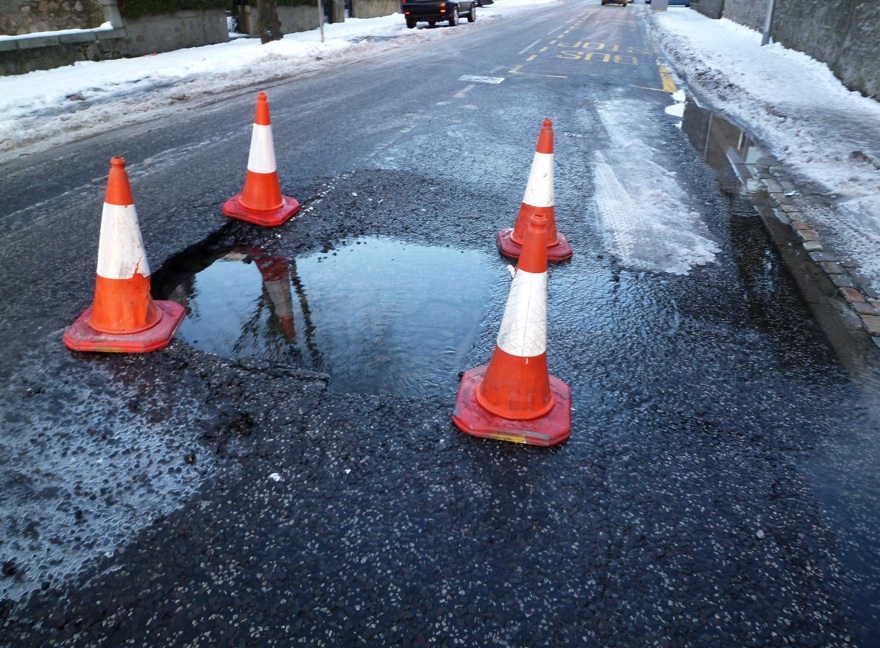
However, the psychogeographical gods were similing on us that day, and as we walked up the south-facing slope that is Pitmuxton, we noticed that Broomhill Road had been disrupted by something bad happening to the carriageway.

It's the Geldie! We did get to see it's water flowing after all!
Yay!
According to the Scottish Water engineers who showed up to try to fix it, the culvert which carries the Geldieburn underneath Broomhill Road close to Salisbury Terrace had collapsed.

By later in the day, the situation had worsened.


By monday, the culvert had been cleared and the Geldie was back in bondage, but the carriageway cannot be repaired until the temperature rises above freezing. A light control has been installed, much to the frustration of the tea-time commuters hurrying home in time for The Simpsons.


And we thought that only cyclists went through red lights!

Tuesday, 7 December 2010

Aberdeen Green Lanes

With the last fortnight's snow in Aberdeen still lying on pavements and roofs, the town -  while looking beautiful in this frosty cowl - isn't ideal for walking about much. Our lives are literally lacking color, and there's not many sunlight hours in the December day. We're feeling a bit stuck-in and pent-up, as it were.


As an antidote, I indulged in the following train of thought which was set in motion when writing the "Personalities" post, with the Aberdeen Adamant pavingstone. My wandering thoughts went here...

One place where the Aberdeen Adamant paving stones were notably used (pdf) is the borough of Haringey in London. A few years back, some friends of ours lived in Haringey and when we visited, we found that it's an exceedingly colourful place, a mix of diverse cultures, a place full of edges. We thought it fascinating.

The main drag through the borough is a street called "Green Lanes". We considered this name most evocative, bringing to mind as it does a time before the urban development of Greater London had subsumed the pre-existing villages which are now the hubs of its semi-suburban boroughs.

Today, there's a Green Lanes movement in England (eek! crappy code warning!) which lobbies to keep unsurfaced roads open for motor vehicles, while we in Scotland have a statutory right of responsible access which seems to work pretty well for all sensible users.

During our psychogeographical wanderings around Aberdeen, we've discovered that the town is full of our own surviving "Green Lanes" system, which extends from the suburbs to the very heart of the town centre, forming a network of urban refuges away from noise and pollution and everyday concern. These linear bucolic(ish) havens - penetrating the modern town like ancient unbypasses - form a web of wildlife corridors and allow a surprising level of relaxed access to many places in the town. These routes differ from the rest of the town, which they are at right angles to. Seek them out; let them take you over, under and through, Aberdeen.

Here are just a few:

Airyhall

Kingswells

Sunnybank 
Fernhill

Loanhead

Rosemount

Gilcomston

Hill of Rubislaw

Hill of Rubislaw (Denburn running to the right)

Westholm (Denburn to the left)

Pitfodels

Airyhall

Devanah Lane - Ferryhill

Devanah Lane

Dyers Hall Lane

Old Mill Road

Seafield Lane

Rubislaw Lane

Rubislaw Lane

Rubislaw Lane

Friday, 3 December 2010

Hyperreal Reality Distortion Field Generation

A weird new type of industry forms itself around the Oil and Gas sector in Aberdeen and finds cheap office accommodation in the glut of former retail premises located just outside Aberdeen town centre.

Compounding the increasing feeling of hyperreality we feel when walking around Aberdeen, we note that the companies who participate in this industry openly trumpet their expertise in generating reality distortion fields.


From Response Consultants website:
(Our emphasis)
Response Consultants ... provide the following resources, as required, to participate in emergency response exercises and training courses:
Organisation Role Players
Response Consultants has a pool of associate consultants who simulate the role of non-participating organisations in exercises. These professional consultants have a wealth of experience of working in the oil and gas industry but have different skills including coastguard, police, production, safety, personnel and logistics.
Casualties and Evacuees
Response Consultants have a pool of personnel who have experience in simulating casualties and personnel evacuated from offshore in major exercises and evacuation reception training courses.
Relative Role Players
Response Consultants has its own team of relatives role players to generate telephone enquiries from concerned next of kin during exercises and training courses. 
Media Role Players
Response Consultants utilise freelance journalists in training courses and exercises to simulate telephone enquiries from the media, conduct doorstep interviews and attend press conferences.

Fair enough. We're glad that organisations like Response Consultants are helping companies look after their preparedness for this difficult aspect of the intrinsically dangerous industry which to a large extent sustains our town.

However, that last paragraph relating to "Media Role Players" troubles us somewhat. We begin to fear that an expertise in news and agenda management might be on offer here. We've also noticed that an ecosystem of media companies is beginning to spring up with the express aim not of mitigating the effects of any disastrous event upon its victims, but rather of mitigating the unfavourable commercial effects of an adverse event upon the corporate entity responsible.

media response - crisis management - presentation skills


From Frasermedia website:
(Again, our emphasis)
emergency media response training
We can offer you the best and most up-to-date crisis media response training available using a team of industry trained professionals with a wealth of knowledge and many years of experience in television, print and radio news.
We are all journalists, we are still involved in the media and we have all the skills you need to deal with the media.
We will put your team through a ‘realistic’ company crisis and see how they cope with the pressures of the media from beginning to end, offering valuable guidance and advice throughout.
We use a number of media interview techniques throughout the training from telephone interviews through to mock ‘live’ TV interviews. Each interview is recorded and played back so delegates can improve on their performance throughout the day.
Preparation is the key - don’t be caught out – be prepared with Frasermedia Training.
Aberdeen Airport say:
Frasermedia provided media training for five senior managers from Aberdeen Airport, who had next to no media-related experience. By the end of the day, all five had experienced a wide range of simulated scenarios in which they had to think on their feet and deal with unexpected questions, while ensuring the integrity and reputation of the business was protected and maintained.

Yes, Frasermedia will train your bullshist army PR department in the generation of a reality distortion field. They will coach you repeatedly on your performance. Thus - in the regrettable event of something bad happening - your organisation's reputation will be protected and maintained.

So that's all right then.

Thursday, 2 December 2010

R. C. Matthews: Retail Development becomes Retail Wipeout.

For as long as we can remember, this corner-site on the border of Pitmuxton and Ferryhill had been occupied by an off-license. At the far horizon of our recollection it was an Agnews (at which there was always change), then a series of corporate takeovers and re-brandings: firstly Augustus Barnett, then Victoria Wine, then the shop was re-branded as Victoria Wine's downmarket sub-brand Haddows. Now, having succumbed to the loss-leading unfair competition and the monolithic procurement and promotional power of the large megamarkets, another local specialist outlet is lost. Pitmuxton is thus made that little bit poorer.

Click to see a bigger version.
The photos show that a much older signwriter-painted shop sign has been exposed during the shop refit work; "R. C. Matthews." It's fascinating that successive changes to the shop had simply crufted their new signs on top of that pre-existing sign, and it's satisfying (if saddening) to see these layers peeled back one by one in the final unravelling of retail history on this site. The "R. C. Matthews." sign is worthy of comment. It has substance. We can imagine the signwriter's care and art as he created it; his easy skill with brush and mahlstick, his efficiency of line and curve, his pride in a job well done and his worthy position as creator of townscape artifacts - see how the style of signwriting matches (but does not copy) the ceramic tile street-sign immediately above? There was no artifice in this coincidence, no branding strategy or focus-group feedback - it was just the way it was. Thus, the town created itself for the times during the retail period of R. C. Matthews.

Soon, though, the "R. C. Matthews" sign too will be gone, to be replaced by that of a hairdresser or tanning salon, these types of personal services being the predominant business model in this zone of replacement close to the town centre. Specialist retail at a community-based human scale with generations of continuity is replaced by transient services as monopoly power pulls consumer demand towards a handful of hangar-sized car-accessed retail parks only.

This story fits into an extraordinary continuity (or, rather, discontinuity) of retail development and competition. According to my old dad, R. C. Matthews was a licensed grocer which closed shortly after the Holburn Bar moved to it's (then new) purpose-built modernist block - where it remains to this day. Previously the Holburn Bar had occupied the ground floor of the neighbouring tenement block now occupied by a Co-op. Once the bar had moved out, it's former site was immediately occupied by one of the first self-service groceries in Aberdeen - a 1960's supermarket - the protozoic antecedent of today's megamarkets. Of course - with it's slick modernity and promise of convenience, speed, labour-saving efficiency and progress - this usurping business model from the United States soon condemed the old order of counter-service grocery to the past; it's days were numbered. So failed R. C. Matthews and countless other grocers around the country at that time. Now with this - the final end of it's rump; the off-license - having been at last wiped out by the descendants of the first supermarkets, the narrative arc of this story has reached its sad end.

Click for a bigger version
Thanks are due to local artist Mike Crawford for the splendid photos. We like Mike's photographic style; the grit and grime, the grain and gloom. Too often, we reckon, today's constant PR imperative is to always and firstmost indulge in a form of reality-distorting propaganda: to make bad things look good. In business and politics, entertainment and journalism we see this imperative deployed by reflex. That's why we like Mike's shots - they explicitly and expressly resist this temptation. What's wrong with a little gloom? What's wrong with a little woe? Down with Pangloss! Up with Buchstansangur! It's much more realistic.

In this case, we think that the downbeat atmosphere invoked by these photos helps to show us that, indeed, something is being lost here. Something which we may never see return...

Wednesday, 1 December 2010

T alisman H ouse

We like Talisman House on Holburn St. We don't love it, but we like it well enough. Standing proud just south-west of the city centre, it fastens Ferryhill to the town like an obsidian brooch and is visible from just about every point in the south of the city. It is a landmark, and has been ever since it replaced the vacant, derlict and structurally-unsound brutalist slab-and-plinth College of Commerce (now part of Aberdeen College).


We think that Talisman House's blue-grey smoked glass (which sometimes reflects dramatic skyscapes) is OK. We can appreciate the effect that they've tried to achieve with the exposed gubbins of the window-cleaner's cradle track. And we can't really complain about the serpentine roof-line which adds to the scenographic sense of iconic placemaking in an après-post-modern way. It even lights up green at night. Yay!


What we can complain about, though, is the abominably uncorrected kerning (spacing) of the type which has been monumentally engraved on the polished granite gate piers.


In situ

Typed uncorrected in a word processor.
Check out the spacing between the capitals and lowercase - ugh!


It would seem to us that, when spending a five-figure sum on monumental granite, penny-pinching a couple of hundred quid on the graphic design aspect is penny-wise, pound-foolish. The result is that it looks as if whoever was in charge of organising this most public-facing aspect of the building didn't bother with retaining a graphics professional to do the work; deciding instead that all you really need to achieve a professional look is to keep it in-house, do it yourself, use Microsoft Word, print it out on a laser printer and hand the result to the mason telling him to do it just like that.

In total, there are four of these engraved polished granite gatepost plaques, two at the front and two at the back.

T alisman H ouse
S ervice E ntry


We are reminded of this NSFW vid:


If only they'd asked...

There.

We'd have done it for £3.50 and thought of it "as a foot in the door".

Personalities.

Aberdeen Adamant 

Yes, we know, we've covered these before. This one's in Ferryhill
 Savage Nuneaton


Thus Brickhouse


Glynwed Vanguard