Wednesday, 26 October 2011

An Open Goal, An Uncontested Scrum

If you're familiar with local planning issues in Aberdeen, skim this first couple of paragraphs. If you're not, then you might be surprised to learn that in Aberdeen we have a sunken town-centre park called Union Terrace Gardens (very much like a pocket-sized version of Edinburgh's Princes Street Gardens) which is under threat of redevelopment for the sake of business profits. The vision of one man (oil tycoon Sir Ian Wood), this proposed redevelopment has been branded as the "City Gardens Project" and is being 'driven' forward by local business development quango ACSEF (Aberdeen City and Shire Economic Future) along with some other local tycoons. Visit the website if you want.

Other than a scrubby swatch in the centre of a large roundabout on the Inner City Ring-Road, Union Terrace Gardens is the only open green space in the centre of our town. We've covered some aspects of this proposed redevelopment before, and we've even proposed our alternative 'vision' for what could be done to improve and safeguard (rather than destroy or jeopardise) this open green space in the town centre. Against stiff opposition, the business-orientated boosters of this commercial annexation of public space have pushed forward, ever onward - and last week opened an exhibition of the competing submissions to the international design competition which they had taken it upon themselves to organise with public funds. Members of the public are invited to view the proposals for the destruction of the gardens and are asked to vote for which of the six on offer they prefer. No minimum intervention option to restore the park to its originally-intended amenity is offered. Radical change is presented as a fait accompli.

Concept #1.
For visual interest, we've sprinkled this post with images from the submissions to the design competition, which we got from STV local. You can download big PDFs of the full submissions and read all the usual starchitect boilerplate for yourself from design competition gatekeeper Malcolm Reading Consultants' website here.

Interviewed on local TV channel STV, ACSEF-styled "heritage expert" Malcolm Reading himself, interviewed at the VIP-only opening of the exhibition which showcases the six competing designs, said:
>>transcript
It's a testament to Aberdeen haha really, in a sense of er it is a world city and these are world class design teams who're interested in building in this city. I, eh I think its a - its a - really it is, it is, a testament to an interest in design quality about what cities are going to be like in the twenty-first century [sic]
Concept #2
OK. Notwithstanding what's written specifically below, we're not going to examine the various proposals. To do so would be redundant, for friend of OtherAberdeen Fraser Denholm has already examined the six proposals and has written a blistering critique in his trademark style, which we endorse. Go and read it here.

Right, did you read it? Good. So we continue...


1. STARCHITECTS & THE BILBAO EFFECT

http://en.wikipedia.org/wiki/Starchitect
With urban generation from the turn of the twentieth century picking up, economists forecast that globalization and the powers of multi-national corporations would shift the balance of power away from nation states towards individual cities, which would then compete with neighbouring cities and cities elsewhere for the most lucrative modern industries, and which increasingly in major Western Europe and US cities did not include manufacturing. Thus cities set about 'reinventing themselves', giving precedence to the value given by culture. Municipalities and non-profit organizations hope the use of a Starchitect will drive traffic and tourist income to their new facilities. With the popular and critical success of the Guggenheim Museum in Bilbao, Spain, by Frank Gehry, in which a rundown area of a city in economic decline brought in huge financial growth and prestige, the media started to talk about the so-called "Bilbao factor"; a star architect designing a blue-chip, prestige building was thought to make all the difference in producing a landmark for the city.
Concept #3

http://www.thedailybeast.com/newsweek/2010/06/11/starchitecture-a-modest-proposal.html
NEWSWEEK
The trend [named] “the Bilbao Effect” after the huge success of Frank Gehry’s 1997 Guggenheim Museum Bilbao in Spain—is just about over. 
The phenomenon of using iconic architecture to promote a city, an institution, or a real-estate development was a product of the economic boom that began in the late 1990s and ended with the recession in 2008. As Western economies begin to recover, extravagant, eye-popping architecture is giving way to a subtler new aesthetic. In the U.S. and Europe, architectural values are shifting from can-you-top-this designs toward more efficient, functional building. Innovation and experimentation are increasingly directed at sustainability and new technology. For a younger generation of architects in particular, “the spectacle building is kind of a dinosaur,” says Rosalie Genevro, director of the Architectural League in New York.

Two years ago, the Boston Globe article 'Marking the End of the Bilbao Decade' said: "…times dictate a shift away from vanity projects" and asked: "have we reached the climax and termination of a whole era in architecture?…" And now, Maria Misra writing in last month's Prospect magazine says: "We can expect the monstrous regiment of 'starchitects' who have strewn crass monuments to their [and their clients'] own narcissism across our cities to embrace a more sober, elegant and functional style…"

Concept #4
Alas, here in Aberdeen we must suffer the detritus left after the retreat of the waves at the high-water mark. In our tycoons we have a reservoir of not only the single minded monomania but also the narcissism necessary to power the last of the starchitects forward on one final vanity project, one last triumph of the will. And just as fast-fashion garments are remaindered unsold stepwise through the logistical chain all the way north through the towns and cities of the UK until at last they wash up last-gasp last-chance-to-sell in the shops of Aberdeen (next stop Africa!), so we see the last gasp of this will to "wow factor architecture" expire in our town centre.


2. THE OPEN GOAL

Whatever your feelings about the quality (or otherwise) of the conceptual proposals for the destruction of Union Terrace Gardens, it's important to realise that it's the choice of site that's the problem. We must be careful not to confuse context with content. Imagine, for instance, that these proposals instead were for a building/gardens project to be sited at:
  • Mounthooly Roundabout / West Nth st. (Brownfield/transport land-use at present) 
  • Timmer Market/Hannover St car park (Brownfield/transport)
  • Denburn Health Ctr (Brownfield)
  • Holburn Valley North Slope at Justice Mill Lane (Recently redeveloped brownfield - now commercial)
  • Site of Union Square (Recently redeveloped brownfield - now retail)
We imagine that, on any of these other sites, the starchitect proposals would have been "grasped with open arms" [sic, per ACSEF] by the people of Aberdeen.

Concept #5
But, of course, the great big open goal which the tycoons and their bagmen have missed is the site of the now empty and soon to be derelict St Nicholas House, former headquarters building of Aberdeen City Council. Leaving our own feelings aside, the building is (rightly or wrongly) generally regarded as a much-loathed buck-tooth turned rotten, an eyesore in the heart of our town. Were the tycoons to have proposed a city garden or civic square on that site, they would have been pushing at an open door and been assured of the wholehearted support of the vast majority of Aberdonians. They would have reaped the benefit of citizens' goodwill for years to come (along with all the consent thereby manufactured for their atmosphere-jeopardising hydrocarbon production activities - but that's another story). How could they miss so obvious a wide open goal? What's wrong with them? We thought they were supposed to be clever.


3. AN ILL-DEFINED CONTEXT LEADS TO A FALSE PREMISE

As mentioned, this project is being forced onward by local enterprise quango ACSEF (Aberdeen City and Shire Economic Future) on behalf of the oil-tycoons for who's interests they provide the necessary administrative fig leaves. But the name ACSEF itself points to the problem these people have in defining the necessary content for our local community and wider society as they and we collectively face an uncertain future, for they have a demonstrable problem in defining the context in which they work. The name ACSEF - Aberdeen City and Shire Economic Future - is a misnomer, for these people concentrate their efforts on maximising benefits for local business (which is the concern of discrete private individuals, and is limited in its time horizon by reporting seasons and tax-return basis periods) rather than the local economy. The local economy, which is by definition the entirety of the local area, its land, its people, its society, its natural and human resources, its knowledge, its potential and its limitations - in addition to its businesses - is not delimited by time horizons either in the past or the future, and is much larger in scope than can be encompassed by mere business concerns. Thus, by viewing everything through the myopic lens of business, ACSEF blithely have alienated significant sectors of local discourse, which they simply cannot see.

So, having established that, we examine sceptically ACSEF's assertions that this redevelopment project is a "fundamental plank" necessary for "businesses and investment to secure jobs for our children and grand-children" and is required to "transform the economy". All this, somehow, from a small city centre park. It's clear that the problems facing the economy are several orders of magnitude more grave than any which might be solved by a real estate deal involving a town centre park. Again, from Prospect Magazine, from back in 2008 - close to the start of the current economic difficulties:

Gelrald Holtham writes:
The freeing of capital movements in the 1980s combined with the collapse of communism, releasing billions of new workers into the world economy, has recreated a global reserve army of labour. That in turn has contributed to a rise in the share of world GDP accounted for by profits and an accompanying decline in the share accounted for by wages. Such a development easily leads either to over-investment by businesses or a shortfall of aggregate demand. When wages lag, spending can keep up with output only by an expansion of consumer debt.
[...]
Since Keynes was unfashionable and Marx unmentionable, no-one asked what this would mean for the level and pattern of demand.
[...]
Yet here was the central problem with the globalised system. If profits and output rise persistently faster than wages, who will buy the output? A lack of effective demand, in Keynesian terms is averted for a time [by the expansion credit], but ultimately shows up in a problem of "the realisation of capital". 
So we in the developed world find ourselves here: globally defective demand caused by an imbalance between wage and profit rates, made worse by a collapse in the availability of the very consumer credit which had masked the problem for a decade or more, and severely aggravated by the necessity to pay down that debt at both national and personal levels.

But here, in our small corner, those who have taken it upon themselves to secure an 'economic future' for Aberdeen believe (or, rather, would try to have us believe) that a real-estate deal involving a small public park and benefitting a handful of local construction companies and property developers will fix it. It will not, of course. The imbalance between wages and profit took decades to reach this crisis point and so it will take comprehensive attitudinal shifts in society; a change in the local, national and international conversation, and a widespread paradigm shift to remedy this imbalance. It's tasteless in the extreme that a local business development quango should use the global crisis as a smokescreen for what is, in fact, a project to privatise - for the benefit of a tiny handful of already-affluent local business-people - a relatively small (but high-value) patch of what has been community-owned land since the middle-ages.


Concept #6

4. THE STING, AN UNCONTESTED SCRUM. "CHOICE ARCHITECTURE"

Above, when we pointed out the 'open goal' we mocked the boosters of the City Gardens Project for their choice of site. But maybe, just maybe they are cleverer than we give them credit for. We are particularly worried about the Concept #6 proposal, with it's bizarre monolith. Go and look at it again (pdf). Maybe we're just paranoid, but we worry nonetheless. Throughout this entire controversial debacle, we've had the feeling that we're being scammed in some way - and not the obvious one - that this whole thing is some sort of shell game. Large real estate deals have always and everywhere been characterised by the now-you-see-it-now-you-don't misdirection of bad-things-made-to-look-good and good-things-made-to-look-bad conjuring. Our concern is that this Concept #6 has been chosen for us, pre-selected. On internet chat forums, blogs and social networking sites, we're all too busy having a damned good laugh at its egregious MONOLITH to notice that this is, indeed, the only proposal which 1. nearly fits the tycoon Sir Ian Woods' parameters and 2. is said to have a 'feasible payback strategy'. We're all too busy being misdirected by the big flashing red herring MONOLITH to notice the 13000 sq metre three-storey public car-park which sits beneath the MONOLITH, and the unspecified area of private car-park which occupies the airspace above the Denburn Road dual carriageway to service the parking needs of the workers in the the 7000 sq metre commercial offices which straddle the valley and 'add to the urban grain' along the eastern slope of the Denburn valley.


For this design, rather than take the approach of all the other designs which are, in fact singular, genuinely monolithic buildings filling the valley. Concept #6 is actually modular, consisting of several discrete buildings which can be pick-mixed to suit. And, indeed (MONOLITH aside) to the vast majority of the public, proposal #6 looks OK. The gardens -particularly the natural [sic] amphitheatre - are shown to be left more-or-less untouched. With a push and a rush, we might envisage this proposal being adopted as Aberdeen City Council favourite, with the proviso that the horrid monolith part is left out (thus making it 'even' cheaper). Of course, the ever-promised arts centre was intended for location in the monolith - but you can't make an omelette without breaking eggs! So, in the end what we get is Concept #6 sans monolith (sans arts centre) but including its large development of commercial offices straddling the Denburn at Union Bridge and several new blocks of offices along the eastern slope of the Denburn valley. These commercial developments along with the large new carparks occupying the current 'dark' area of the gardens and over the Denburn Road dual carriageway. These commercial enterprises, carparks and offices, forming the 'payback strategy'. Brilliant!

We have heard members of the public mentioning that the #6 concept has nice things included in it - for instance the extension of the gardens to encompass the William Wallace statue and the inclusion of a spur which appears to extend greenery a hundred metres north as far as Woolmanhill. It has also been pointed out that the Concept #6 plans include the re-greening of Golden Square. But the 'nice' things about this proposal are merely the (very cheap) quid pro quo for developing the currently green backlands of Belmont St for commercial offices and turning fully one third of Union Terrace Gardens into a multi-story carpark.

Surely we need hardly point out that the extension of the park to Woolmanhill and Wallace, and the greening of Golden Square do not require the polity of Aberdeen to give consent to a real estate deal which will see the rest of the Denburn Valley at Union Terrace and Belmont Street fall prey to overdevelopment. Yet, having been presented with a fait accompli, we fear that people will feel compelled to choose the 'least worst' option. The 'least worst' option - we have heard and read a number of our townsfolk opine - is option #6.

And so the moneyed interests which would benefit from this privatisation of common land are offered an uncontested scrum. Amazing. We have heard a great deal from the promoters of this project about "World Class Architects". We have no particular comment on their competence as architects in the usual sense of building design. But we must offer our complements on the developers' heresthetical skills in the design of the "Choice Architecture" which is being presented to the people of our town. World Class.


Submission #6 - Multi-storey carpark on common ground

Submission #6 - Overdevelopment of Belmont backlands

Submission #6 - Overdevelopment of Belmont backlands


Wednesday, 12 October 2011

High-Water Mark


>>>>

I.

Cast iron parapet riveted.
Rolled steel structural skeleton.
Baked clay ceramic blue-green brick.
Dressed stone rusticate masonry.
Damp lime mortar stalactites.

Lilac, turquoise, cobalt, umber,
Citrine, cadmium orange and slimy
Intersticial ion exchange,
Anodic and cathodic they drip.

The tangy products of corrosion
Slither smeary snot slick, thick,
Serous and silvery electric.
Slatherous and lathering - chemical biology
Minerally feeds bacterial bloom.
Over ferrous, igneous metamorphic
And ceramic substrate:
Fungus, lichen and blistering moss
And leaf litter
And litter
And guano
And frass.

Then just dust.

From pustulating mustard and viridian blisters
Mushroom dank dribbling papules
And the ocherous crevice; a dark citrine fracture
Is a disquietingly cold fissuring breach

crack
delaminating
disintegrating
aromatic wet-dry rupture

A fragrant technicolour symbiosis born of organic metallic bacillus mineral ejecta. Animal, vegetable, mineral -  it's a meaningless distinction.
For now, it is alive - that's all.
It's beautiful - that's enough.


II.

"It's beautiful"

Under my breath,
Just to myself.
But overheard by
The one passerby
Who replied:


III.


"Aye. I bet they couldn't make it like that these days".


I was standing still, and had been for a while. The passerby was walking smartly through, underneath the railway arch. So we lacked a common frame of reference - that's why it took a while to understand that the beauty he appreciated was in the structure of the arch, its construction and its span rather than the entropic interplay of the arch's intricately dynamic atrophy; that which so fascinated me. Instead, he thought I was lauding the beauty of this stone, brick, rubble, iron and steel arch of the mile's stretch gently-graded railway viaduct. It's a testament to single-minded capital. A river diverted, the estuary drained. Ecological devastation brought and so many lives and fortunes lost to bring it here, now so very very long ago.

Here where the natives once came to gawp and cheer maharajas and tsars changing trains - highland-bound they were to go and placate with fawning tribute the heavily-armed and continually victorious megalomaniac widow in her mountain-fastness purdah. Her, and her vast armies.

And here now the London-bound, soon to be superannuated, high-speed diesel loco coughs and farts its humming flywheels into whirring angular momentum. Blue-grey particulate smoke issues in fitting discharges from stubby rearward-raked exhaust pipes which penetrate the striated locomotive roof. Then, carriage linkages finally flexed, smooth acceleration. Deserted first class carriages, an oily yellow glow diffusing from their chi-chi little table lamps into the autumning gloom. As the driver throttles-up the 25-year old engines front and rear with their Record-Breaker's potential on the Flying Scotsman run, I think of how far we came. And why we stopped.

That same viaduct, travelling all the way down time from 1867. That same rail-line brought the commissar Tony Benn from Westminster to oil-boom Aberdeen in 1976. Gravid with rational civilisation's last message to the joint-stock seven sister daughters of Standard Oil;  he was to tell Mobil and Exxon and Chevron and Amoco and the others that no, they couldn't just take it all. Our British National Oil Corporation would have 51%, for all the people of the UK.

Those same locomotives and carriages, travelling all the way down time from 1976. That same late 20th century high-speed diesel train - as promoted, commissioned and inspired into existence by the insistence of that same rational socialist technocrat. High-tech high-speed rail for all! Now fading glory - yes. But because of that, all the more evocative and heart-wrenching a glimpse into the Concorde- (or TU144-?) era world-we-could-have-all-had.

And all the while, as free-market votaries kicked their heels in the shadows, (sharpening their stilettos and scissors and axes in Chile and elsewhere), our own stakhanovite visionary government technologists and bureaucrats were accidentally betrayed by unwittingly myopic oblimovist organised labour at the high-water mark of civilisation. Oops.

And that betrayal afforded the stilettoed ideologues of irrationality the trigger they were waiting for to make their putsch; to let the credulous market-religion adherents in. And taking the name of "capitalism" in vain - erroneously using it interchangeably with "free market" - they superstitiously worshipped the idol which they openly called "The Invisible Hand".

Mistaking affluence for wealth, the free-market fundamentalists first concentrated then dissipated our common capital and so grievously failed us all. But they also mistook price for value and so, in turn their beloved markets failed. And all that is solid melts into air.

"Aye. I bet they couldn't make it like that these days".


Tuesday, 11 October 2011

Invasion


>>>>>>>>>>>
These abhorrently visually-intrusive recent additions to our stock of spacially-intrusive street furniture in Aberdeen are supposed to improve the air quality in our town.


<<<<<<<<<<<<
http://www.aberdeencity.gov.uk/nmsruntime/saveasdialog.asp?lID=39452&sID=5034

Aberdeen City Council
Air Quality Action Plan 2011

VMS [variable messaging system] is currently used in Aberdeen to provide drivers with general car parking guidance, enabling them to avoid driving unnecessarily looking for car parking spaces. Further VMS signs have recently been implemented around the City on key corridor approaches advising of incidents/events that may affect their travel onwards. ACC [Aberdeen City Council] is also to use the VMS to post general air quality messages, particularly on peripheral City routes. These messages should raise awareness of air quality, especially during air pollution episodes [sic].
(our emphasis)


//////////////////_____________


But the system exists solely for the benefit and convenience of motorists. It marshals and directs them with the maximum possible state-of-the-art technological efficiency towards the surfeit of parking spaces available in the town centre. We cannot remember seeing this variable messaging system ever displaying a total number of fewer than two thousand vacant parking spaces available.

How can this be? This is a contradiction to the aim, we cannot reduce the harm cause by motoring by encouraging more motoring. For this system, which demonstrably has the increase of driver convenience as its entire reason for being, serves as an invitation for irresponsible motorists to bring cars into the very centre of the town. So the system acts as a disincentive to active travel or modal shift. This system normalises the bringing of noisy polluting vehicles into the town centre. It provides both permission and facility. The message sent by this Variable Message System is: "If you are a motorist, you are very welcome in the centre of this town - look; see how much space we have made available for you. Don't worry about climate change, don't worry about air quality. This town doesn't - it will pander to you, don't worry... don't worry..." We very much doubt that the promise to "post general air quality messages" to "raise awareness... during air pollution episodes" will ever suggest that the motorist reading the message is contributing to the problem and should leave the car at home. No - secure in their hot, locked, filth-belching, noisy metal boxes - motorists are comforted and enabled by this system.

This is wrong. Motorists must be made to worry, life must be made difficult for them in town centres. To offer motorists facility and sanction for their harmful and selfish activity is no way to reduce pollution, no way to cut down on dangerous carbon emissions. A better policy which would result in improved air quality in this town and a reduction in its carbon budget would be a policy which sees the removal of this car parking guidance system, accompanied by a complete ban on creating any more parking spaces and the phased closing down of existing parking facilities.

Friday, 7 October 2011

COLLAPSE

//////////////////////////////////////////////////
CARBON-CAPTURE-PROJECT-LONGANNET-COLLAPSE?NEWSFEED=TRUE
//////////////////////////////////////////////////


///////////http://www.guardian.co.uk/environment/2011/oct/06/carbon-capture-project-longannet-collapse?newsfeed=true...

<<<<<<<<
--------------------------------------------------- 
Flagship UK carbon capture project 'close to collapse'  
Scottish Power expected to pull out of government-promoted scheme to build a £1bn prototype CCS plant at Longannet
Terry Macalister and Damian Carrington
guardian.co.uk, Thursday 6 October 2011 15.32 BST

---------------------------------------------------
A £1bn flagship government project for fighting climate change – the construction of a prototype carbon capture and storage (CCS) project at Longannet in Scotland – is on the verge of collapse, it emerged on Thursday. Talks between the Department of Energy and Climate Change (Decc) and Scottish Power have run into deep trouble and the electricity supplier is expected to pull the plug on the government-promoted scheme, which hoped to bury carbon emissions from the coal power station in the North Sea. [...]


 Decc had promised £1bn of public money but the developers are understood to be arguing that they cannot proceed without more money to trial the scheme, close to the Firth of Forth. Both sides insist "talks are ongoing" but well-placed industry and political sources say the process is "pretty much over" and a statement to that effect could be expected shortly. Jeff Chapman, the chief executive of theCarbon Capture and Storage Association, said the collapse of the Longannet scheme would be a "severe disappointment" for the wider hopes of the sector. "Everybody knows the negotiations have been very difficult, so to that extent it's quite possible [the talks] don't come to a conclusion – although there are other projects coming through the system hopefully."  [...]


 The Fife scheme was by far the most advanced and spearheaded the drive to develop this new technology in Britain. Ministers have repeatedly stressed the importance of CCS as a way of keeping coal and potentially other fossil-fuel burning power stations in operation without undermining moves to cut CO2. Longannet is the third largest coal-fired power station in Europe at 2,400MW and was once highlighted as Scotland's biggest single polluter.

>>>>>>>>>>>


\\\\\\\\\\\\\\\\\\\\\\\\\\\\\\\\\\\\\\\\\\\\\\\\\\\\\\\\


-------§§§-------

Three mega-rich (at least one of them giga-rich) capitalists of Aberdeen. Standing at the head of their multiple boardroom tables in the town which styles itself the 'Energy Capital of Europe' they are watching as this scheme to neutralise the atmosphere-menacing emissions of Europe third's largest coal-burning power-station - Scotland's biggest polluter - collapses. This project to neuter its teratogenic discharges lies close to breakdown for want of an investment shortfall - the sum of which would be less than one tenth of this cadre's aggregate net worth. That is; this project does not want for material, or know-how, or industrial capacity: no, it fails for lack of the trivial fiction of cash-money.

For this novel technology (while scientifically simple) remains commercially unproven; it is a business risk; the financial returns are uncertain. For this pecuniary reason alone - despite its promise of continual gigawatts (but scrubbed, guilt-free, of harmful carbon) from the 50-year-yet certain supply of global coal - no power station anywhere in the world has a full-scale carbon capture and storage system running. No-one yet knows just how much it will cost to clean up electricity which is manufactured from coal. No-one yet knows how much (or how little) profit is to be made.

In this town, we have a large workforce of innovative technologists and engineers with the skills and experience necessary to design, manufacture and operate systems like these. The wrangling of high-pressure gas, fluid and plasma is very much our stock-in-trade. And in our oil tycoons, we have the capital which, if deployed into these low- and no- carbon electricity and motive power sources (of which CCS is just one) would truly, finally change this town's self-styled moniker from "Oil Capital" to "Energy Capital" and so at last give truth to the conceit. 

Now, today, we all stand at the crossroads. Will these men mobilise their capital - are they prepared to take the risk? Much is made by the PR agencies they retain of their philanthropic credentials. What could be more humanity-loving than risking a small part of their capital on a chance to safeguard the atmosphere? Or is the one-way-bet certainty afforded by an oil-price which, despite globally defective demand; despite recession or depression, remains proudly above the psychologically significant $100 per barrel mark distracting them?

Flashing in their minds like the urgent "HOLD NOW" buttons of a slot machine stuck on a jackpot payout, this ton-high oil price militates against any thought of reallocation of capital crossing the minds of the tycoons. The certain play of continued and renewed investment in the oil-bearing strata beneath the seas of the UK's continental shelf satisfies the needs of capital oh so much more than adequately. Why would capital (the need to increase itself being its primary reason for existing - integral to its true definition) redeploy away from so certain a one-way bet into something risky?

The tycoons stand at the heads of their boardroom tables, their hands on the levers of capital. The tickers tick up on global heat budget, CO2 concentration, social inequality, species extinction, deforestation, ocean acidification, resource depletion and political instability and conflict. But the ticker also ticks up - ever up - on the free-market price of a barrel of oil. The tycoons have their hands on the control levers of capital. But they have feet of clay.


-------oo0oo-------


  1.
/NATURAL RESERVE/


Profile: Ian Suttie, the tycoon with natural reserve

Published Date: 02 October 2011
HE IS the stealth bomber of Scottish business, appearing only rarely on to the radar screen of public consciousness before quickly disappearing. And that, by and large, is the way Ian Suttie likes it. But all that changed last week when a major oil find in the Kraken field, 88 miles off Shetland, by Aberdeen-based First Oil put Suttie at the top of Scotland's rich list. With one positive North Sea seismograph, he was catapulted out of the business sections of newspapers and on to the front pages. 

For an oil tycoon with 40 directorships whose company's 30 per cent stake in the Kraken field means he is now reputed to be worth more than a billion pounds, remarkably little is known about Suttie. Indeed, Suttie is said to regard the prospect of becoming public property with unalloyed horror. An oilman who worked with him said he's "not exactly reclusive, but he's not far off it - he's very private".


\\\\\\\\\\\\\\\\\\\\\\\\\\\\\\\\\\\\\\\\\\\\\\\\\\\\\\\\


2.
/ONE OF A KIND/


Jimmy Milne - A journey there and back again


“I was born on Boxing Day and have been fighting for existence ever since,” he says.
Milne [Balmoral Group chairman] celebrated his 70th birthday last year but to suggest that it might be time to ease up risks permanent impairment by the Samurai sword which sits beside his desk.
“I still feel like a 20-year-old most days and I still have a spring in my step and fire in my belly.
“I am driven by throwing back the frontiers of technology and always trying to beat the biggest and the best in the world. That’s what gets me out of bed in the morning.
“I can’t stand anyone saying ‘Jim I can’t do this.’ I say let’s just start again. Let’s get rid of the ‘t’ because there is always a way of doing it. I really believe in positive thinking and positive action and with that you can literally shift mountains. Another thing I can’t stand is people coming to me and saying ‘I tried the best I could.’
“Winston Churchill said that to try your best is not good enough - you have to go out and achieve what has to be achieved and there is a gulf of a difference between these mindsets.
“I don’t take no for an answer and I will never give up – but it is not just Jimmy Milne. I drive it but I have a terrific team of guys, very loyal and hard working who take pride in Balmoral and what we do but we never get complacent.
“My first employee is still with me and we have 54 long term members of staff and more than 1000 man-years of polymer experience - and that’s not just me!”
He has no doubt that the hard work ethic goes back to his childhood on the farm.


Demand for oil and gas pulls energy sector through recession
Although the oil and gas industry has been affected by the global economic slowdown the energy sector tends to work in longer-term cycles. This is particularly true of deepwater operations. The demand for hydrocarbon-based energy is continually increasing and this has pushed the industry into new territories and ever deeper waters. As a result of continuous exploration and production activity much of the offshore supply chain has remained relatively well protected from the worst ravages of recession. Despite the economic slowdown Balmoral Offshore Engineering’s international business has increased exponentially between 2007 and 2010 We are delighted that the industry is showing its faith in us as a premium provider of high quality, reliable products and have been successful in securing significant contracts for some of the industry’s most prestigious global deepwater provinces. To cope with the increasing demand we are investing heavily in a new manufacturing plant in Brazil 

Jim Milne CBE, Chairman and Managing Director, Balmoral Group 

\\\\\\\\\\\\\\\\\\\\\\\\\\\\\\\\\\\\\\\\\\\\\\\\\\\\\\\\


3.
/NORTHERNMOST TYCOON/
/LOOKS BEYOND OIL/


In the school of hard Knox: Sir Ian Wood: Britain's northernmost tycoon looks beyond oil. 
[...]
Sir Ian is proud of the Granite City. Once it had realised the opportunities of oil, he says, it did the right things. 'It would be wrong to say it would all have happened anyway. The business could have gone to Dundee or elsewhere. The harbour has been rebuilt, and the local civic leaders did what they could to encourage development. That is very much to their credit.'
Now he feels his job is to make sure Aberdeen does not drift back into economic obscurity. 'We're the lucky generation of north-east Scotland,' he says. 'I'd hate the next generation to look back and say,
 "Well, what did you leave us?" '

\\\\\\\\\\\\\\\\\\\\\\\\\\\\\\\\\\\\\\\\\\\\\\\\\\\\\\\\


Sunday, 2 October 2011

Culture of Victim Blaming and Pre-punishing

>>>>

The cyclist travels southbound on Aberdeen’s Ashley Road at a speed somewhere between 15 and 18 mph - a usual cruising speed for level-terrain cycling around town. Ashely Road is the type of inner-urban residential street typical in Scotland, characterised by terraced and semi-detached townhouses, small-trader shops and a large primary school. The speed limit on this road is 20 mph. But it is used as a rat-run.


Passing the school, the impatient roar of motor vehicles can be heard behind the cyclist - and then a taxi thunders past, overtaking at excessive speed. Emboldened by the taxi driver’s audacious manoeuvre, the driver of a flat-bed truck decides that he too should also be in front of the cyclist. So sure is he of his right to precede the cyclist that he takes no account of an oncoming vehicle - another cyclist - who is forced to slow down and pull over into the gutter to avoid a head-on collision with this truck travelling at speed on the wrong side of the road. Both motor-vehicles, in their drivers' arrogant haste to stamp their inconsiderate and dangerous precedence on the roadspace are then pictured waiting at a set of traffic lights as the cyclist immediately catches up with and passes them, seconds later.

A couple of years ago a young boy, a pupil at Ashley Road School, was injured quite badly by a similarly inconsiderate and reckless motorist at exactly this spot, travelling at excessive speed outside the school, rat-running between Pitmuxton and Rubislaw. And as the menacing crunch-time graphs ski-jump up, plotting the upward trajectories of oil price, human population, resource depletion, carbon emissions, deforestation, inequality, species extinctions and global heat budget - what is the proposed solution - here, in this town - to the harm caused by inappropriate motoring in inner-urban residential areas near schools? Unsurprisingly, the response which is regarded as “common sense” in this town is a proliferation of pedestian-restricting railings, behind which our children are taught that the outside world is a dangerous and frightening place. Everything is done to accommodate the convenience of motor-traffic, all the while impinging on the convenience of pedestrians, eroding the utility of other modes of transport and extinguishing the right of children to behave as children.

But worse even than all this, only in Aberdeen could a situation of psychogeographcal false consciousness exist to such a high state that it leads to the invention of the “Walkodile”. Check it out:


Walkodile: It's a kind of rigid tethering system for small children. A sort of sick plastic-spined victim-prepunishing chain gang. Just because motorists can't be trusted to behave themselves around schools.


Astonishing. So, rather than consider motor-traffic management policies along principles of shared space or filtered permeability - restricting the unhindered high-speed movement of motor traffic along residential roads where primary schools and community facilities are situated - we are presented instead with measures and systems which restrict the movement of children. Rather than address the issue of irresponsible and uncivilised motorist behaviour around schools, we have this alienating response based upon rules and restrictions which pre-punish potential victims. This locally invented “Walkodile” is particularly execrable, resembling - actually no: replicating - as it does a chain gang for pre-teens. Locking them together in shackles, wearing high-vis sashes, restricting free movement, reinforcing the message that going outside is a dangerous and special activity, something which requires special planning, special clothing, special equipment and special permission. This teaches children that being outside is not something you can do independently; you are required to be part of a team which is tethered in a rigid and arbitrary hierarchy. Moreover, it conditions these kids that they will, for the rest of their lives, be constrained and chained. Freedom but a dream, they will be forever forced into rigid and arbitrary hierarchies, ordered where to go and when to go there. And this lesson will be forced upon the coming generation of Aberdonians from their pre-school days - by the time they are ready to join the workforce they will be pre-conditioned for unquestioning obedience. Indeed, they will have become dependent upon the constraints and chains which were put upon them from their earliest memory. They will be unquestionably and unquestioningly ready to service capital in the pursuit of endless economic growth. And that's all that really matters in this town, isn't it?

We hope that the business behind the “Walkodile” fails, and we hope that anyone who has invested in it suffers the humiliating loss of their capital. Below is a video of the inventor demonstrating her "product" and attempting to explain herself. If it were up to us she would be prosecuted and jailed. But then, she's already a hopeless prisoner of her own world-view, isn't she?


?????


Edit - update.

Hoho, the inventors of the Walkodile are now promoting the "Walkodile Song" which bears an astonishing similarity to those songs sung in the 'call out and reply' style by chain gangs, cotton-picking slave teams and yolked together galley-slaves. Coincidence?

http://www.youtube.com/watch?v=Qjyuo_-BnEw


Saturday, 1 October 2011

Carshare? No, don't think so.

>>>>>>>>>>>>
We draw your attention to coverage of the risible failures of both "Car-Free Day" and "In Town Without My Car in Aberdeen", these active transport initiatives being handled in our town by the curious quango "GetAbout", which, according to their website is "a joint project featuring [sic] several organisations". Imagine our surprise when we noticed that they'd bought airtime on STV during Dickinson's Real Deal yesterday to screen an advert which promotes carsharing. In case you missed it:


In the video, you can follow the heartening tale of Cartoon Graeme and Cartoon Pete, both of whom commute from Westhill to Tullos every day. With the help of GetAbout's free service, they get hooked up to share cars and so save "about half" on their fuel costs. Right. So there are a few things wrong with that. Like the fact that just how, exactly, did they expect office workers on the 8.30 to 5.30 treadmill to see a TV ad-spot at quarter to three in the mid-afternoon? (We are happy to provide this "watch again catchup" service, free!)

But more fundamentally than that, the ad implies quite correctly that motoring is expensive (and, indeed, it is - costing about £550 per month for the average person running the average car, according to the RAC's 2010 figures). Counter-intuitively, this is why car-share promotion will fail in Aberdeen. It’s true that, whenever there’s a petrol-tax-hike or price increase because of record-high oil costs, we all see the STV cub reporter sent out to do his easy-peasy hack-work lazy boilerplate on “hard pressed” motorists who are “beleaguered” by record fuel prices. And there they are: motorists-in-solidarity-on-the-forecourt being interviewed; happy to be interviewed venting about paying “more than enough”. They roll their eyes and go through the motions of complaining bitterly, but if you look closely, if you examine the micro-gestures, you’ll see that their eyes are actually smiling – laughing even – with self-regarding relish. Oh yes, the motorists love to complain because in that complaining they get to boast about how much money they spend on running their cars, and how hard they work in extra overtime hours to keep the show on the road (how does car-sharing work when you're doing ad-hoc overtime, anyway?) This demonstrates that they are cash-rich and time-poor: the very badges of high status. Thus the ever-increasing cost of motoring affords the motorist a chance to perform Darwinian status-display dances. From the young contract engineer using his soft-top roadster as a fanny-magnet to the yummy-mummy piloting her oil-tanker-vast Range Rover around the centre of town on the yummy mummy money-go-round – higher motoring costs simply and conveniently serve to enhance status, for in Aberdeen motoring is now a Veblen Good; the more expensive it is, the greater its attraction. Indeed motoring today is the high status distilled essence of aspiration itself. This is why car-sharing in Aberdeen is doomed to fail. You wouldn’t want to look poor, now would you?

You see, car-sharing robs the motorist of his or her most potent status-symbol signpost. And, as our society is hierarchical, a lack of obvious signposts to status troubles the type of people (so common in this town) who have a pathological need to signal their place in the hierarchy to those around them. While the models and levels of spec of their vehicles are distinguished only artificially and superficially, it is enough - for the little cryptic collection of numbers and letters on the boot-lip is the urgent bip-bip-beep telegraph of their pay-grade, their rank, their position on the ladder; their level in the hierarchy. While of course all hierarchies are repulsive, arbitrary, artificial and absurd - they are the compelling organising principal of our society and are evident everywhere. The language of aspiration and the impulse to 'upgrade' is woven into the fabric of every aspect of late-stage consumer capitalism, and this is why the type of people so predominant in our town cling so tightly to their motorcars - for the alternative is a mode of transport which is less amenable to hierarchical status displays. Having spent a life on the upgrade cycle gathering those letters and numbers on the boot-lip of their car - those glyphs and cartouches which so shorthandedly signify their importance - to then tell them that it was all for nothing and that they must abandon these status-displays is to so undermine the foundations of their world-view that they cannot integrate it into reasonable discourse. You might as well tell them that everything they believe in and hold dear is demonstrably wrong, and that everything they think they have achieved and hope to go on to attain is just an illusion. It's like telling a toddler that Santa doesn't exist, and taking away their lollipop at the same time. The reaction you get is not good. For this reason, car-sharing will fail in this town.

But, more fundamentally even than that, we abhor the GetAbout carsharing campaign for it's wheedling compromise. We hate compromise. The premise (now uncontroversial) is that spending an hour a day, every working day, commuting by motorcar is harmful; economically and ecologically unsustainable; unbearably costly both to the individual and to larger society. It is now clear that so egregious are the harms caused by motor commuting and the normalisation of car-dependent motorcentric lifestyles, that the time has arrived for people of good conscience to demand an end to this bizarre fixation with personal motor transport. But, rather than do this, GetAbout prefer only to ask politely that those who perpetrate the harm do so just a little less, cut down a bit, please. Like nicely asking the house-breaker to burgle only houses with odd numbers, GetAbout have missed a chance to promote real beneficial change and instead choose the compromise of hand-wringing cringing negotiation with the wrong-doer. We hate compromise and we execrate negotiation. Both compromise and negotiation are signs of an initially dishonest lack of total commitment to the original premise. We must ask, what is it that GetAbout are afraid of? And why will they not commit fully to active and sustainable transport? Rather than this embarrassing and humiliating call for slightly less motoring, why cannot they just come out and deliver the message that the perceived necessity to build one's life around such an unsustainable commute to work is something which must now be rigorously questioned? GetAbout should be demanding that people make urgent efforts through their work/life choices to create a sustainable context in which to experience that life and work. This requires demanding denser mixed urban developments which allow living nearer to work or working nearer to home. It requires demanding that employers plan for, enable and compel workers to telecommute whenever possible. It requires demanding an immediate moratorium on expensive and unnecessary roadbuilding schemes (like the Aberdeen bypass motorway with its associated radial expressways) and the vast public subsidies consumed by these projects. It requires demanding continental-style commitment to diverse modes of public and active transport and a total ban on the provision of subsidised parking spaces for workers and residents.

What it does not require is the airing of a cheap silly little counterproductive cartoon on afternoon TV to needily beg ever so politely that the wrongdoers (who aren't watching anyway) do just a little bit less wrong all the while continuing to authorise and normalise their damaging levels of undesirable activity. The time for such cringing and cringeworthy compromise is over, because existential questions are now being asked of our civilisation as we enter this age of ecological crises and societal anomie. This long emergency, the slow motion crisis: Are we in it?  Has it started yet? How far in are we? Yes, we are in it. Yes, it has started. And how we behave today and tomorrow will determine how far in we go and whether it's possible to reverse the most grievous predictions outlined by the worst-case scenarios. How's your conscience?


---???---

Thursday, 29 September 2011

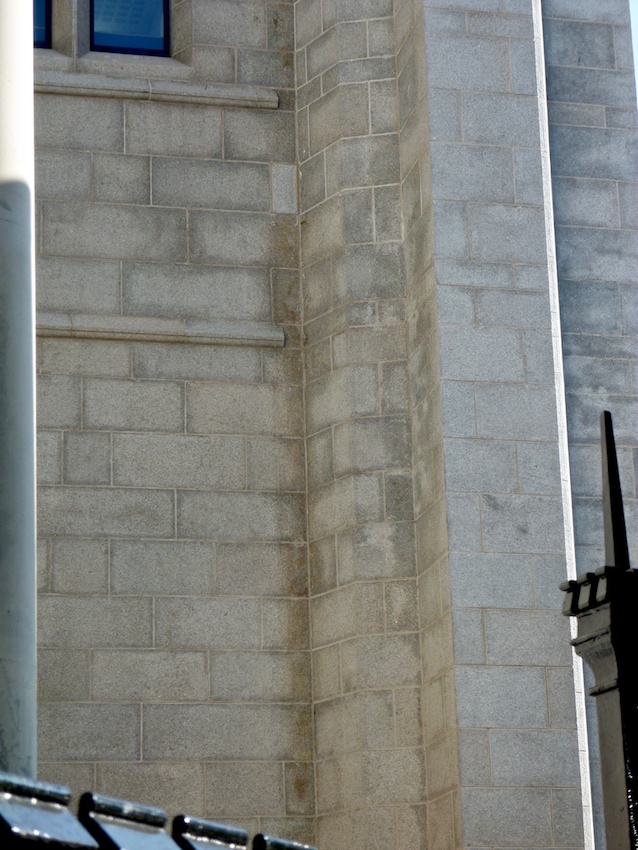
Marischal Frontage Affront Outrage. Reconditioning and Conditioning

-----§§§-----


http://otheraberdeen.blogspot.com/2011/01/first-look-marischal-college.html
<<<<<<<<<<<<<<<<


reader comments...

Johanna said...
Have you gone back now, that the building is totally finished and the brickwork is dry???

The reason it looks blotchy was when you took the photos,
it had not long finished raining and the facia [sic] was drying out, hence it being blotchy....

//////////----------
Firstly, Johanna thanks for your comment, but no; that's not right, it hadn't been raining. And yes; we have returned many times. Most recently on this beautiful dry hot bright Indian Summer afternoon today. Photos were taken - see below. The state of the facade has definitely not improved. If anything, the bright sunlight today threw the awful condition of the frontage into sharper relief than we'd seen before.

But that's old news now. What mostly surprises us about this matter is the denial which our fellow townspeople continue to exhibit when discussing the [botched] reconditioning of the Marischal College frontage and how [bad] it looks. As we said after our second visit:


http://otheraberdeen.blogspot.com/2011/04/marischal-college-second-look.html 
From a distance, or if you're passing through Broad Street in a vehicle, it looks OK-ish. Perhaps that's all that matters to whoever wrote the specification or managed the job on site. We prefer to take a slower, measured and more contemplative and up-close approach to our life within the urban realm, and it is this unhurried and ruminative attitude which has allowed us to notice problems at Marischal. We say that the standard of the work at Marischal is a scandal. We all should be outraged. But it seems we are at variance with the times, for when we try to discuss this issue with our fellow townsfolk, very few of them seem to have noticed. Or if they have, they deny that it's an issue.
----------//////////////


While we were there this afternoon, we sat on one of the benches beside the risibly literal new statue of Robert the Bruce, taking the time to look carefully and allow the atrocious state of the frontage to sink into our consciousness; taking the time to think about it and to think about and discuss between us what it means. During this rumination, we couldn't help but overhear some of the comments of the passers-by, comments which struck us with the cognitive dissonance of their stark contrast to what was actually being looked at. "Lovely," said the passers-by... "stunning"... "pristine"... "former glory"; it was as if a press release was being read out loud. We felt like strangers in a strange land where up is down and black is white. Joanna's comment above is not the first contact of its kind we've received on this matter, but it is one of the more polite. The fact that Aberdonians are willing, indeed keen, to disbelieve demonstrable facts and are happy, in the face of incontrovertible evidence, to openly contradict those facts or to make improbable excuses for them says much more about the situation of these Aberdonians than it does about the uncomfortable actualities themselves.

This is epiphenomenal. Which is to say that what we can learn about Aberdeen's people through their willing and wilful self-delusion on this matter tells us more about how Aberdonians fit themselves into the wider societal context than it does about their abilities as architecture critics. It tells us about the perceptual filters which these people are happy to don rather than confront a disappointing or difficult truth. It tells us of a false consciousness and an almost Pavlovian conditioning to which these people have, willingly or unconsciously, submitted or been subjected. This conditioning has rendered the populace compliant, unquestioning, malleable and directable. We can't help but wonder if there are other matters, matters more serious than the mere fucking up of a building reconditioning project, about which the Aberdonian public are willingly misled and are happy to wilfully misunderstand.
And we can't help wondering, thinking of the future, what other obfuscations of inconvenient truths will this emperor's-new-cloths-blind population be happy to swallow whole? And what beliefs, however egregious and incorrect, might be planted in the conditioned-compliant group-consciousness? And, in defence of these beliefs, what actions will those people be happy - eager, even- to take?

---ooo0ooo---